What We Talk about When We Talk about Reading

In my work as a public educator/scholar, I have had conversations with dozens of people seeking to understand education issues and topics because they are not themselves educators or are not literacy educators.

Yesterday, I had such a conversation for over an hour, discussing the issue of reading in my state in the context of the “science of reading” (SOR) movement.

During that discussion, a key point was made about how debates about reading proficiency of students and teaching reading are often absent nuance—and that the nuance itself is part of the problem with finding effective reform.

Like all states in the US (although at an extreme level), my home state of South Carolina has been an early and eager education reform state, including multiple iterations of reading legislation reform.

Also like most states, SC education and reading reform has been a constant cycle of crisis and new reform. We seem to refuse to acknowledge that reform itself is need of reform because so far the reform never works (or we wouldn’t need the next round of reform).

None the less, since we seem committed to shouting reading crisis every few years in order to justify yet more reading reform, this round of reading crisis serves as a powerful example of how the rhetoric around discussing reading proficiency and teaching reading is fraught with miscommunication and often unnecessary antagonism because of basic misunderstandings or problematic clarifications.

At the broadest level, what we mean by “reading” is an essential part of the conversation.

Particularly in the SOR era, there is a spectrum of what counts as “reading” for beginning readers that has on one extreme the ability to pronounce words absent meaning (such as nonsense words), and then on the other extreme, students being able to create meaning from a text without decoding (walking through a picture book and recreating the story either from memory or using the pictures).

Somewhere in the middle of that spectrum is, I think, what we should be talking about when we talk about reading—a student’s ability to eagerly and critically produce meaning from text grounded in automatic word recognition.

However, what greatly complicates how we talk about “reading” is that discussion often relies on (what should be) technical language.

Media, public, and political rhetoric around reading tends to use for “reading” both “reading proficiency” and “grade level reading.” Rarely, those two terms are used distinctly, but more often than not, they are tossed around as synonymns.

Here is a serious concern as I have noted often.

First, we have no standard metric of “proficient” or “grade level” at the federal or state level, and there is little understanding about how “proficient” is often an aspirational metric that is well above “grade level” (for example, NAEP achievement levels in which “basic” is approximately grade level).

Next, we have no clarification in the US about what percentage of students can or should be at whatever level we agree on and at what grade. [Note that I would add another issue is that we prefer “grade level” to “age level,” the latter being in my opinion a better metric.]

This, then, leads to another significant aspect of the current SOR movement; when we talk about reading, we often talk about what percentage of students are reading appropriately (?) at certain designated grades, often grade 3 or 4.

A claim made by SOR advocates helps show how this is a problem since many of them promise that 90-95% of students can be proficient readers.

Setting aside that this is a speculative claim and not a statistic supported by a valid body of science, the 90-95% argument often isn’t a clear one in terms of when.

Does that mean 90-95% of students can eventually become proficient readers or grade level readers, or that 90-95% of students can be proficient or at grade level in every single grade throughout schooling?

I think those questions are essential clarifications to address.

Among other elements of reading wars and education/reading reform, I think what we talk about when we talk about reading needs to be addressed in ways that clarify the elements noted above.

We need standard definitions for “reading,” “reading proficiency,” and “grade level reading”; we also should strongly consider replacing “grade level” with “age level” (to alleviate that distorting impact of policies such as grade retention on standardized measures of reading).

And we also need a national conversation about what are reasonable and aspirational goals for what percentage of students meet those metrics and when.

We seem to have ignored a key lesson and failure of NCLB—mandating 100% of students achieve proficiency by 2014. In other words, aspirational mandates doom reform to failure and erase any possibility that we do in fact reform reading policy in the best interests of students (and not the adults who profit in the debate and reform).

We all must do better to acknowledge what we talk about when we talk about reading—or we are destined to remain trapped in the crisis/reform cycle that hasn’t served anyone well (except for the profiteering) for over forty years.


Note

The title is a reference to a title that is a reference. Haruki Murakami’s What I Talk About When I Talk About Running, which is inspired by Raymond Carver’s What We Talk About When We Talk About Love.

“Science of Reading” Playing Numbers Games Not Supported by Science

Although my book publishing career includes a couple works from 2001, I consider my first “real” book a volume from 2004, Numbers Games: Measuring and Mandating American Education.

I wrote a brief piece for a colleague at the time that she included in a book she was working on for Peter Lang USA under the guidance of Joe Kincheloe. Joe asked her if I could write a book for Lang based on that passage.

Kincheloe was a kind and generous scholar who launched my official scholarly career, although I had been writing seriously for two decades before we met.

Five years later, 2009, I co-authored 21st Century Literacy: If We Are Scripted, Are We Literate?, another work supported by Kincheloe.

Here in 2024, I am somewhat discouraged that I find reason to mention those works since, it appears, the evidence and arguments included in both fell on deaf ears, specifically with the widespread adoption of “science of reading” (SOR) legislation blanketing the US.

Many advocates and legislators have completely caved on teacher autonomy as state after state is mandating scripted reading programs based on false stories in the media that misrepresent teacher expertise about reading and a reading crisis.

At the core of the SOR movement, then, is the pernicious use of numbers games.

A foundational example I have addressed often is the misrepresentation of NAEP reading scores to declare that 60% (the seminal claim of Emily Hanford) or 2/3 of students are not proficient readers and/or not reading at grade level (see dozens of media articles such as one by Nicholas Kristof).

This numbers shell game is based in the misleading use of “proficient” by NAEP as well as the combination of ignorance about those achievement levels and willful ignorance about those achievement levels (see I. here about the NAEP Big Lie).

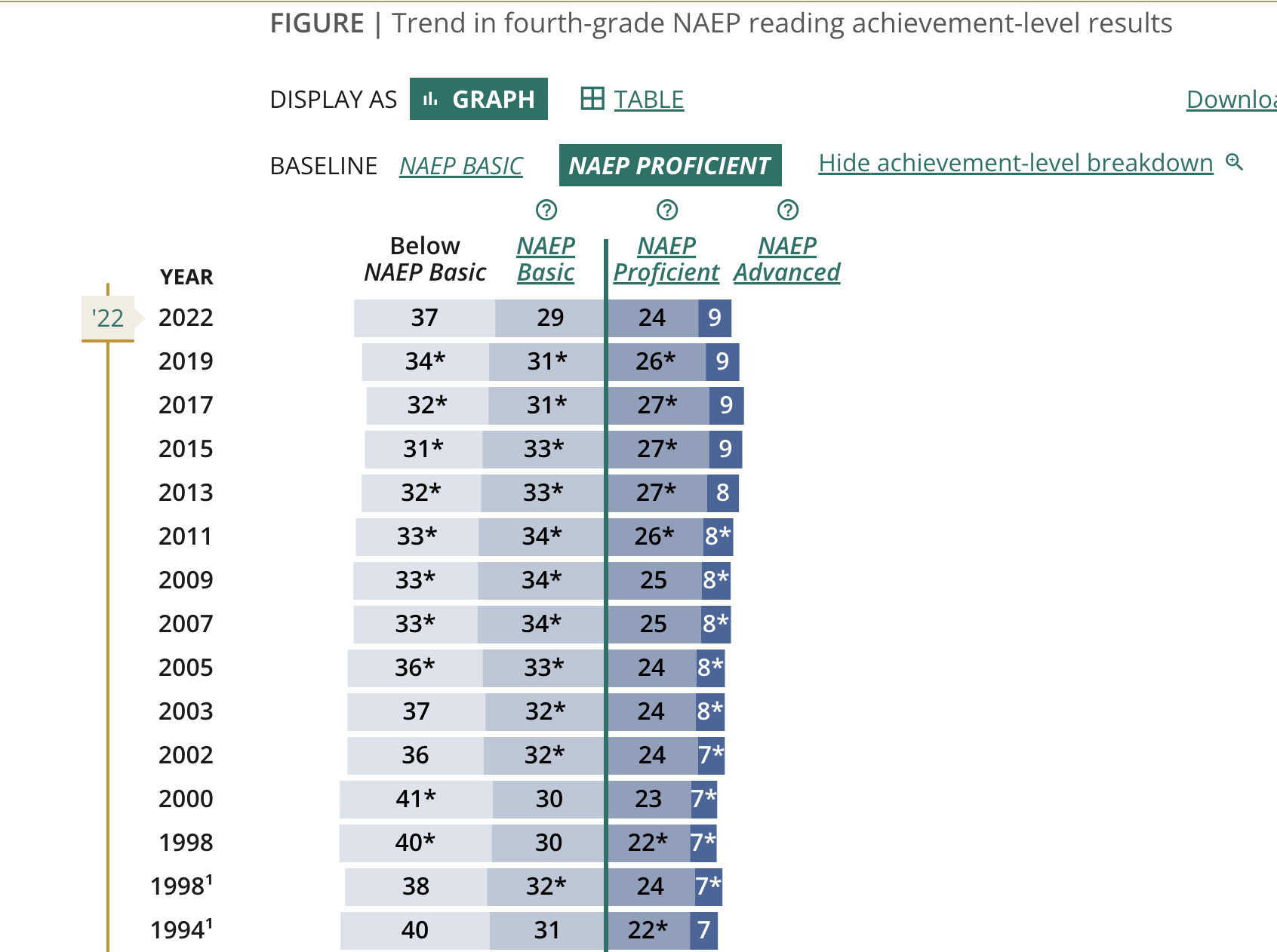
The NAEP numbers game is frustrating because the claim shuffles “not proficient” and “not on grade level” while literally inverting the valid claim based on NAEP. In fact, for 30 years, NAEP grade 4 reading data show that about 60%+ of students are reading at grade level and above since NAEP “basic” (not “proficient”) is equivalent to grade level reading:

NAEP Grade 4 Reading National Trends

Further, and even more frustrating, is that this numbers game distracts us from the real issues: (1) The US has no standard for “grade level” reading, (2) we have never fully interrogated the need for a standard “age level” instead of “grade level” metric, and most importantly, (3) the real issue is the disproportionate number of marginalized and minoritized students in the below grade level data pool.

Swirling around the NAEP Big Lie, as well, is a numbers game that hasn’t been fully unpacked—the claim that 90-95% students can be proficient if we simply implement SOR.

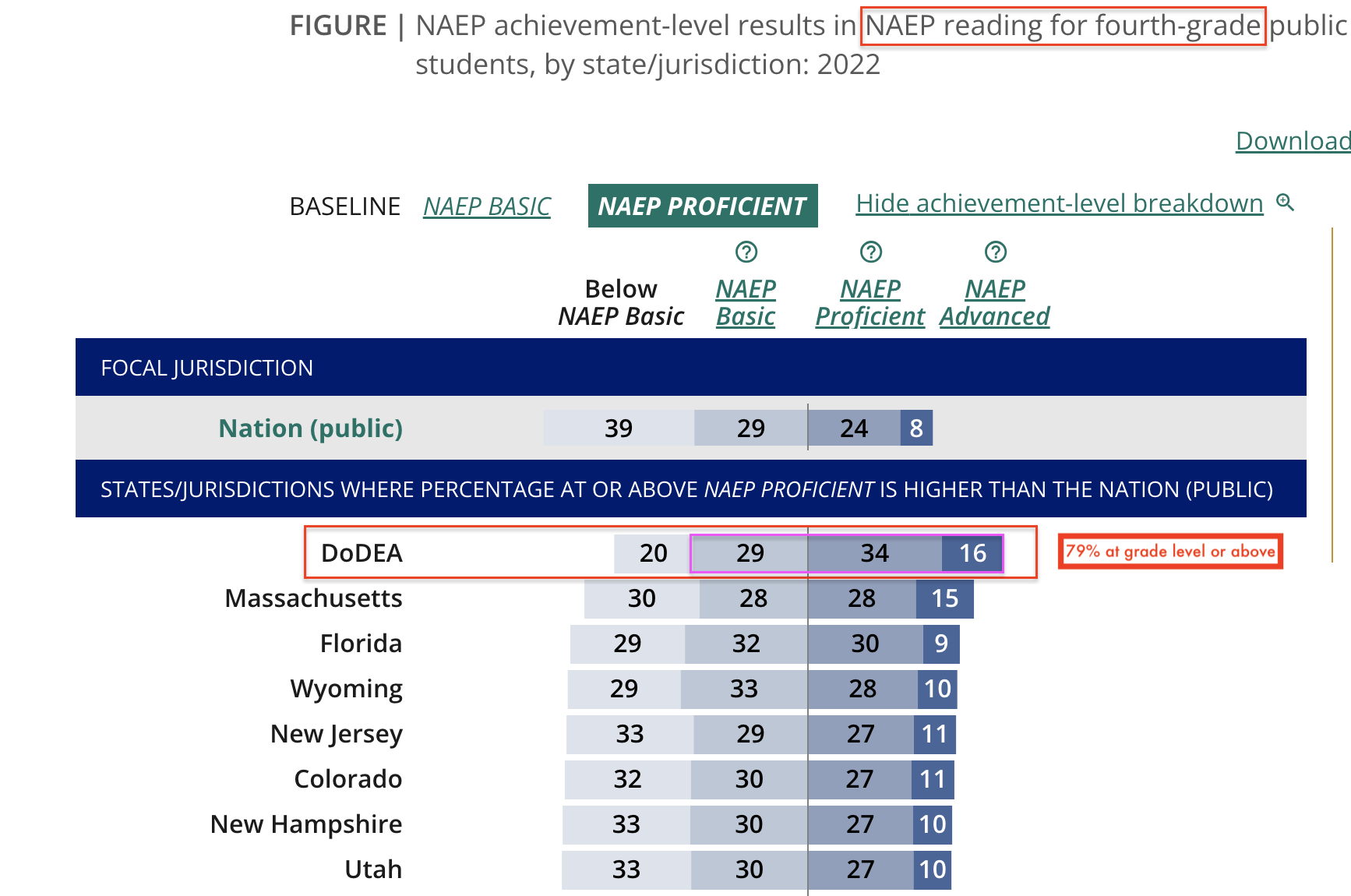
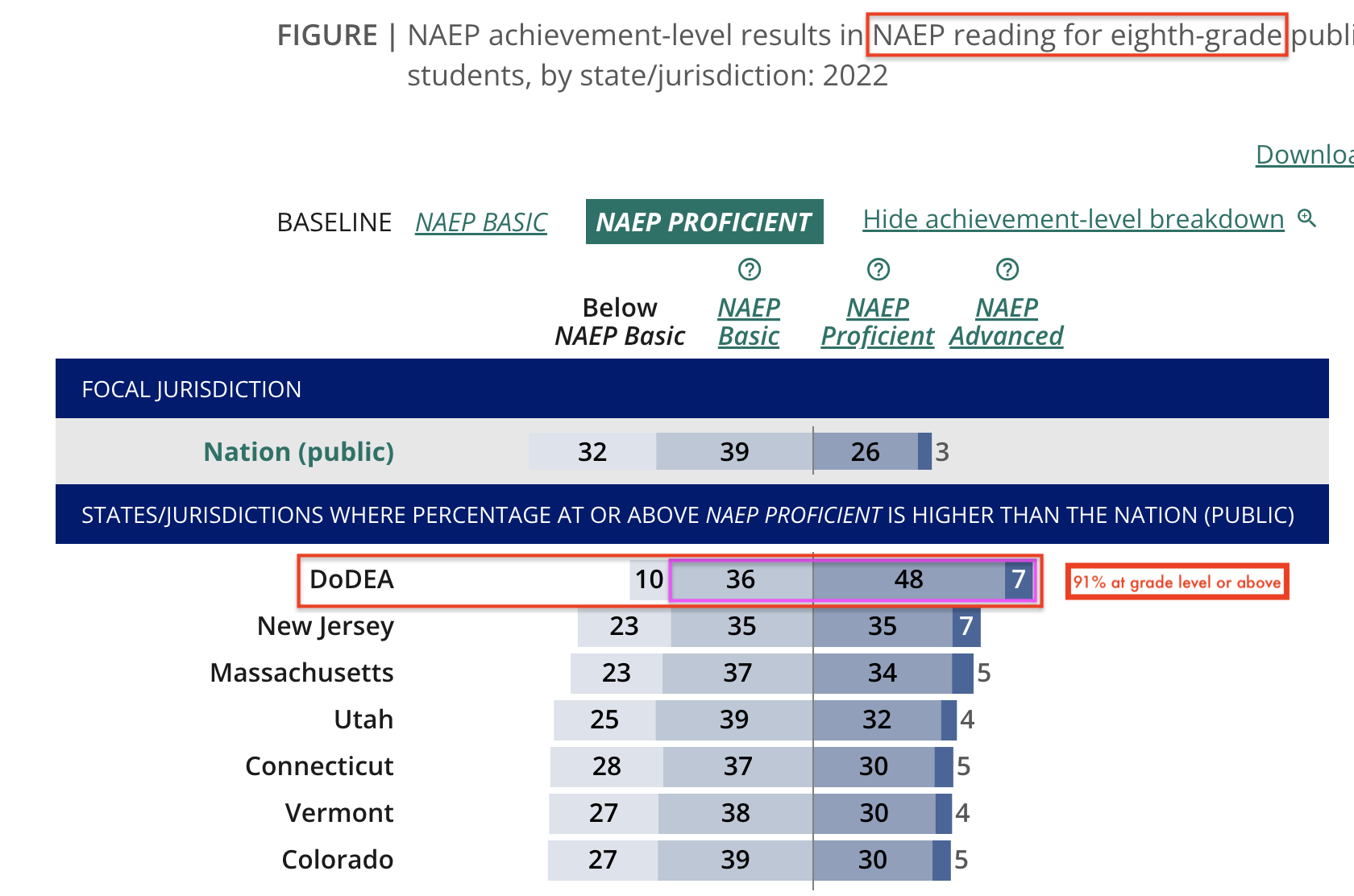
As a side note, those SOR advocates making this shifting claim (sometimes it is 90%, sometimes it is 95%) have not, along with most of mainstream media, noted a powerful example of the possibility that the 90-95% proficiency is achievable: DoDEA schools have close to that rate of achievement (see below).

Now as the SOR movement has grown over the past 6 years, I have seen the 90-95% claim more and more although that numbers game still has less traction than the 2/3 not proficient claim.

However, when I began my review of a recent NCTQ report, I took the time to interrogate the 90% claim by the anti-teacher education think tank: “With effective reading instruction, we could take that [student reading proficiency] to more than 90%” (p. 4)

That claim by NCTQ has a footnote to a few studies, but the most interesting evidence is the final citation to a blog post by Nathaniel Hansford who admits at the beginning, “it has always stuck out to me as a strange figure” because:

First, most academic research does not typically use percentages in this sort of manner. Second, I often see this figure unaccompanied by a citation. And third, it seems low; I find it hard to believe that 5% of students just cannot learn how to read.

Can 95% of Children Learn to Read?

When Hansford asked for scientific evidence for the claim, this is what he discovered:

Some of the citations I was sent were policy papers, by authors and institutions that used this claim. However, these papers were not experimental and usually cited popular Science of Reading books, not experimental research. There was also, interestingly, one research paper sent to me from the 1980s, that made the claim, but did not cite any evidence to support it. So it appears that this claim has been in circulation for a long time. The most common source listed for this claim seemed to be Louisa Moats, who has written about this rule on numerous occasions. However, she does not claim that 95% of students can reach grade level, based on just core instruction, but rather in totality. Louisa Moats cites 4 sources in support for this rule. In Kilpatrick’s book Essentials of Assessing, Preventing, and Overcoming Reading Difficulties;  a 2009  paper by Lim, et al. on students with Down Syndrome; a 2005 paper by Mathes, et al, examining the rate of risk reduction for struggling reading, with intensive intervention instruction, and a literature review of risk reduction, by Joseph Torgersen. In my opinion, the last two citations provide some experimental evidence to support this claim.

Can 95% of Children Learn to Read?

I have found no better conclusion about the 90-95% claim than the one offered by Hansford; there is scarce and dated scientific evidence to support, at best, that the 90-95% claim is a valid aspirational goal of reading proficiency: “This all said, it does seem there is some level of support for 96% being a benchmark goal [emphasis added], for reading proficiency rates.”

But key here is that like the NAEP Big Lie, the 90-95% claim is in no way a scientific claim being used by a movement that has used “scientific” as a rhetorical baseball bat to promote their ideological (not scientific) agenda.

The SOR numbers games are essentially lies and distractions. Regretfully, we certainly need to address reading proficiency in students, especially for marginalized and minoritized students.

But the real problems and achievable solutions are likely not to make the education marketers money but will require a different way to view education, one that acknowledges the key number that education reformers and SOR advocates ignore.

That number is 60+%.

A new study confirms a statistic that has been repeated by scientific research for decades—about 60+% of measurable student achievement is causally linked to out-of-school (OOS) factors (not reading programs, not instructional practices, not teacher quality): “Almost 63% of the variance in test performance was explained by social capital family income variables that influence the development of background knowledge.”

That fact of measurable student achievement discredits claims that reading proficiency, for example, is mostly a problem of reading programs and reading instructional practices. Reading reform for decades has simply shuffled programs and reading theory, which amounts to rearranging chairs on the deck of the Titanic.

Yet as I noted above, there is credible evidence that something approaching 90% reading proficiency is achievable if we address those OOS factors, the reading achievement of DoDEA students:

NAEP Reading Grade 4 2022
NAEP Reading Grade 8 2022

The DoDEA story isn’t one of reading programs, reading theory, or teacher bashing; in fact, there is a compelling story here:

How does the military do it? In large part by operating a school system that is insulated from many of the problems plaguing American education.

Defense Department schools are well-funded, socioeconomically and racially integrated, and have a centralized structure that is not subject to the whims of school boards or mayors….

But there are key differences.

For starters, families have access to housing and health care through the military, and at least one parent has a job.

“Having as many of those basic needs met does help set the scene for learning to occur ,” said Jessica Thorne, the principal at E.A. White Elementary, a school of about 350 students.

Her teachers are also well paid, supported by a Pentagon budget that allocates $3 billion to its schools each year, far more than comparably sized school districts. While much of the money goes toward the complicated logistics of operating schools internationally, the Defense Department estimates that it spends about $25,000 per student, on par with the highest-spending states like New York, and far more than states like Arizona, where spending per student is about $10,000 a year .

“I doubled my income,” said Heather Ryan, a White Elementary teacher . Starting her career in Florida, she said she made $31,900; after transferring to the military, she earned $65,000. With more years of experience, she now pulls in $88,000.

Competitive salaries — scaled to education and experience levels — help retain teachers at a time when many are leaving the profession. At White Elementary, teachers typically have 10 to 15 years of experience, Ms. Thorne said.

Who Runs the Best U.S. Schools? It May Be the Defense Department.

The SOR movement is playing a harmful and duplicitous numbers game that fits into decades of ineffective and harmful education reform. But the SOR movement is also following the corrosive playbook of using “science” as a rhetorical veneer for ideological agendas. Like scientific racism, the SOR movement is disturbingly absent science for many of their foundational claims.

Numbers games have consequences, and ironically, the research emerging from SOR policies is beginning to show that SOR legislation is whitewashing the curriculum and deprofessionalizing teachers.

While there are several shifting numbers in the SOR movement, there is in fact very little science to back them up. And the numbers that are being ignored are the huge taxpayers costs for shuffling reading programs to line the pockets of many of the people promoting those numbers games.

“Kids Today,” and Other Nonsense about Reading and Writing

[Header Photo by Josh Applegate on Unsplash]

Let’s start with a scavenger hunt.

Find a news article published since the 1940s that shows that students not only read proficiently but eagerly and a lot.

I’ll wait, and don’t worry, this blog will (likely) be here when you return.

Glad you’re back and I suspect you are (virtually) empty handed.

So that little adventure is about this latest nonsense: The Loss of Things I Took for Granted by Adam Kotsko.

I should clarify that I taught high school English throughout the 1980s and 1990s, and then, I have been a college professor (teaching mostly first-year students) since 2002.

I know a great deal about students as readers and writers.

In fact, when I was a student in the 1960s and 1970s, most students did not read assigned writing, and we were almost never asked to write anything of substance (I did lots of grammar book assignments and diagramed a metric-ton of sentences).

My students in the 1980s and 1990s (including my AP Lit students and advanced students) confessed to me that they often did not read assigned writing and my class was almost the only place they had to write (including other English classes).

Now, before I go further, I must note that Kotsko’s take is a tired and lazy one that also does identify a fact about students as readers—a lack of engagement with extended texts—that is in no way unique to the last decade, but a common reality for a century (or more) of formal schooling.

Except for a brief shining moment of possibility in the 1970s and into the 1980s when the National Writing Project promoted writing workshop and a few key literacy advocates introduced reading workshop (both of which offered structure for students choosing to read and writing in authentic and extended ways), traditional schooling and especially the accountability era of schooling since the 1980s have created students who are non-readers and non-writers.

Multiple times Applebee and Langer have shown that students are rarely asked to write in authentic and extended situations, and Gallagher’s Readcide directly confronts how schooling creates nonreaders.

We as a culture in the US have a very long history of handwringing about “kids today” while simultaneously working furiously to insure that those same kids are underperforming because our expectations are nonsense, our shouts of “Crisis!” are nonsense, and our education reform approaches are nonsense.

My own reading and writing lives were created outside of school—a love of science fiction and comic books laying the groundwork for me as a writer and academic.

I was an incredibly good student, reader, and writer in spite of school (although I was also lucky to have a few wonderful and encouraging teachers who worked outside the norms of schooling).

Since I have spent my entire career as a literacy educator and as a writer/scholar, I certainly deeply value reading and writing, but I also recognize that false rhetoric and narratives are equally common for a century and harmful in terms of actually achieving anything like most students being proficient and eager readers and writers.

The “kids today” approach combined with perpetual reading/writing crises is, again, tired and lazy while successfully keeping our blame-gaze on students and their teachers without rightfully pulling back and confronting the systemic forces at play.

The most profound barriers to reading and writing for students are social inequities; recent research once again confirms that a significant majority of measurable student learning is causally linked to out-of-school factors.

Yet, our obsession with reading/writing crises and “kids today” is typically paired with back-to-basics calls (More phonics! More grammar!) and in-school only reform (that looks exactly like the previous reform).

I recently sat in on a book club. Adults decided to have the book club, chose the book, and then sat around drinking wine and simply talking about the book.

And this past weekend, a friend excitedly told me they were posting an informal blog about rewatching a TV series.

People read and write.

By choice.

And it makes their lives richer.

Formal schooling has never looked like that for children as beginning readers and writers.

If we are not happy with “kids today,” we might be better off finding a mirror and taking a long look.


Update: Paired Texts from Slate

The Loss of Things I Took for Granted by Adam Kotsko (11 February 2024)

If and when that happens, however, we will not be able to declare victory quite yet. Defeating the open conspiracy to deprive students of physical access to books will do little to counteract the more diffuse confluence of forces that are depriving students of the skills needed to meaningfully engage with those books in the first place. As a college educator, I am confronted daily with the results of that conspiracy-without-conspirators. I have been teaching in small liberal arts colleges for over 15 years now, and in the past five years, it’s as though someone flipped a switch. For most of my career, I assigned around 30 pages of reading per class meeting as a baseline expectation—sometimes scaling up for purely expository readings or pulling back for more difficult texts. (No human being can read 30 pages of Hegel in one sitting, for example.) Now students are intimidated by anything over 10 pages and seem to walk away from readings of as little as 20 pages with no real understanding. Even smart and motivated students struggle to do more with written texts than extract decontextualized take-aways. Considerable class time is taken up simply establishing what happened in a story or the basic steps of an argument—skills I used to be able to take for granted.

Who Cares If Johnny Can’t Read? (17 April 1997)

Among the truisms that make up the eschatology of American cultural decline, one of the most banal is the assumption that Americans don’t read. Once, the story goes–in the 1950s, say–we read much more than we do now, and read the good stuff, the classics. Now, we don’t care about reading anymore, we’re barely literate, and television and computers are rendering books obsolete.

None of this is true. We read much more now than we did in the ‘50s. In 1957, 17 percent of people surveyed in a Gallup poll said they were currently reading a book; in 1990, over twice as many did. In 1953, 40 percent of people polled by Gallup could name the author of Huckleberry Finn; in 1990, 51 percent could. In 1950, 8,600 new titles were published; in 1981, almost five times as many.

Yellowface: Adventures in Storytelling

It is hard for me to overemphasize the profound impact discovering irreverent humor had on me as a young human in the 1970s.

The list is long—George Carlin, Richard Pryor, The Firesign Theater, National Lampoon, Monty Python, Saturday Night Live, and so many films.

I was 13 when Blazing Saddles (1974) was released, now celebrating its 50th year anniversary. I came to love all of Mel Brooks’s films, but Blazing Saddles found a spot not only in my consciousness but also among my mother’s side of the family.

For many years our gatherings were punctuated with quotes from the movie followed by outbursts of laughter.

But witnessing how people have responded to the film over the years raises an important question: How can anything so misunderstood also be so beloved and enduring?

You see, the anniversary of Blazing Saddles has resurrected an utterly nonsensical response: Blazing Saddles at 50: the button-pushing spoof that could never get made today.

Just as conservatives and anti-woke warriors have misrepresented and dishonored George Carlin, claiming that the film could not be made today because of the woke mob completely misses that Blazing Saddles is a woke film (ironically, suggesting otherwise erases the brilliance of Black contributions to the film by Cleavon Little and Ricard Pryor).

And this leads to another question: When are misrepresentations of racism racism and when are they anti-racism?

We have ample literary evidence of this problem, also recently center stage in the rise of rightwing censorship: Adventures of Huckleberry Finn and To Kill a Mockingbird are excellent examples of representations of racism that offer extremely complicated ways to understand the texts and their appropriateness for exploring racism.

Both novels suffer from centering white characters, and TKAM is likely a poor text for examining racism since it perpetuates the white savior myth.

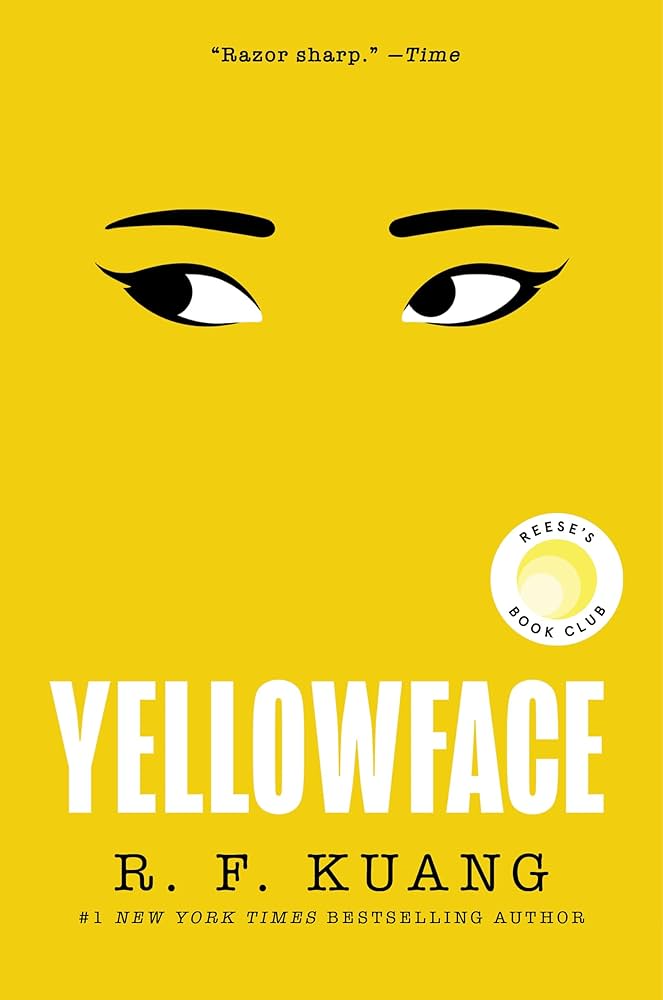
The reignited but jumbled public debate about Blazing Saddles comes in the wake of my first audiobook experience, Yellowface by R.F. Kuang.

Soon after that listening, I also sat mostly listening to a book club discussion among almost exclusively women.

One of the points brought up, and one of my central reactions, overlaps strongly with the Blazing Saddles/ Huck Finn/ TKAM issues noted above: How does a work become popular while being either misunderstood or not fully understood?

Broadly, I read Yellowface as a scathing satire of the publishing industry (and the insider’s view of MFA and creative writing programs) and a cautionary tale about the corrosive influence of capitalism/The Market on literary quality (sort of the myth that publishing is a meritocracy) as well as DEI commitments among publishers (the novel unmasks DEI as mostly marketing and tokenism).

I mentioned to my partner that I think much of that insider satire has to be lost on many readers in the same way I think Jeffrey Eugenides’s sort of English major perspective is missed by the average reader.

Regardless, Yellowface is incredibly rich and complex in terms of what we are experiencing and how readers might best navigate the storytelling.

First, I think storytelling is central to this work about writers, of course, but Kuang—like Twain and Lee—chooses to center a white character and her white voice (often one we find hard to feel any sympathy for) in order to interrogate storytelling and even story ownership in the context of race and racism.

Here, two important elements come to mind—the use of the unreliable narrator and the overlap between Yellowface and The Handmaid’s Tale by Margaret Atwood.

“Many of Edgar Allan Poe’s works include obsessed narrators who are plagued by their unconscious in order to discover their true selves,” Rachel McCoppin writes. And this description in many ways perfectly describes June Hayward, narrator of Yellowface.

June is relentlessly plagued by her Self to the exclusion of others and ultimately, it seems, to the exclusion of the Self she seems to be seeking.

Here, I must highlight Atwood’s The Handmaid’s Tale since, similar to Yellowface, the novel centers a white woman and her voice while also repeatedly disorienting the reader’s perception of that storytelling.

The narrator in HMT often tells an event and then confesses that version is wrong, only to tell it differently. Then, in the Historical Notes, we discover this story is a transcript recreated by a scholar from audio recordings.

Yellowface also significantly challenges the storytelling while also directly raising questions about who tells the stories as well as who should.

Does the scholar in HMT own the story simply by discovering the tapes? Does June have a right to Athena Liu’s manuscript that is also Liu’s retelling (claiming?) of the stories of Chinese laborers in WWI?

Whether intentional or not, I am also struck not only by the many names by which June Heyward goes (June Hayward, Juniper Song, Junie) but also how that mirrors the imposed name of June on the narrator of HMT:

When I first began “The Handmaid’s Tale” it was called “Offred,” the name of its central character. This name is composed of a man’s first name, “Fred,” and a prefix denoting “belonging to,” so it is like “de” in French or “von” in German, or like the suffix “son” in English last names like Williamson. Within this name is concealed another possibility: “offered,” denoting a religious offering or a victim offered for sacrifice.

Why do we never learn the real name of the central character, I have often been asked. Because, I reply, so many people throughout history have had their names changed, or have simply disappeared from view. Some have deduced that Offred’s real name is June, since, of all the names whispered among the Handmaids in the gymnasium/dormitory, “June” is the only one that never appears again. That was not my original thought but it fits, so readers are welcome to it if they wish.

Margaret Atwood on What ‘The Handmaid’s Tale’ Means in the Age of Trump

Atwood and Kuang invite readers to consider the importances of names, and these works are complex dramatizations of the complexity of not only storytelling but also the storyteller.

I have been a teacher and a literary critic for many decades so after my initial urge to connect Kuang’s novel to Poe’s unreliable narrator (and his foundational role in genre fiction such as horror), I was drawn to the many wonderful referential aspects of Yellowface.

Kuang masterfully blends and fictionalizes high-profile controversies in literature and publishing. [1]

Two are linked to Oprah Winfrey’s book club: A Million Little Pieces and American Dirt.

A Million Little Pieces sparked a public debate about the nature of genre since James Frey was accused of bogus claims in his published memoir (which began as a novel).

I use this debate often with students as a way to interrogate what we mean by genre, by fiction versus nonfiction, and by modes of expression. Among writers, teachers, and literary scholars, these lines are blurred, not distinct. But in the general public, there is little patience for anything other than black and white.

American Dirt, mentioned in the novel, is a recent and key publication that raised the questions many are exploring because of reading Yellowface—who has the right to a story and what constitutes appropriation (Jeanine Cummins’s novel was criticized as “brownface”).

The third reference is one of the most effective turns of Yellowface, when June discloses that Athena had co-opted a sexual assault situation experienced by June. This parallels the short story controversy around “Cat Person.”

While I struggle to feel compassion for June (or frankly any characters in the novel), the storytelling gradually reveals that Athena (and maybe all writers?) traffic in claiming other people’s stories as her own. One later scene involves June talking with Athena’s ex-boyfriend who directly confronts Athena’s willingness to use other people for her literary gain.

As I have continued to think and talk about Yellowface, I am more and more certain about what I don’t know for sure.

The end of the novel includes a revengeful character eventually (maybe?) bringing June’s charade to light, only to parlay that into her own book, Yelllowface.

Kuang has directly noted: “Who has the right to tell a story? It’s the wrong question to ask.”

For me, I am more fascinated by the storytelling than the storyteller. And Yellowface—again, like HMT—forces us through so many twist and turns that we are left unsure what story is true, or even if anything like the truth can exist.


[1] See:

“Science” as a Veneer for Misinformation: Media Continues to Misread Reading in Missouri

Entering the sixth year of detailing how the “science of reading” (SOR) movement uses “science” as a cover for claims that are primarily rhetorical and ideological, I once again must highlight that this misinformation campaign continues to be “holy text” in mainstream media.

Missouri kids are way behind. Making them guess at words doesn’t teach them to read, writes Emily Durig, National Director of Elementary Coaching for The Literacy Lab.

What remains stunning about the relentless misleading and factually wrong series of articles in mainstream media is the sheer absence of understanding about the topic of reading by those promoting SOR with missionary zeal.

SOR advocates lack scientific evidence for their claims and seem mostly driven by market/commercial or political/ideological agendas.

Durig’s misinformation is not only the exact same series of false claims you can find weekly since about 2018, but also a disturbingly careless recycling of Emily Hanford’s copycat misinformation articles initiated by “Hard Words” and then recycled into the melodramatic and misleading Sold a Story podcast.

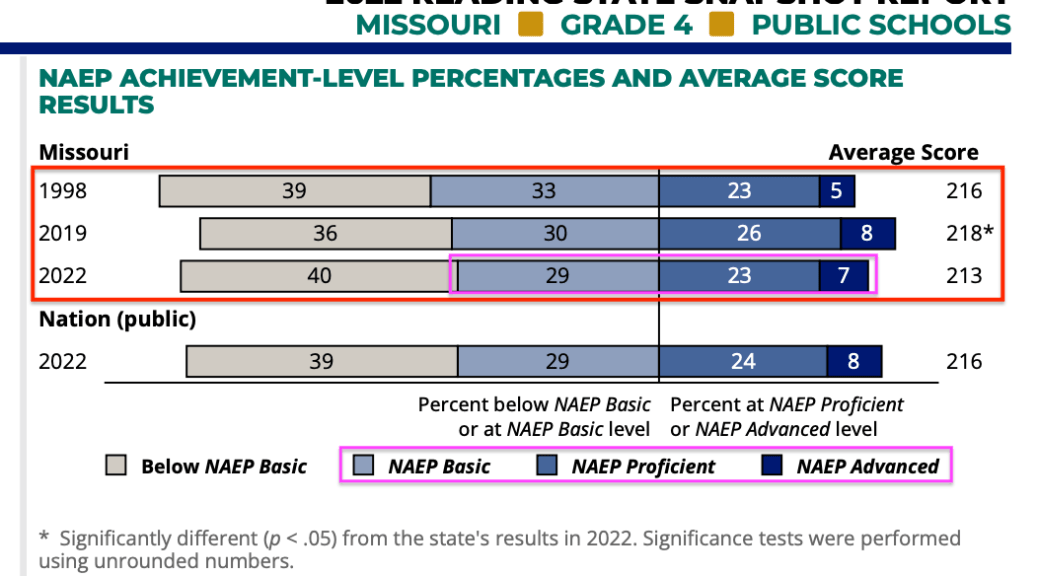
Durig begins with the NAEP Big Lie: “Missouri students are headed down a dangerous road. Only 30% of the state’s fourth-graders are reading at grade level.”

If you follow that link, you find a reference to MO’s NAEP grade 4 reading scores:

Using the exact same misinformation tactic as Hanford in 2018 and Nicholas Kristof in the NYT, Durig either doesn’t understand NAEP achievement levels or is being purposefully misleading; in either case, readers would be better served by not reading further since her argument is built on a lie.

NAEP “basic” is approximately grade level reading, and thus, 60% of MO students are reading at grade level or above, not 30%. [1]

One must ask, if you have to lie to make your case, do you have a case?

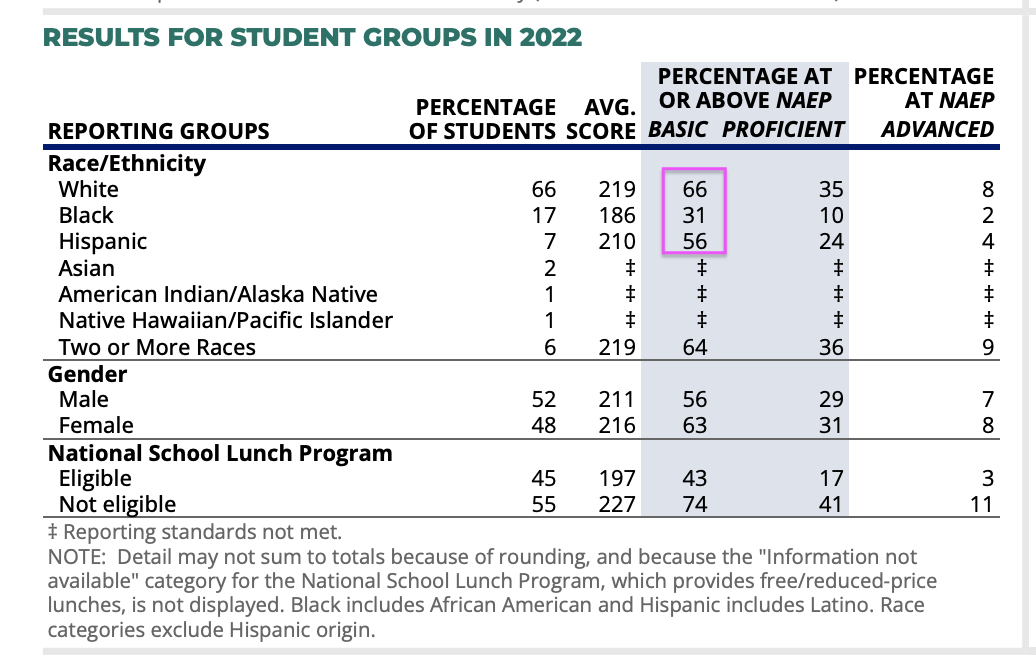
The follow-up claims—”The numbers are even more alarming for Black and Hispanic students in the state. They drop to 17% and 7%, respectively”—do not seem corroborated by the NAEP link, showing 31% of Black students at grade level or above and 56% of Hispanic students at grade level or above:

In the US, achievement inequity along racial lines is a historical failure of all achievement, not just reading. But again, if this is a serious issue, misinformation isn’t needed.

But it gets worse, if that is possible, because, Durig claims, “We are in the midst of a reading revolution. The way kids are taught to read in Missouri — and across the country — needs to be overhauled. And any rebuild should be based on the science of reading, including phonics.”

What is most disturbing is the lack of “science” in what follows, notably these well-worn but false series of claims and the links to anything except “science”:

More than 90% of children could learn to read if their teachers used instructional methods grounded in the science of reading.

Unfortunately, a lot of early reading teachers in the United States still practice what’s known as balanced literacy. That approach relies heavily on teacher choice and professional judgment. Teachers are taught to have many tools in their toolbox, and to use the methods that they think are most appropriate for their students.

One common practice in balanced literacy is guided reading, in which teachers coach students in a variety of comprehension strategies as they read a book matched to their level. Teachers encourage students who struggle over individual words to use pictures and context, in addition to looking at the letters, to guess at what the word could be.

But should kids be guessing at words when learning to read? There’s a ton of research that says no.

Missouri kids are way behind. Making them guess at words doesn’t teach them to read

Note that these claims include two hyperlinks—the first to NCTQ (which links to a blog post to prove the 90% claim), and the second to Education Week, more misinformation journalism, not science.

As many have demonstrated by conducting external peer-review, NCTQ is an ideologically conservative think tank founded by The Thomas B. Fordham Institute. NCTQ releases non-scientific reports that are not peer-reviewed. In other words, no NCTQ report meets even the minimum standards of “science,” and in fact, the reports have been shown to use shoddy methods to draw predetermined conclusions about teacher education. [2]

Durig also depends on the Balanced Literacy Big Lie, reducing BL to a caricature of guessing using pictures instead of decoding. Notably as well, Durig offers no links for the “ton of research” claim (because there is none).

The accurate claim about BL is that we have no scientific research to support claims of a reading crisis, no scientific research proving BL has failed, and no data proving any universal application of BL or reading programs. The media and political attacks on BL and reading programs are entirely rhetorical and ideological.

With this careless and misleading article, we find ourselves trapped in the sixth year of the Hanford SOR lie, and it seems too few people are willing to tell the real story of reading, the one that students deserve instead of using “science” to promote the same baseless reading war we have been waging since at least the 1940s.


[1] See:

[2] Reviews of NCTQ reports:

Dudley-Marling, C., Stevens, L. P., & Gurn, A. (2007, April). A critical policy analysis and response to the report of the National Council on Teacher Quality (NCTQ). NCTE. https://ncte.org/resources/reports/critical-policy-analysis-response-nctq-report/

Benner, S. M. (2012). Quality in student teaching: Flawed research leads to unsound recommendations. Boulder, CO: National Education Policy Center. https://nepc.colorado.edu/thinktank/review-student-teaching

Fuller, E. J. (2014). Shaky methods, shaky motives: A critique of the National Council of Teacher Quality’s review of teacher preparation programs. Journal of Teacher Education, 65(1), 63-77. https://journals.sagepub.com/doi/10.1177/0022487113503872

Cochran-Smith, M., Stern, R., Sánchez, J.G., Miller, A., Keefe, E.S., Fernández, M.B., Chang, W., Carney, M.C., Burton, S., & Baker, M. (2016). Holding teacher preparation accountable: A review of claims and evidence. Boulder, CO: National Education Policy Center. http://nepc.colorado.edu/publication/teacher-prep

Thomas, P.L., & Goering, C.Z. (2016). Review of “Learning about Learning: What Every New Teacher Needs to Know.” Boulder, CO: National Education Policy Center. http://nepc.colorado.edu/thinktank/review-teacher-education

Cochran-Smith, M., Keefe, E.S., Chang, W.C., & Carney, M.C. (2018). NEPC Review: “2018 Teacher Prep Review.” Boulder, CO: National Education Policy Center. http://nepc.colorado.edu/thinktank/review-teacher-prep-2018

Burke, K. J., & DeLeon, A. (2020). Wooden dolls and disarray: Rethinking United States’ teacher education to the side of quantification. Critical Studies in Education, 61(4), 480-495. https://www.tandfonline.com/doi/abs/10.1080/17508487.2018.1506351

Stillman, J., & Schultz, K. (2021). NEPC Review: “2020 Teacher Prep Review: Clinical Practice and Classroom Management.” Boulder, CO: National Education Policy Center. http://nepc.colorado.edu/thinktank/teacher-prep

Thomas, P.L. (2023, September). NEPC review: Teacher prep review: Strengthening elementary reading instruction. Boulder, CO: National Education Policy Center. https://nepc.colorado.edu/review/teacher-prep

Poem: coincidence (a fact we carry with us)

your eyes are green today
you still don’t look anything like your father


she tells me
on a chilly day in february
while we are playing fetch
with our dog

the first and only day
she met my father
he died in front of us
asking to go to the bathroom

    this is just a fact
    we carry with us
    a thing
    a coincidence

my eyes are brown
and my father’s eyes
were startlingly green
nestled still there underneath my sadness

there was nothing anyone could do then
just a million things we all could have done
over dozens of indistinct years
when we were doing almost anything else

that’s a poem i said
you can have it she smiled
like i ask permission i laughed
thinking about my lips on her chilled skin

we didn’t acknowledge this unspoken
the time she asked me the color of her eyes
lying in the dark together
and i said blue about her brown eyes

    this is just a fact
    we carry with us
    a thing
    a coincidence

—P.L. Thomas


Reading Program Mirage Redux: “Programs do not teach kids”

Let’s start with paired texts, one from X/Twitter and one from media:

With more than half of Connecticut’s third-graders failing to meet reading benchmarks, education stakeholders across the state agree that existing strategies must change in order to boost student scores.

How to go about that change is where the consensus ends.

State education officials are doubling down on their support of “Right to Read” legislation they believe will provide equal opportunity for all children learning how to read, despite local school leaders’ misgivings about the implementation of the law.

One of those critics is Westport Supt. of Schools Thomas Scarice, who after state officials refused to grant the town a waiver from the new program, expressed “disappointment as a result of the endless hours our faculty and leaders have spent on this waiver process.” He was responding to a request for comment from the Westport Journal in December.

In Westport, 73.8 percent of third graders achieved reading proficiency last year — 10 percentage points lower than the year before — but still among the highest in the state.

The state Department of Education “moved the goal posts throughout the process, and we continued to flex to meet those expectations,” Scarice contended.

“Programs do not teach kids. Materials do not teach kids. Highly skilled professional educators teach kids, and that is what we have in Westport,” he said.

State to Scarice: Criticism of new reading program a ‘myth’

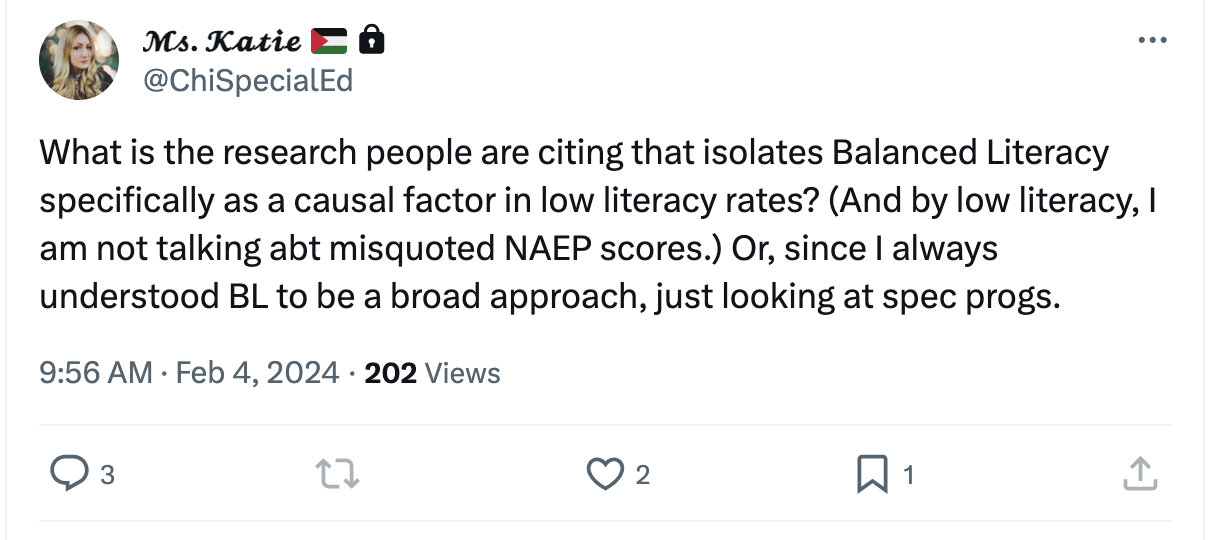
In the midst of the reading program shuffle that the second text above is addressing, we must answer Katie’s question with a not-so-fun fact: “Science of Reading” (SOR) foundational claims that balanced literacy programs have cause a reading crisis in the US are not supported by science.

In fact, research for decades (including NRP reports) have shown that whole language, balanced literacy, and systematic phonics are about equally effective for student reading proficiency (comprehension); for example:

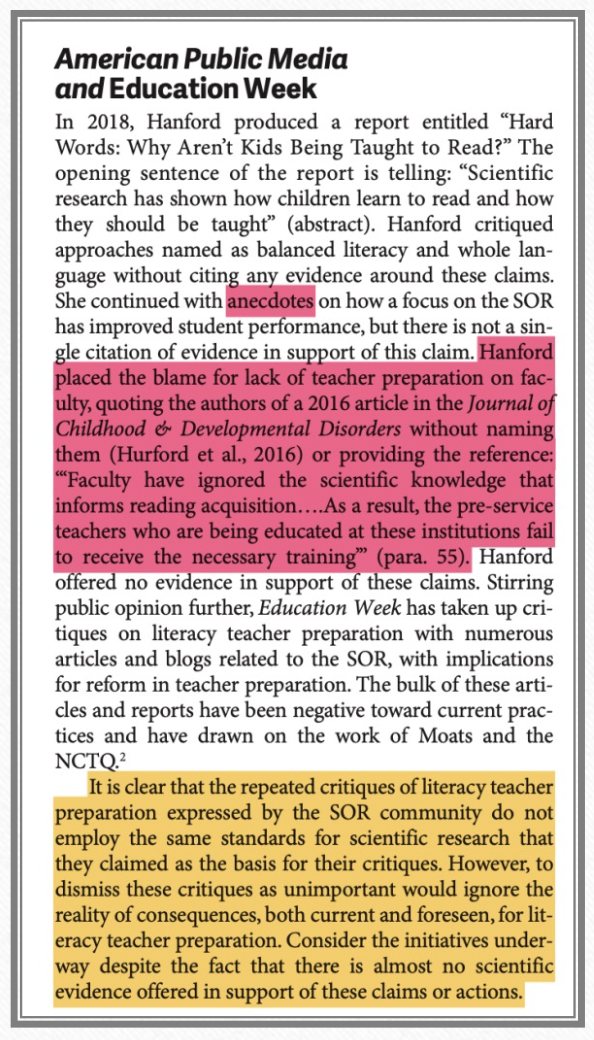
The really frustrating fact about the SOR movement is that “science” is the rhetoric of the advocacy and legislation, but anecdote is the primary evidence used to perpetuate essentially ideological claims:

Hoffman, J.V., Hikida, M., & Sailors, M. (2020). Contesting science that silences: Amplifying equity, agency, and design research in literacy teacher
preparation. Reading Research Quarterly, 55(S1), S255–S266. https://doi.org/10.1002/rrq.353

Like CT, most states and notably NYC have passed legislation mandating districts and schools drop existing programs falsely labeled as “failing” and choose among a few reading programs falsely labeled SOR.

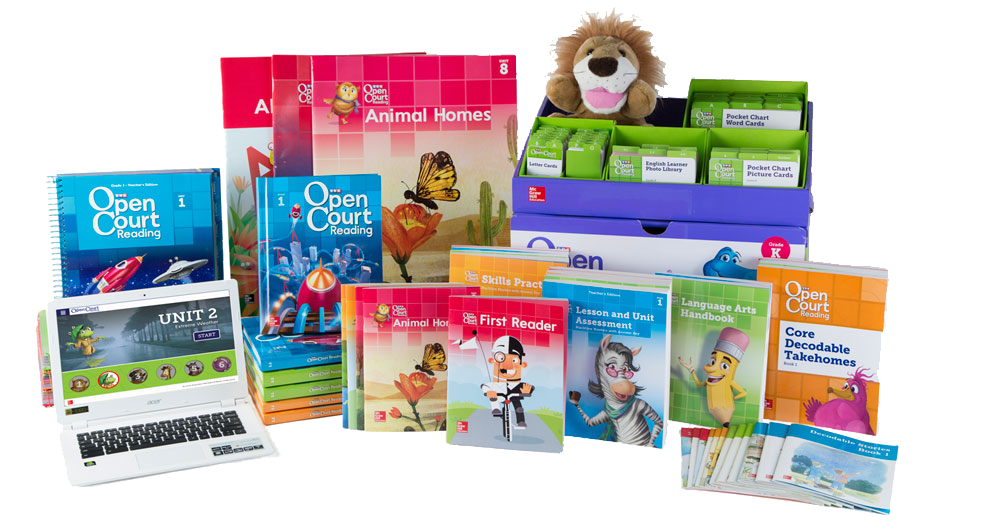
As one vivid example of this charade is the fate of the program Open Court, which has had a recent turn as program-of-the-day in the wake of the NRP/NCLB mandate that all programs had to be scientifically-based.

Although written in 2017, this overview of Open Court by McQuillan could have been written today, or sadly, several years from now:

Translation: Open Court does no better, and often worse, than the alternatives. 

This most recent study is by no means the only evidence against phonics instruction or programs such as Open Court. The list of studies that show the failure of phonics is too long to repeat here, but you can whet your appetite by looking at what happened with the U.S. Department of Education’s spectacularly expensive and utterly ineffective Reading First program (herehere, and here, for starters).

Journalists and politicians get to move on to the next Great Cause, but the teachers and kids stuck in Open Court classrooms often have no such option.

Closing the Books on Open Court Reading

And thus, the really not-so-fun fact is that despite ample evidence to the contrary, some states have included Open Court in the new mandates!

Here is the real issue that is at the core of our obsession with manufacturing a reading crisis and then demanding the exact same reform strategies, again—mostly declaring some programs failures and mandating new programs instead: Reading programs have not caused a reading crisis, and different reading programs are not the reform solution regardless of our reading goals.

Since I have been making this argument literally for decades, I end here with a reader to emphasize that I endorse no reading programs—never have, never will:

And it bears repeating: “’Programs do not teach kids. Materials do not teach kids. Highly skilled professional educators teach kids, and that is what we have in Westport,’ [Westport Supt. of Schools Thomas Scarice] said.”

The New Illinois Literacy Plan: How Will It Impact K-12 Teachers Across Illinois?

THURSDAY, FEBRUARY 22nd 5:30 – 7:00p.m.

VIRTUAL (livestreamed via YouTube)

The Illinois State Board of Education has released a new statewide plan for literacy curricula and instruction.


Buyer Beware!: Avoiding the Unintended (But Predictable) Consequences of SOR Legislation [Click for PDF]

P.L. Thomas


All PK-12 teachers in our public schools—especially those who teach reading and language arts; those who work with English Language Learners; and those whose practice includes teaching content-area reading—as well as their administrators, plus those who prepare teachers, are part of this plan Illinois State Board of Education notes is designed to “guide and unify literacy efforts across the state.”

Our panel will help attendees understand the national context within which this plan was developed, along with how ISBE defines the problems in current Illinois literacy teaching. The core components of the plan, and how they will affect the curricular and instructional choices made by classroom teachers and teacher education program faculty, will be described and discussed.

One focus of the panel will be on examining critiques of the plan, what was left out, what the next steps will be for school districts, and the extent to which its provisions promote the complexity and nuances of literacy acquisition and teaching. The crucial question—What do teachers really need to support their literacy instruction? —will be considered from multiple viewpoints by the panel and attendees. 

PANELISTS INCLUDE:

 Dr. Marie Donovan, Associate Professor & Program Director, Early Childhood, College of Education, DePaul University

Cathy Mannen,Professional Issues Director, Illinois Federation of Teachers; Early Childhood and Literacy Teacher & Mentor

Cristina Sanchez-Lopez, Co-President Paridad Education; Bilingual, Bicultural Instructor, College of Education, DePaul University 

https://www.paridad.us/cristina-lopez

Dr. Paul Thomas, Professor, Education, Furman University 

https://www.infoagepub.com/products/How-to-End-the-Reading-War-and-Serve-the-Literacy-Needs-of-All-Students-2nd-ed

This forum will build upon the Spring 2023 forum on the ‘reading wars,’ where expert panelists discussed the ‘science of reading’ as well as what we now know from research are hallmarks of effective literacy instruction. Here is the link to that forum’s recording: https://www.youtube.com/live/wlM4kOgXikU?si=4m8AzgttSKDzj-Rp

All attendees must register individually. If you register and can’t attend you will receive a recording of the forum the following week. Please share this notice and flyer with colleagues and friends.

REGISTER AT: https://www.eventbrite.com/e/coe-winter-forum-the-new-illinois-literacy-plan-tickets-803161476597

We hope to see you there!

Dr. Diane Horwitz, Coordinator Education Issues Forums

dhorwit1@depaul.edu

Missing the Forest for the Trees in Literacy Instruction: Resisting the Nonsense in Crisis-based Reading Reform (Again)

[Header Photo by Irina Iriser on Unsplash]

One brief analogy I use when asking students to consider both literacy and teaching literacy (as well as teaching and learning in general) is to recall a time when they had to assemble something like a bookshelf or a large toy for children.

The point is to consider the ways in which we navigate the directions and assembling the item. I nudge them by asking how well they feel the written directions help them and then what they do when they find themselves confused while assembling.

A typical moment of community in this thought experiment is that many of us rely on the picture on the box to help guide us.

Yes, we turn to look at the picture to help us make meaning of the process.

I recently assembled two large filing cabinets and cannot express the relief of having the detailed directions, the image of the completed filing cabinet in several angles on amazon, and a video of someone assembling the cabinets.

My point is that the most compelling part of assembling an item for many people is the whole, finished product. We really want and even need is to see the whole authentic thing.

But that does not mean that the step-by-step instructions do not matter; they certainly help, and following the instructions carefully often makes assembly successful.

In my case, I also found that the second cabinet was a breeze because I had the experience of building the first one.

All of this is to say that literacy, like the assembling analogy, is a holistic and authentic human behavior that is both natural (speaking and listening) and requires a learning process (reading and writing).

And like my experience with building two cabinets, literacy development is best learned when grounded in its holistic state but greatly aided by attending in some ways with identifiable parts (so-called skills). Ultimately, as well, literacy development requires a great deal of authentic experiences as part of that growth.

I have again been thinking about all this after presenting at LitCon 2024 and having several people approach me about my stance on nonsense words as a way to asses students’ phonics knowledge.

The reason issues about how to teach phonics in reading instruction (parallel to how to teach grammar, mechanics, and usage in writing instruction) remains a point of debate, I think, is that most literacy debate is driven those who are missing the forest for the trees, committed to implementing inauthentic and decontextualized practices.

My standard position is that using nonsense words to assess phonics knowledge in students is misrepresenting the purpose of reading skills (all of which are ways in which readers seek to make meaning) and misrepresenting reading achievement (testing phonics knowledge is not testing reading, which must include comprehension).

For a century, alas, we have remained mired in a literacy debate that itself is mostly nonsense.

I know of no one who advocates for no phonics (or no grammar) instruction.

Again, the debate is mostly between those hyper-focusing on the trees (such as the “science of reading” [SOR] mandates for phonics-first and systematic phonics for all students) and those arguing that regardless of how we teach, we must keep the forest in sight (the holistic and authentic acts of literacy, reading and writing).

A key question is not whether students have acquired phonics knowledge but if students can read for meaning and are eager to do so.

The SOR movement and the concurrent rise in SOR legislation, policy, instructional practices, and programs are mostly a recycling of many eras of reading crises followed by reading reform.

We have in recent history a reading crisis/reform movement grounded in scientifically-based mandates, NCLB, that has led to, yes, the exact same reading crisis and nearly the exact same reform agendas.

And once reading research and science have been diluted by ill-informed media and even more ill-informed politicians, we are faced with mandates that are banning some practices as not “scientific” (often without any citation to that science) and mandating practices and programs that are themselves not supported by scientific evidence—LETRS training, Orton-Gillingham, so-called SOR programs (see blow), decodable texts, phonics checks using nonsense words, etc.

In short, reading wars often fail reading, students, and teachers because ideological biases are wrapped in veneers such as “science” and research. The agents of that failure are often non-literacy experts and non-educators—notably journalists, politicians, and corporate entities eager to rebrand and market new educational materials and programs.

As I documented in my SOR policy brief, the problems with SOR are mostly not that we should avoid reading reform (specifically the need to do a much better job of serving the needs of marginalized and minoritized students since literacy, like all of formal education, remains inexcusably inequitable), but that reform must be (1) grounded in accurate identification of the problems, (2) informed by educators and educational researchers without market stakes in that reform, and (3) designed to serve the individual needs of all students (and not one-size-fits all mandates).

The current wave of SOR stories and legislation fails all of those guidelines and is proving to be another attempt at doing the same thing over and over while expecting different results.

Let’s now consider a couple examples of why SOR is misguided.

First, assessments using nonsense words and systematic phonics for all students are not supported by reading science; further, these practices can in fact cause harm:

Advocates of the phonics screening tests claim that they are fun. In fact, for fluent readers, it can destroy their recognition as competent readers. In one school example, a boy who came to school reading, and who continued to flourish as a fluent reader, scored 2/40! Since the test includes nonsense words in the quest to focus on decoding (he read “elt” as “let,” “sarps” as “rasp,” and “chab” as “cab,” to foreground a few!) What he seemed to be doing was re-arranging the letters or sounds and reconstructing them into recognizable words that he knew made sense. Meanwhile, another child whom the teacher regarded as not being a fluent reader was able to sound out the nonsense words as well as regular words and achieve a score of 16/40, all without knowing their meaning. Thus, the raw scores from the test of each child give us no information about them as readers and how they can make meaning from text; they simply show how they decode words out of context.

Phoney Phonics: How Decoding Came to Rule and Reading Lost
Meaning

When any instruction starts with the content or skill without regard for what the student knows or needs to know, that practice is wasting precious time better spent on what that student needs and in some cases mis-teaching students (nonsense words make the phonics knowledge the goal and misleads students to see making meaning as unneeded).

Next, as noted above, the SOR reform movement is once again making the fatal mistake of misreading the importance of reading programs while simultaneously falsely blaming some programs as failures while endorsing programs that have (ironically) been discredited through research.

Once at the center of the Reading First scandal during NCLB, Open Court is now being mandated in states such as Virginia (as one of a few districts can choose).

Endorsing Open Court is evidence that the SOR movement remains mostly ideology and not “scientific”; in fact, the resurfacing of Open Court is deja vu all over again:

Back in the 1990s, the Los Angeles Times was a big fan of the scripted reading curriculum, Open Court, designed to teach reading in the elementary grades through a heavy dose of explicit, systematic phonics. The Times reporters wrote lots of favorable articles about phonics instruction in general, especially then-education reporter, Richard Lee Colvin. Others got in on the act, too, including Jill Stewart of the LA Weekly, whose “The Blackboard Bungle” article should be a case study in the lack of “fact checking” in reporting.*

Open Court ended up being adopted by Los Angeles Unified School District (LAUSD), among many other districts around the country – never mind that the evidence for the effectiveness of phonics was (and is) severely lacking. (LAUSD eventually abandoned the program in 2011.)

Closing the Books on Open Court Reading

And after Open Court was adopted in a major US city (think about the outsized anger leveled at Units of Study in NYC), what does the scientific evidence show?:

Translation: Open Court does no better, and often worse, than the alternatives. 

This most recent study is by no means the only evidence against phonics instruction or programs such as Open Court. The list of studies that show the failure of phonics is too long to repeat here, but you can whet your appetite by looking at what happened with the U.S. Department of Education’s spectacularly expensive and utterly ineffective Reading First program (herehere, and here, for starters).

Journalists and politicians get to move on to the next Great Cause, but the teachers and kids stuck in Open Court classrooms often have no such option.

Closing the Books on Open Court Reading

As McQuillan warned, we are now in the throes of the “next Great Cause,” and students and teachers are trapped, again, by mandates driven by ideology, politics, and market interests.

If you take the time to look, the greater the missionary zeal about a reading crisis and reading reform, the more likely the person is blinded by beliefs, motivated by political gain, or cashing in.

Regretfully, centering the use of nonsense words in the SOR movement does capture what all the reading crisis histrionics ultimately are—nonsense.

As is typical of education reform, SOR advocates are missing the forest for the trees.


Recommended

 Literacy Crises: False Claims and Real Solutions by Jeff McQuillan

The Science of Reading and the Media: Is Reporting Biased?, Maren Aukerman

The Science of Reading and the Media: Does the Media Draw on High-Quality Reading Research?, Maren Aukerman

The Science of Reading and the Media: How Do Current Reporting Patterns Cause Damage?, Maren Aukerman

Legislating Phonics: Settled Science or Political Polemics? David Reinking, George G. Hruby, and Victoria J. Risko