Category Archives: education

Third Grade Retention: The Fool’s Gold of Reading Reform

[Header Photo by Renee Kiffin on Unsplash]

Here is a report on reading reform across the US that is very important, but likely not in the ways intended: The Effects of Early Literacy Policies on Student Achievement, John Westall and Amy Cummings.

A key value in this report is the comprehensive data on reading reform in the US, such as these two figures:

Notably, most of the US has early literacy policy, significantly clustered since about 2010. While this is important context, the figures also reveal a key problem with this report—the source being a conservative think tank, ExcelinEd.

ExcelinEd is a Jeb Bush venture and represents the political and ideological connections among third grade retention, reading policy, and political gain.

I want here to focus on that dynamic, specifically how this report provides further evidence of the need for intense and critical re-evaluation of third grade retention.

ExcelinEd is grounded in Florida’s reading reform and high rates of grade retention that have produced exceptionally high NAEP scores in grade 4 reading (an outcome this report confirms across the US), but the largest decrease from grade 4 to grade 8 reading scores.

Let’s here note what Westall and Cummings detail about grade retention:

  • Third grade retention (required by 22 states) significantly contributes to increases in early grade high-stakes assessment scores as part of comprehensive early literacy policy.
  • Retention does not appear to drive similar increases in low-stakes assessments.
  • No direct causal claim is made about the impact of retention since other policy and practices linked to retention may drive the increases.

Here is where this report is important, I think, but, again, not as intended:

Similar to the results for states with comprehensive early literacy policies, states whose policies mandate third-grade retention see significant and persistent increases in high-stakes reading scores in all cohorts. The magnitude of these estimates is similar to that of the “any early literacy policy” estimates described in Section 4.1.1 above, suggesting that states with retention components essentially explain all the average effects of early literacy policies on high-stakes reading scores. By contrast, there is no consistent evidence that high-stakes reading scores increase in states without a retention component.

Grade retention has immediate political appeal since we as a nation primarily discuss and judge schools and students based on high-stakes testing data.

What is lost in that political appeal is that this report clearly notes that we still have significant gaps in understanding the role of retention in raising test scores, evidence that early test score increases fade by middle grade testing, and evidence that retention creates inequity and non-academic harm in students.

Therefore, third grade retention is the Fool’s Gold of reading reform.

What I suspect you will not see emphasized by the most ardent reading reform advocates is the closing concessions in this report:

Although our study sheds light on the potential benefits of early literacy policies, there are some limitations that point to areas for future research. For example, while we provide evidence that comprehensive early literacy policies and retention mandates play an important role in improving state summative assessment scores, we cannot examine the mechanisms by which these policy components improve outcomes. Further research on the implementation of these policy components is therefore vital to understanding how early literacy policies operate. Additionally, we only focus on short-run test-score outcomes. However, prior work has established the importance of early literacy skills in determining non-cognitive outcomes and long-term student success (Cunningham & Stanovich, 1997; Fiester & Smith, 2010; Hernandez, 2011; Sparks et al., 2014). To fully understand the benefits of early literacy policies, it is important to enumerate their non-cognitive and long-term impacts. Finally, this study does not examine the costs associated with early literacy policies.

I want here to emphasize the need to critically examine “mechanisms by which these policy components improve outcomes.”

Again, as I have stressed before, we need a more standard and understandable set of terminology and assessments that produce NAEP and state-level high-stakes testing data that can help drive authentic reform (not misleading early gains and then drops in later grades).

Currently, NAEP “proficient” remains misleading and the terminology used in state-level testing is incredibly mixed and difficult for the media, the public, and political leaders to navigate (see the information provided here).

Next, since England has implemented early literacy reform at a comprehensive and national level beginning in 2006, we must heed to lessons found in their outcomes.

In terms of the impact of grade retention on high-stakes testing, the UK implements phonics checks that have shown score increases by age month, suggesting that age-based development could be driving scores instead of any policy or instruction:

And thus, I agree with this argument from the UK:

There is certainly a strong argument for changing primary assessment to take account of age to lessen the risk of singling out summer born pupils as the low achievers. Assessments should be fewer in number, standardised, comparable with one another and generate norm-referenced age-standardised scores. And even then, the phrase ‘below age-related expectations‘ would be a misnomer; pupils with low attainment for their age would be more appropriate. This is not about re-designing the assessment system for Ofsted; this is about creating a more efficient and effective approach that would provide accurate, timely data capable of ironing out the creases caused by differences in age and allow attainment to be tracked over time. Yes, it would allow Inspectors  – and teachers – to identify those in the lowest 20% nationally – for their age! – but it would also have an interesting side-effect: a move to age standardisation would signal the end of expected standards as we know them.

My concern has always been that since NAEP is grade-based, grade retention removes the lowest scoring students from the testing pool and then reintroduces them when they are biologically older than their grade peers. Both of those skew test data by distorting the testing pool.

The NAEP Long-term trend (LTT) data is age-based and often reveals different outcomes that grade-based NAEP.

Finally, we must start with better data but also be more honest about what we know and do not know.

The first thing we know is that high-stakes testing data is causally related to out-of-school factors at 60%+ rate.

And as this report concludes, we do not know how the matrix of policy reforms [1] impact high- and low-stake testing:

This report is incredibly important in that it does suggest that despite that complex list of different policy elements, grade retention may be the single policy that produces the outcomes that are politically attractive (this same dynamic holds in college admission where despite using a matrix of admission criteria, SAT/ACT scores often are the determining data point).

Finally, although this report identifies evidence on grade retention as mixed, the body of research over decades confirms significant negative consequences from retention.

Therefore, until we can answer these questions, we are making political and not educational decisions about early literacy in the US:

  • How causally linked is biological age with high-stakes assessment, and thus, how does grade retention distort grade-level testing?
  • What are the criteria for assessments that are labeled “reading” and does that criteria impact the ability to increase test scores without improving student achievement?
  • Are there policies and practices linked to grade retention that can support student achievement without negative outcomes for those students?
  • How do we reform reading in the US by focusing more on equity than high-stakes testing data?

I predict that if we answered these questions we would expose grade retention as Fool’s gold in reading policy.

And unless we change how we are debating and mandating reading policy, those students who need and deserve reform the most will continue to be cheated by education reform as industry.


[1] Note that although most of the current state-level reading policy is identified as conforming to the “science of reading,” many of the mandates support practices not supported by the current body of research (LETRS training, Orton-Gillingham phonics, decodable texts, etc.):

The Science of Reading: A Literature Review

Attacking Public Education and Teachers as American as Apple Pie

[Header Photo by CDC on Unsplash]

The more things change, the more they stay the same.

Let’s always avoid outsized hand wringing about how much worse anything is today than in some idealized past.

If you take a bit of time, you can explore how public education in the US was demonized and attacked in the nineteenth century, primarily by the Catholic Church who saw public education as a threat to their education monopoly:

[P]ublic schools … [are] a “dragon … devouring the hope of the country as well as religion.” Secular public education … [is filled with] “Socialism, Red Republicanism, Universalism, Infidelity, Deism, Atheism, and Pantheism—anything, everything, except religion and patriotism.” (Jacoby, pp. 257-258)


Yet in 2024, public education is under several waves of assault that, if not unprecedented, is at an intensity that is exceptional.

In literacy education, two waves have targeted schools—censorship and bans as well as the “science of reading” (SOR) movement that has demonized teachers as well as decreased the diversity and quality of texts used to teach students to read.

Although not exclusively but significantly, these attacks on public education and literacy specifically are conservative. And then, beneath those traditional values are deeply harmful beliefs grounded in sexism/misogyny and racism.

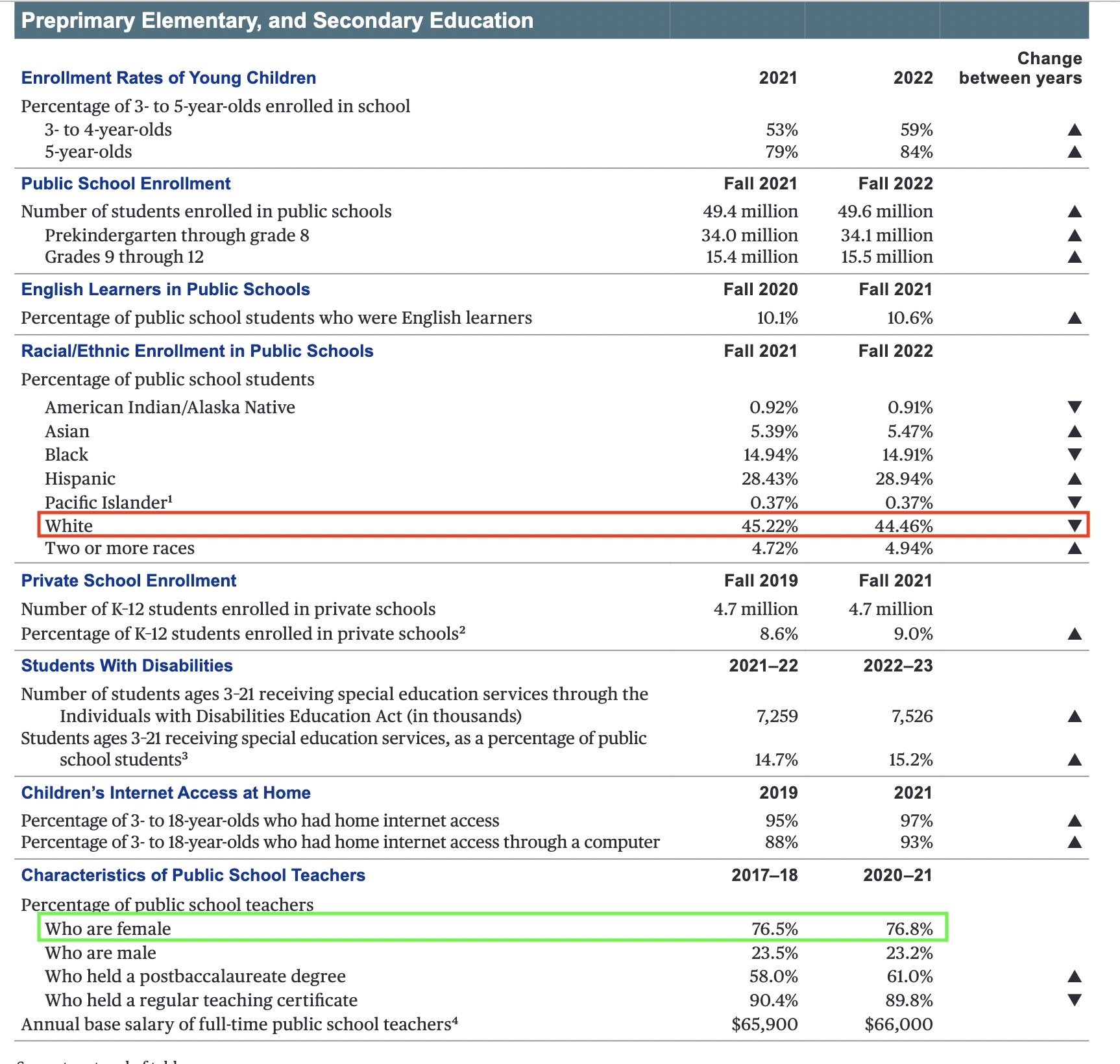
The recent Report on the Condition of Education 2024 provides a couple data points to support why attacks on public education and teachers are intensifying, if not increasing:

First, the proportion of white students in US public schools is below 50% and continuing to decrease.

Next, the teacher workforce in the US is over 3/4 women, and among literacy teachers, that number is even higher.

Republican states are again increasing school choice schemes, and at the core of that is another move to allow white flight from public schools, funded by the public. This parallels the rise of private schools and white flight after Brown v. Board (notably across the South).

The nation-wide and often bi-partisan embracing of the SOR movement is grounded in a false but compelling claim that teachers of reading and teacher educators don’t know how to teach reading, a claim made without evidence among journalists and politicians.

That the teacher workforce is almost entirely women drives both the attacks on teachers and why that attack is uncritically embraced.

The result is so-called “structured literacy,” which is a veneer for scripted curriculum.

Scripted curriculum de-professionalizes teaching as a profession and centers instructional authority in commercial programs and not teachers.

Public education and public education teachers deserve better, primarily because they both serve our children and if allowed our democracy.

Deinfluencing Reading Policy

[Header Photo by Diggity Marketing on Unsplash]

My partner and I were discussing this YouTube video by Nick Lewis, who explains in the beginning how social media influencers make profits (watch the first few minutes, by the way, for his explanation):

The key point here is that social media influencers need consumers to always be interested and buying the next thing, the new thing.

Influencers are not incentivized to find for their audiences The Thing, something that lasts, something that solves a problem, because the value is in churn—consumer buying the thing and then almost immediately positioned to want to replace that thing with the new thing.

That dynamic is exactly what is working in the perpetual reading war where influencers (journalists, education reformers, politicians) are incentivized to keep the public in a constant state of crisis/reform.

Those crisis influencers must first create market space (“Reading programs X and Y have failed!”) and then promote the New Reading Program—and then in just a few years, that reading program will be declared a failure so if we will only adopt this Next New Reading Program …

Reading reform influencers are like social media influencers as well in that they lack expertise in the issue; their only expertise is the influencing and the creation of constant churn.

The “science of” movements in education are just that—influencers creating market churn—and not in most ways about addressing real educational problems and certainly not about solving them.

If education and reading were satisfactorily improved, what would they do?

We need to deinfluence reading (and education) reform if we are genuinely concerned about improving student achievement.

Ignoring Evidence in the “Science of” Era: Fidelity and Deficit Ideology Edition

[Header Photo by Isabela Kronemberger on Unsplash]

As a writer and a teacher of writing, I am well aware of the need to avoid cliches, but cliches often do, in fact, capture well something that is worth considering.

In this education reform “science of” era, reading reformers are suffering the negative consequences of missing the forest by hyper-focusing on a few trees.

The ugliest of ironies is that reading reform driven by the “science of reading” (SOR) story fails the evidence test, notably that SOR legislation is not based on science. A growing body of research has been detailing how SOR legislation and mandates are misguided and even harmful.

The cautionary tales being ignored [1] are also expanding, and possibly the most powerful evidence that the SOR movement is misguided is in the UK, where a similar reading reform movement was implemented in 2006.

Not surprising, but phonics-intensive reading reform in the UK has not achieved what was promised—and media as well as political leaders are still shouting “reading crisis.” [2]

At the core of education reform broadly and reading reform narrowly are several fatal flaws that mainstream reformers refuse to avoid: (1) manufactured crises, (2) one-size-fits-all solutions, and (3) policies and mandates that are hostile to teacher autonomy and individual student needs.

Digging deeper into the monolithic reading reform cycles over the past 40 years (and reaching back into 80 years of reading crisis rhetoric and fruitless reading wars), some of the most ignored evidence in reading crisis rhetoric and reading reform/policy concerns the failure to address how demanding teacher fidelity to policy and programs reinforces deficit ideology about language and marginalized students.

As I have noted, I was confronted with evidence about Units of Study (UoS) that has never been the focus of the outsized and misguided attacks on that program and Lucy Calkins. Teachers at a conference just weeks before the Covid shutdown explained to me that their problem with UoS was not the program itself but the excessive policing and accountability by administrators that teachers implement the program with fidelity.

Two problems exist with implementing programs with fidelity. First, that shifts the locus of authority away from the teacher and to the program itself. And thus, second, that shift institutionalizes a deficit ideology about language and students since programs tend to impose standardized versions of literacy as well as evaluate students in terms of how they fail to demonstrate standard literacy.

Fidelity to programs creates obstacles for honoring fidelity to student needs.

Few people challenge how efforts to standardized language is a way to standardize humans (and children). Formal schooling’s approach to language is almost exclusively standardizing—systematic phonics, Standard English grammar, and false concepts such as the “word gap” (see Recommended articles below).

What we in the US should not be ignoring is evidence from the UK of how policy manifests itself in the real-world classroom.

One example is a new article: Teachers Challenging Language Discrimination in England’s Schools: A Typology of Resistance by Ian Cushing and Dan Clayton.

Cushing and Clayton offer excellent data based on evidence drawn from the Critical Language Awareness group (CLAW). Here are some of the highlights of that evidence:

  • “[T]eachers work in contexts where they undoubtedly negotiate a dense array of top-down policy initiatives which may well not align with their language ideological beliefs.” Key here is that policy imposes beliefs about language, thus, there is no such thing as objective or apolitical policy.
  • And thus: “We understand language discrimination not simply as about individual attitudes which manifest in individual, malicious acts of prejudice, but as a structural phenomenon underpinned by language ideologies which stratify, rank, and hierarchically organise language varieties and the communities associated with them (Lippi-Green, 2012). Schools are particularly key sites of language ideological production and the co-construction of racial, class, and linguistic stratification.”
  • Language/reading policy legislates national ideology grounded in deficit ideology:

Attempting to justify these structural deficits, the state produced a stigmatising narrative of strivers and scroungers which framed working-class and racialised minorities as responsible for their own hardships, and thus responsible for their own welfare by modifying their individual behaviours, including language (Tyler, 2018).

Austerity, public cuts, and the 2011 nationwide uprisings that followed created an ideological space in which educational reform was deemed by the state to be urgent and necessary, and where the most marginalised members of society could begin to experience upward social mobility and educational success simply by changing their language (see Nijjar, 2018).

  • The dynamic in place in the UK is being replicated in the US:

These mechanisms include new national curricula, high-stakes standardised grammar tests for primary school students, high-stakes GCSE assessments for secondary school students, revised professional standards for teachers, and Ofsted, the schools inspectorate. These policy mechanisms place teachers into positions where they are encouraged (and rewarded) to perceive marginalised students’ language as deficient, to engage in hostile language policing, and to reproduce ideologies of linguistic correctness which bolster language discrimination. At the same time, post-2010 curriculum changes stripped away units and assessments concerned with spoken language study, leaving little room for teachers to engage in critical debates about language variation, attitudes, and ideologies. These changes coordinated with a resurgence of deficit discourses in policy, such as those clustered around the so-called word gap and an increased focus on technical grammar and vocabulary—at the expense of critical and social aspects of language.

  • Language/reading policy tends to erase how language ideologies are “intricately connected to race, class, and privilege.” In short, “language ideologies were a proxy for other forms of stigma,” and that stigma impacts both students and teachers, especially those from marginalized backgrounds and identities.
  • Reading policy ignores and even resists critical approaches to language that “challenge language discrimination.” Yet, Cushing and Clayton document “how students had ‘loved looking at how and why their language got policed’ and how the unit allowed students to see that ‘attitudes about their language were really just about their social class.'”
  • Literacy instruction not grounded in deficit ideology faces multiple obstacles, then: “internal obstacles (in the form of management) and external obstacles (in the form of Ofsted, national curricula, assessments, and examination boards).”
  • “What is important to stress here is that schools are under increasing pressure to demonstrate ideological fidelity to externally produced, state-produced education policy, themselves which are underpinned by academic scholarship subscribing to normative ideologies about language and discourses of deficit (Cushing, 2023c).”
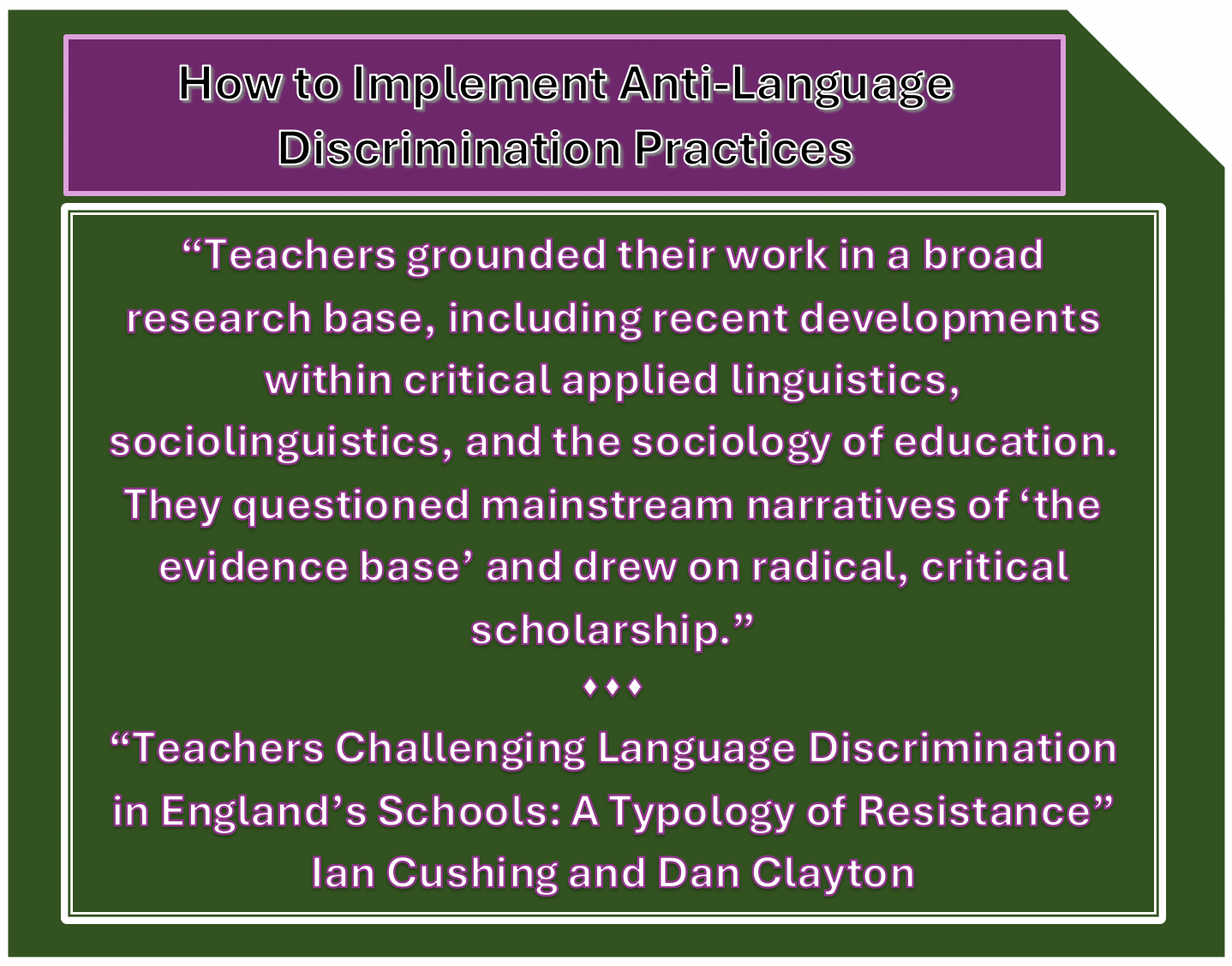
  • Cushing and Clayton build to a typology for anti-language discrimination. Here, I want to emphasize a key component about what counts as evidence: “Teachers grounded their work in a broad research base, including recent developments within critical applied linguistics, sociolinguistics, and the sociology of education. They questioned mainstream narratives of ‘the evidence base’ and drew on radical, critical scholarship.”

The article ends by noting that teachers alone cannot change this pattern, and I want to stress that is especially true in the US where teachers are often powerless and have been publicly discredited as not knowing how to teach reading.

However, the evidence is clear that “[l]anguage discrimination is a structural phenomenon” and that reading policy and reading programs are key elements in that structure.

Mandating fidelity to deficit beliefs about language and students is at the core of the SOR movement. Once again, we are missing the evidence by focusing on a few trees and ignoring the forest.


[1] Another Cautionary Tale of Education Reform: “Improving teaching quality to compensate for socio-economic disadvantages: A study of research dissemination across secondary schools in England”; Cautionary Tales of State Reading Legislation: UK; Cautionary Tales of State Reading Legislation: Tennessee; UK PISA 2022 Results Offer Cautionary Tale for US Reading Reform; Research, the Media, and the Market: A Cautionary Tale

[2] Recommended: The Balancing Act by Dominic Wyse and Charlotte Hacking

Recommended

Tiered vocabulary and raciolinguistic discourses of deficit: from academic scholarship to education policy, Ian Cushing

Social in/justice and the deficit foundations of oracy, Ian Cushing

Teachers Challenging Language Discrimination in England’s Schools: A Typology of Resistance, Ian Cushing and Dan Clayton

Pathologizing the Language and Culture of Poor Children, Curt Dudley-Marling and Krista Lucas


Recommendations Spring/Summer 2024

[Header Photo by Ethan Robertson on Unsplash]

I have had a notably good run lately with entertainment (books, films, series, music, etc.) and pop culture. And nothing makes that more enjoyable than sharing with others.

This covers a good deal of re-reading and re-watching by me, but also some wonderful new works and thinkers/creators that I am really excited about.

Here, then, is a very eclectic list of recommendations for your spring and summer of 2024.

Haruki Murakami

Kafka on the Shore [Just finished re-reading. A wonderful and powerful work by Murkami, many think his best.]

1Q84 [Currently in the midst of re-reading, and my initial venture into Murakami. Brilliant and quite long, which I enjoy.]

Haruki Murakami Manga Stories 1: Super-Frog Saves Tokyo, Where I’m Likely to Find It, Birthday Girl, The Seventh Man [On deck to read.]

Haruki Murakami Manga Stories 2: The Second Bakery Attack; Samsa in Love; Thailand [On deck to read.]

Arthur C. Clarke

Rendezvous with Rama [Just re-read and a gem from my adolescence. Incredibly readable and just wonderful sci-fi.]

Childhood’s End [Another love from my adolescence, and on deck for re-reading.]

Poor Things

Poor Things (2023) [A very graphic and incisive film. Lots of sex and nudity just FYI.]

Poor Things, Alasdair Gray [Really surprised with how wonderful and laugh out loud funny this is. Highly recommend, but an interesting typeset approach with some images.]

Music

Wonderful cover by The National of “Heaven” by Talking Heads

Vampire Weekend [New obsession.]

The Decemberists [New album out soon and “All I Want Is You” is wonderful.]

Series

Outer Range [Currently re-watching because S2 is out. Sci-fi western. Some glorious fun (and a bit of David Lynch vibes) and wonderful acting/writing.]

Fallout [My partner is the gamer and I have no background in this. But the series grew on me so I will be re-watching.]

Ian Cushing

Cushing does excellent scholarship on deficit perspectives of language and the “word gap.” And open-access.

Tiered vocabulary and raciolinguistic discourses of deficit: from academic scholarship to education policy, Ian Cushing

Social in/justice and the deficit foundations of oracy, Ian Cushing

Teachers Challenging Language Discrimination in England’s Schools: A Typology of Resistance, Ian Cushing & Dan Clayton

James Baldwin

“The American institutions are all bankrupt,” explains James Baldwin in “Notes on the House of Bondage.” And he weighs in on voting when “how it happens that in a nation so boastfully autonomous as the United States we are reduced to the present Presidential candidates?”

George Saunders and Lane Smith

The Very Persistent Gappers of Frip, Saunders and Smith [A wonderful work and I cannot recommend it enough. I love Smith’s art, and blogged about this here.]

It’s a Book, Smith [One of my favorite picture books, funny and sharp.]

Lego

Haven’t been much into these types of builds but both are really good ones and nice displays.

Rocket & Baby Groot (76282)

Green Goblin Construction Figure (76284)

Daredevil and Black Widow

Daredevil Omnibus v.3 [I am currently drafting a book on Black Widiow, and this is a wonderful collection of the Daredevil/Black Widow era from my adolescence when I became a comic book collector.]

Lou LaBrant

The US in 2024 has become Russia via 1950s

Diversifying the matter (1951)

To Be Read

Kim Jiyoung, Born 1982: A Novel, Cho Nam-Joo

Frankenstein in Baghdad: A Novel, Ahmed Saadawi

Just What Is “Good Writing”? [Swift Update]

[Header Photo by hannah grace on Unsplash]

I haven’t seen the memo, but it appears that there is a mandate whenever anyone discusses Taylor Swift they must include at least that she is a good songwriter, although usually the claim is that she is a great songwriter, possibly the greatest songwriter ever (although Rolling Stone would beg to differ).

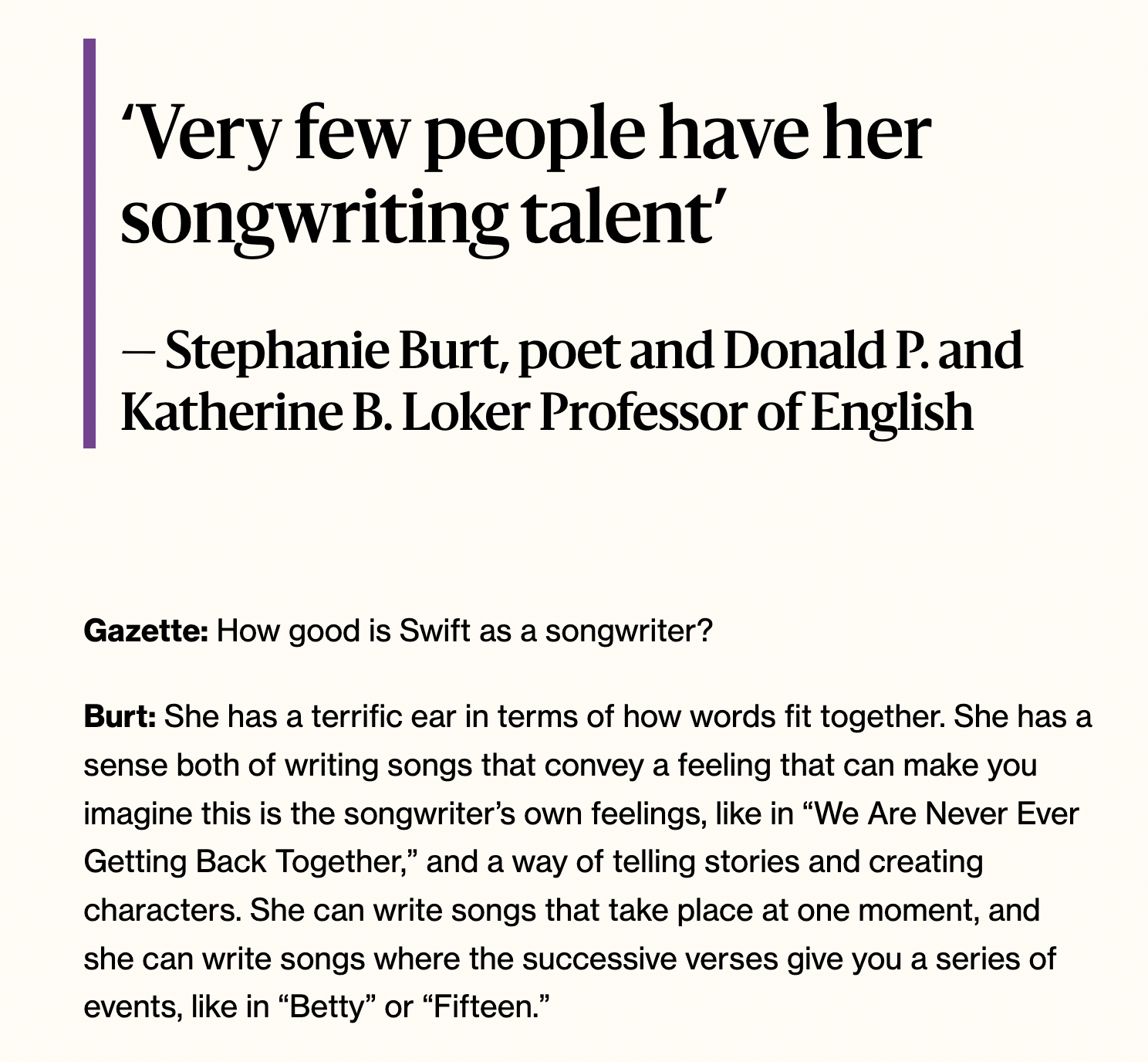
This interview with poet Stephanie Burt typifies the sort of effusive praise Swift elicits for her writing even outside pop culture among so-called serious writers:

Burt continues and makes a key point about Swift being accessible as well:

She has a lot of different gifts as a songwriter, both at the macro level, how the song tells a story or presents an attitude, and at the micro level, how the vowels and consonants fit together, and she’s able to exercise that range, along with quite a lot of melodic gifts, and in a way that does not make her seem highbrow or alienate potential audience members.

So let’s consider a simple question that seems to have already been definitely answered—Are Swift’s lyrics “good writing”?—but only as a context for answering, Just what is “good writing”?

And the short answer is, Yes, and probably not.

Because it all depends on what we mean by “good writing.”

I have been myself a “serious” writer (writing almost daily) since college, about 44 years. For 40 years, I have also been a writing teacher.

I also love popular music, and consider pop art valid art—a craft and genre all its own that shouldn’t be discounted simply for being popular.

My adult life is richer because of my love for The National (and other popular bands) and my renewed life as a comic book collector.

I am drawn myself to pop culture with “good writing”—song lyrics and narratives of comic book writers and artists (yes, I consider comic book artists “writers” as well).

What I want to emphasize, then, is that this isn’t intended to be a snob post that takes a passive aggressive swipe at pop culture icons.

That said, I think we can make fair assessments such as distinguishing song lyrics from poetry; in that, they are not the same but share some of the same characteristics that help us understand what good writing is.

It seems pedantic (like using the word “pedantic”) and even petty to announce that Swift, in fact, isn’t a good songwriter since her success as an artist is elite if not unique.

But for writers and teachers of writing and literature, often “good writing” focuses on the how of expression as well as the what.

I have noticed the general public will say something is well written if the film or book or series is engaging and interesting—regardless of the actual craft of the writing. There is definitely something to accessibility for the general audience—Burt’s writing “in a way that does not make [Swift] seem highbrow or alienate potential audience members.”

Here, then, I want to focus on good writing as craft—the writer’s choices about diction (word choice), sentence formation, and most importantly, the writer’s purposefulness and control.

Swift’s lyrics clearly resonate with a large percentage of listeners, and Swift is consciously composing those lyrics with attention to technique (metaphor and other types of figurative language).

In that respect, her lyrics are good writing in terms of purposefulness.

For example consider Swift’s “Love Story” as a craft lesson on using the Romeo and Juliet narrative. But, for this discussion, I want to offer that your consideration of Swift as a good writer should be posed beside another song also incorporating the same mythology: “Romeo and Juliet” by Dire Straits (lyrics by Mark Knopfler).

I don’t mean this as a negative criticism, but Swift’s use of craft often reads as a music performer purposefully inserting craft into her lyrics—which I would distinguish from writers who incorporate craft elements in the service of the writing and expression. [1]

The opening of the two songs are distinct with Swift framing the Romeo and Juliet reference as a overlay of an actual relationship; her opening, for me, is too direct and a bit clunky:

We were both young when I first saw you
I close my eyes and the flashback starts

Knopfler re-imagines Romeo and Juliet, the narrative creating what John Gardner always emphasized that writing should be a “vivid and continuous dream”—the goal being that the writing is so engaging that the reader forgets they are reading (think also of a viewer forgetting they are watching a film).

Yes, Swift is using figurative language and even allusion (“scarlet letter”); this is clearly writing with craft and purpose.

Not to again be pedantic, but this is about degree of what counts as “good writing” and an argument that there is a range of sophistication in writing.

For example, the use of “like” in a simile is considered more direct (and clunky) than a metaphor. Emily Dickinson’s “Hope” is the thing with feathers remains at the level of metaphor simply by avoiding simile “‘Hope’ is like a bird.”

So that range of sophistication can be seen in the following:

  • Bryan can’t pay attention. His brain is like a squirrel.
  • Karin is squirrely a lot of the time.
  • We’ve always called him “Squirrely Matt.”

Or think about the word “boomerang.” Even in day-to-day speech we tend not to say “That moved like a boomerang” because we have adopted the simile into a metaphorical verb, “That boomeranged.”

It is here that I acknowledge that Swift’s lyrics seem to be pale or under-developed examples of good writing because I am distracted when listening to the lyrics often by a lack of control in terms of word choice and tone.

This will seem like a negative criticism, but part of the accessibility of Swift as a good writer is that her use of craft is still in an adolescent stage (which doesn’t mean “worse” or “bad”).

A poet I found who was accessible for my high school students was James Dickey; not his use of both direct comparisons (similes) in “The Hospital Window” and then the never directly mention comparison (lifeguard like Jesus/savior) in “The Lifeguard”.

This is not intended to be about Swift as much as a plea that we make claims of “good writer” and “good writing” a bit more carefully in terms of acknowledging the craft and, again, the purposefulness and control.

What is the writer doing and how is that craft in the service of expression? And then, ultimately, is that expression itself something novel or unique and, probably more importantly, is the expression a thing we should embrace, endorse, or consider seriously?

Craft in the service of bad ideas, I think, isn’t worthy of considering as “good writing,” for example (in fact, powerful writing and expression that leads humans astray is a horrible thing with too many examples dotting history).

I have to end in teacher mode by offering a smattering of poems that allow you to put my thoughts here into practice; these are glorious examples of “good writing” (I think) because of the craft, the purposefulness and the control (specifically, look closely at the word choice in Plath’s “Daddy” in the service of expression):

Those, I believe rise to the level of “good writing” while remaining mostly accessible. If you want to dip your toe in “good writing” that may be a bit less accessible, you should spend some time on Emily Dickinson (and likely not the poems you have been assigned before:


[1] After the release of Swift’s 2025 The Life of a Showgirl, this analysis of that album adresses some of my concerns about the lyrics—No Good Art Comes From Greed.

See Also

Listening to Langston Hughes about “Make America Great Again”

NEPC: Critical Policy Research. What It Is. And What It Is Not.

[Reposted by permission from NEPC]

It’s a term that often gets misused, misinterpreted, and—in the process—maligned.

By the general public, it’s poorly understood.

It’s critical policy research. And it’s the topic of the June 2024 issue of the peer-reviewed journal, Educational Evaluation and Policy Analysis. A free webinar on the issue will be held from 2:00-3:30 pm Eastern on May 23rd.

Under the name “critical race theory,” this approach to understanding the world was not only denigrated but legally banned by politicians in multiple states, many of whom had a limited understanding of even its definition.

So here’s what critical policy analysis is—and isn’t—according to the introduction to the special issue, written by guest editors Erica O. Turner of the University of Wisconsin-Madison, Dominique J. Baker of the University of Delaware, and NEPC Fellow Huriya Jabbar of the University of Southern California:

1. Approach to existing policies

Traditional policy research: Typically takes policy at face value, presuming it was created for the reasons stated (e.g., “to increase attendance”) or for technical reasons (e.g., “the former policy needs to be updated because it was created before the introduction of artificial intelligence”).

Critical policy research: Starts by examining why policies develop, how they are framed, who benefits, and who does not. In doing so, critical researchers explore the extent to which there may be connections between a policy that on the surface appears to apply to one narrow area (e.g., educational testing) and broader societal issues such as culture, economics, or gender. Critical researchers attend closely to rhetoric, which can provide clues to the values underlying the policy. For example, the use of the phrase “achievement gap” implies students themselves are responsible for the historically lower test scores found among some groups, whereas the phrase “opportunity gap” highlights the idea that some students have more and better chances to learn and prepare than others for exams.

2.  Policy implementation

Traditional policy analysis: Often equates policy with the rhetoric with which it is surrounded, viewing implementation as dichotomous (either it’s implemented or it’s not implemented).

Critical policy research: Examines the extent to which those charged with implementing policy have the ability to do so and how factors such as environment, power, and ideology play into that equation.

3.  Change

Traditional policy research: May assume that certain societal trends (e.g., changes in technology) are inevitable and immutable.

Critical policy analysis: Examines and questions underlying assumptions about social trends, asking for who benefits from them and who does not. Public policy is viewed as a tool with the potential to shift—rather than simply mirror—phenomena that are sometimes described as natural, common sense, or unchangeable.

Even as critical approaches have been villainized by politicians, they are a robust and growing area of academic research on education. The co-editors of the Educational Evaluation and Policy Analysis special issue noted that the call generated nearly 400 submissions—“a clear signal of the excitement and interest in conducting critical education policy research and the real need for more outlets that publish critical policy research in education.”

The Poverty Trap: “Myths that Deform Us”

[Header Photo by James Lee on Unsplash]

I am the son of aspirational working-class parents who grew up themselves in the aspirational 1950s.

My sister and I are posed in front of the barn next to our rented house in Enoree, SC, a mill town slowly withering away.
A portrait of an All-American family filled with hope of the American Dream.

My maternal grandparents for most of my life lived in little more than a shack with a wood-burning stove for heat and an outhouse. By comparison, my paternal grandparents were working-class themselves as my father’s father ran a gas station in our hometown.

By the time I was 38, I had achieved a doctorate, and then a few years later, I moved from teaching high school in my hometown to being a professor at a selective university where most students are from a social class I have almost no context for understanding.

In almost all ways, I am an extreme outlier among other people having been born into poverty or working-class homes.

My achievements are not the only ways in which I am an outlier since my journey through many years of formal education also allowed me to set aside the “myths that deform us” [1]—specifically the belief in rugged individualism and bootstrapping that are the basis of the American Dream.

While I am vividly aware that my education (and my parents’ sacrifices for that education) saved my life intellectually and materially, that education also allowed me to recognize that my personal story and my status as an extreme outlier do not prove that everyone from a similar background should or can rise above those beginnings.

That’s the paradox of the poverty trap and the role of formal education in the US.

So when I made the following post on Twitter (X), I was not surprised by the many ideological responses that resist the wealth of evidence behind the comment:

I was very careful to choose “perform academically” (and not “learn”) because I am addressing the norm of formal schooling in the US over the past 40 years: Schools, teachers, and students are primarily and substantially labeled, sorted, and judged based on test scores of students (what I mean by “perform academically”).

Let’s start there with research from 2024 (that replicated decades of similar studies):

Because many commercially prepared standardized tests of mathematics require large amounts of reading, student background knowledge casts a large shadow over the results because of its influence on reading comprehension skills derived in part from human and social capital. Background knowledge influences students’ ability to comprehend test questions and use their existing knowledge to successfully answer questions or generate answers.

…Almost 63% of the variance in test performance was explained by social capital family income variables that influence the development of background knowledge. Background knowledge is a known predictor of standardized test results. Family income variables are immutable by schools. Only public policies, outside the control of school personnel, can influence family income.

In general students who live in poverty perform significantly lower on standardized testing that students from more affluent backgrounds.

Further, unlike my own personal story, despite access to public education, more people remain in the social class of their birth than not; in short, social mobility in the US has been decreasing for decades.

Despite the cultural beliefs to the contrary, education in the US is not the great equalizer.

In fact, advanced education is often merely a marker for the affluence of people who would have remained affluent with or without the education.

The double paradox here is that if we in the US would set aside those “myths that deform us,” formal education could, in fact, become the great equalizer—but not on its own.

First, the “no excuses” approach education now embraces (students and teachers must not use poverty as an excuse) is both dehumanizing and cruel since it demands that children somehow set aside the negative consequences of lives they did not choose and cannot change (and lives that their families cannot in general change either).

“No excuses” approaches are deficit ideologies that center the failures in the children and not the systemic forces that are reflected in those students’ academic performances (test data). The result is seeing education as a way to “fix” children instead of addressing social inequity.

Evidence shows that living in poverty reduces cognitive function the same as being sleep deprived, and thus, demanding that children in poverty simply perform the same academically in our schools while refusing to address the poverty and inequity of their lives (and too often of their schooling) is both dehumanizing and unrealistic.

Here is an analogy of what I mean.

When people discovered the dangers to children of lead-based paint, the current approach in education (fix the child and not the systemic poverty) would have meant that we simply taught children not to eat lead paint

However, that isn’t what we did. We of course did teach children not to eat lead paint, but we also removed lead from paint.

Today’s educational ideology is only focusing on our students (don’t eat the paint), but we refuse to address the larger systemic burdens (in effect, saying there is nothing we can do about lead in paint).

Absolutely no one is arguing that since poverty and inequity are the overwhelming causal factors in student achievement that we should throw up our hands and do nothing.

However, most people are saying we cannot do anything about poverty so let’s just fix the children (for example, the discredited work of John Hattie and Ruby Payne represents how that ideology is embraced by mainstream education).

Continuing to insist that simply finding the right curriculum and instruction, focusing only on in-school education reform, or identifying the “miracle” schools (so-called “high-flying” schools with high poverty and high achievement) [2] to scale up is not only misguided but also a disservice to children and our society.

Wanting something to be true doesn’t make it so.

Yes, in the US we want to believe our democracy is a meritocracy, we want to believe in the rugged individual, we want to trust in bootstrapping.

And we want to believe that a rising tide lifts all boats; however, we also want to pretend that some people have no boats—and some insist that is their own fault (even children).

Demanding that every child born into poverty must be exceptional is among the cruelest demands a culture can make. That cruelty is magnified by a wealthy society that throws up its collective hands and declares there simply is nothing we can do about poverty, even for children.

I am convinced by the evidence that a different ideology must guide us, one embraced by Martin Luther King Jr.: “We are likely to find that the problems of housing and education, instead of preceding the elimination of poverty, will themselves be affected if poverty is first abolished.”

And as I showed with how we addressed the dangers of lead paint, we must work to eradicate poverty and simultaneously choose equitable and humane ways to offer children from inequitable backgrounds the greatest opportunities to learn possible—while not blaming them for the lives they did not choose or create.


[1] “[A]s we put into practice an education that critically provokes the learner’s consciousness, we are necessarily working against myths that deform us. As we confront such myths, we also face the dominant power because those myths are nothing but the expression of this power, of its ideology.” (Freire, 2005, p. 75)

Freire, P. (2005). Teachers as cultural workers: Letters to those who dare to teach (D. Macedo, D. Koike, & A. Oliveira, Trans.). Boulder, CO: Westview Press.

[2] Thomas, P.L. (2016). Miracle schools or political scam? In W.J. Mathis & T.M. Trujillo, Learning from the Federal Market-Based Reforms: Lessons for ESSA. Charlotte, NC: IAP.

Reading Reform We Refuse to Choose

[Header Photo by Nick Fewings on Unsplash]

Since the early 1980s, the US has been in a constant cycle of accountability-based reform in education. By 2001 and the implementation of No Child Left Behind (NCLB) and the central role of the National Reading Panel (NRP), that education reform cycle intensified by adding a much more robust federal accountability, but as well, the focus on reading was magnified (although education reform and testing have over the past 80 or so years primarily targeted reading and math).

I recently posted that the “science of reading” (SOR) era of reading/education reform is rearranging the chairs on the deck of the Titanic. In that analogy, the Titanic is the current reform paradigm, and with reading reform, one example of rearranging the chairs is the move by states to ban some reading programs and then mandate other (or different) reading programs.

Having engaged now for about six years in the public debates about reading, reading reform, and the SOR movement (the media story and the legislation that has resulted from that), I recognize that resisting SOR and SOR-based reform is mostly pointless since virtually every state has implemented some aspect of SOR, and despite the SOR story being misinformation, the vast majority of media, the public, and political leaders uncritically buy what is being sold.

Briefly here, I want to offer a series of evidence-based conditions that form the basis of the reading reform I think the US has refused to choose (primarily for ideological reasons grounded in rugged individualism and bootstrapping mythology).

First, consider these evidence-based conditions:

  • Since the 1940s, the public and political beliefs about student reading proficiency have been primarily described as a reading “crisis.” Despite an enormous amount of variety across the US for 80-plus years, at no point has anyone declared reading proficiency or student reading as a success or even adequate.
  • Over the past 40-plus years of accountability-based education reform, not a single set of reforms has been declared successful, and the entire public education system in the US has, like reading, been perpetually characterized as being in “crisis” (spurred by A Nation at Risk report from the early 1980s).
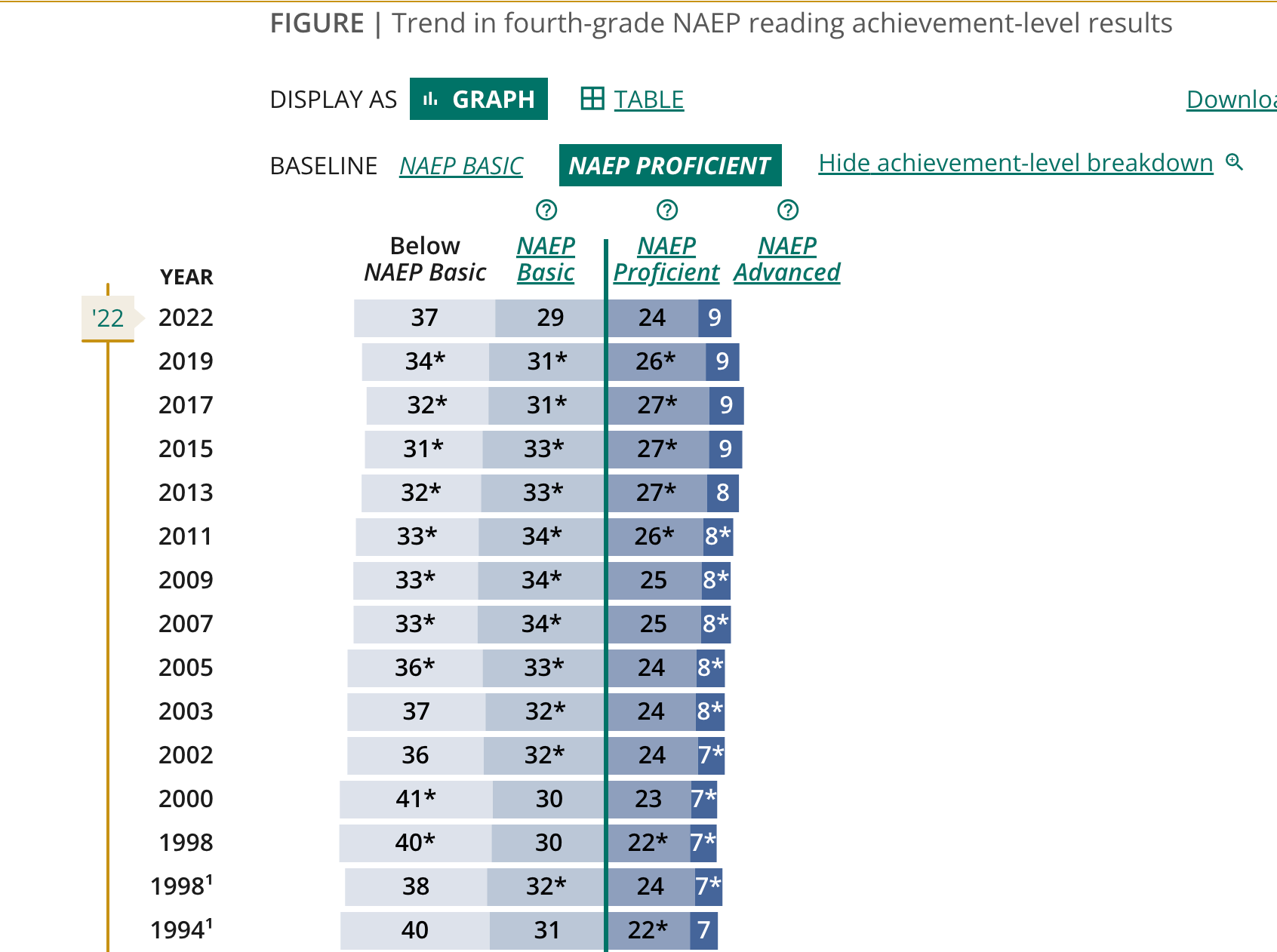
  • The national focus on public education in crisis has been NAEP testing, which has (for reading specifically) basically flat for thirty years, and the public and political discourse about student achievement has been significantly distorted by misunderstanding and misrepresentations about what NAEP achievement levels and data mean:
  • Research continues to confirm that high-stakes standardized testing is causally driven by out-of-school (OOS) factors at a rate of at least 60%, and teaching impact on those test scores are as small as 1-14%.
  • The current SOR movement has grounded claims in the use of the term “science” but depended primarily on anecdotes and citations that are not in fact scientific, such as the 90-95% rule that suggests student reading proficiency should be at 90-95% as opposed to the NAEP pattern of about 60+% (NAEP “basic” and above; see chart above).
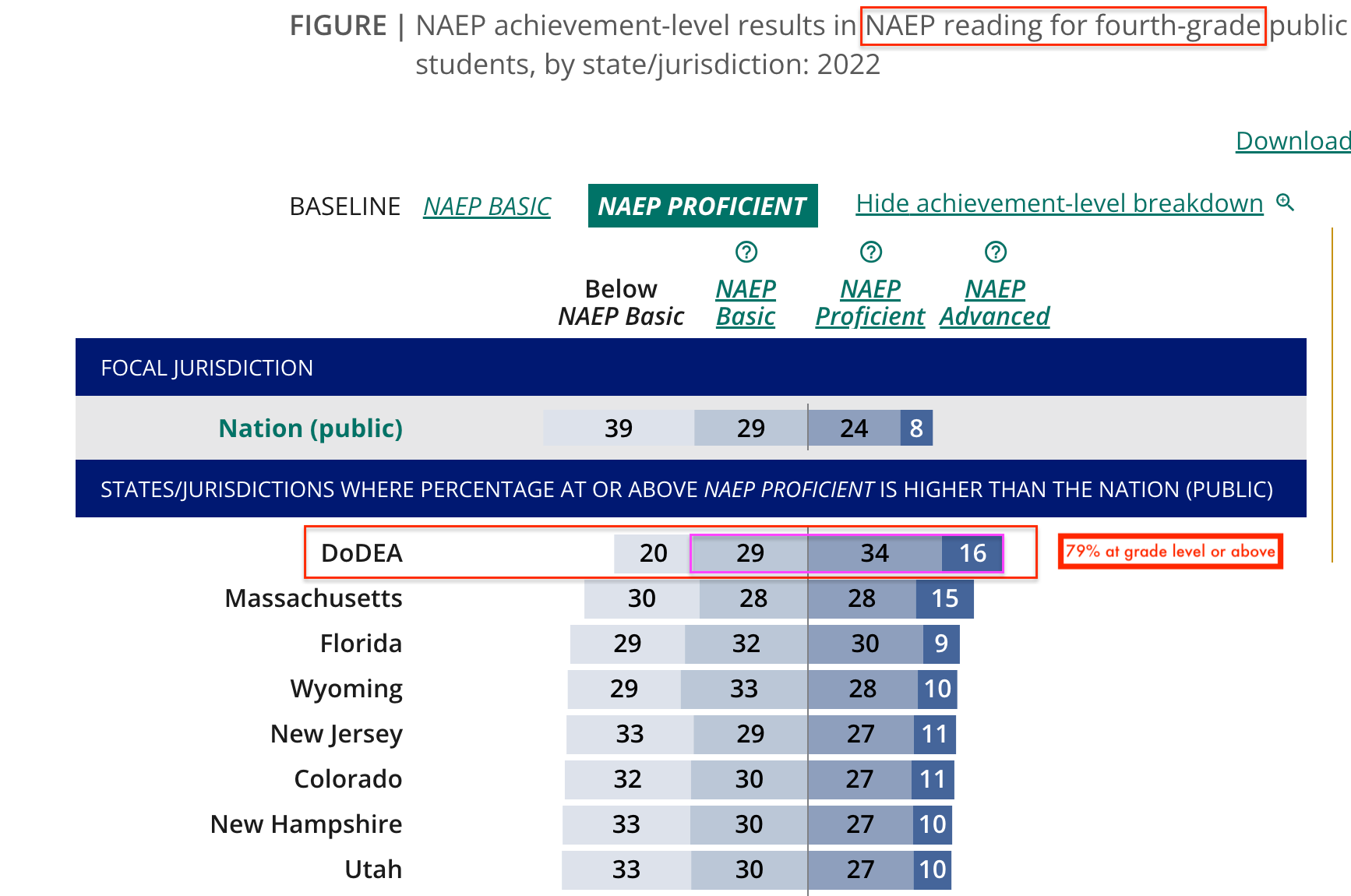
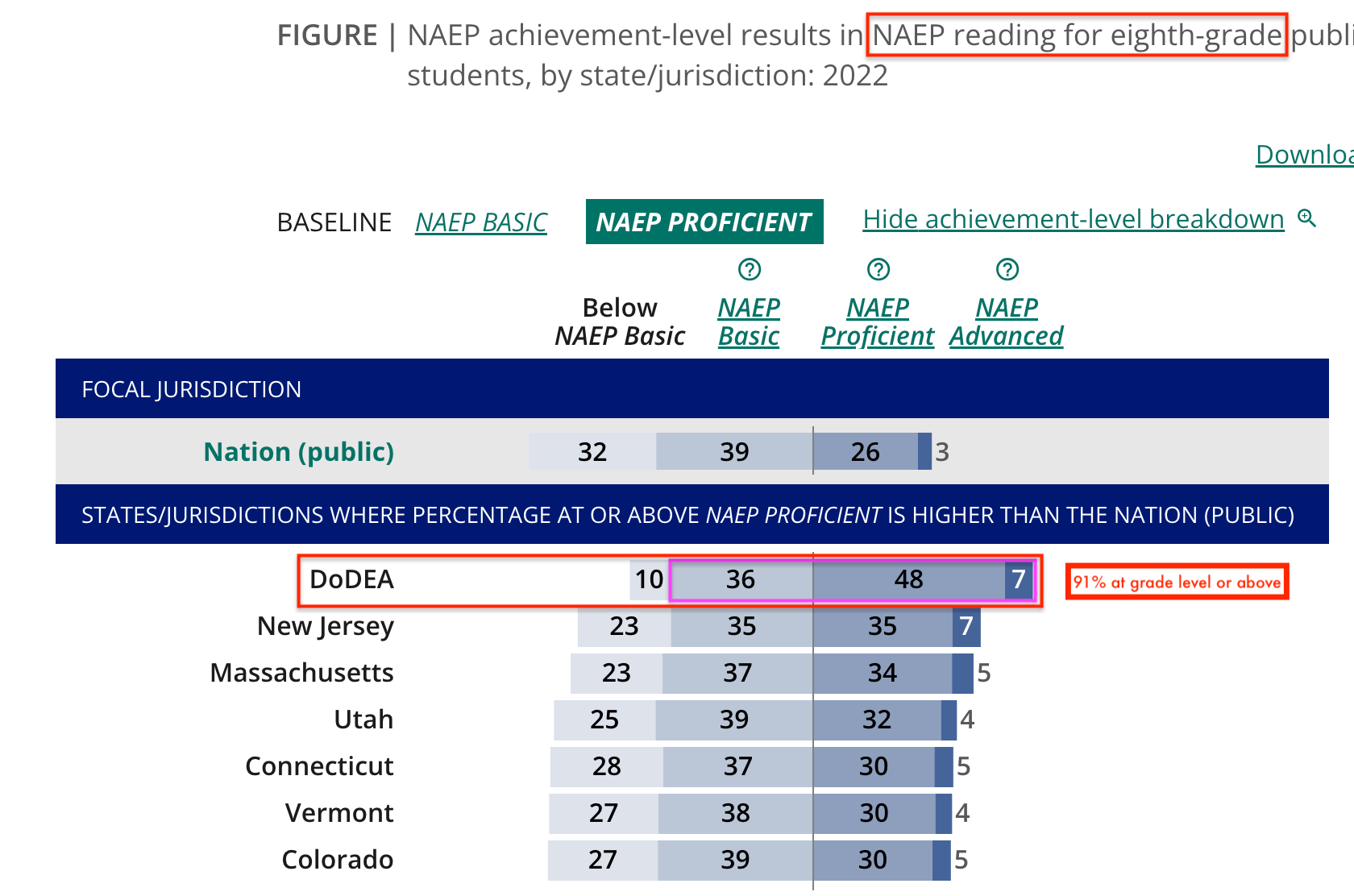
  • Media and political claims of education and reading “miracles” are not grounded in credible evidence, but do distract from evidence of exceptional student achievement (again, notably in reading on NAEP)—the Department of Defense schools:

These related series of evidence inform the following conclusions for me:

  • US public education and student reading are not in crisis, but are trapped in decades of being incredibly inequitable (marginalized and minoritized students are disproportionately under-served or mis-served).
  • Decades of intense education reform have not improved that inequitable status quo, but education and reading do, in fact, need to be reformed.
  • A new reform paradigm for education and reading must include both a new set of social reforms as well as a different approach to in-school reform, both of which must be equity and not accountability based.

What does that last point look like, focusing on reading?

I want to address OOS reform first—not as an argument that we do nothing in terms of in-school reform (which I detail next) but because until we address OOS reform, in-school reform will continue to appear to fail.

For most people in the US, this is counter-intuitive, but the following social contexts must be reformed because social policy is education policy:

  • Universal healthcare, food and home security, and stable work for parents are all essential reforms that would impact reading proficiency measurements in the US.
  • Student access to books/texts in their homes and their communities (public libraries) is an evidence-based and highly correlated mechanism for increasing student reading proficiency.

Let me emphasize here that the US has committed directly and indirectly to a “no excuses” ideology that demands students and teachers set aside the impact of OOS factors and simply do the work of learning and teaching. This is not only a self-defeating ideology but also a dehumanizing ideology.

The people who are most likely to advocate “no excuses” for other people do not live by that dictum themselves.

Acknowledging poverty and inequity is not using that as an excuse to do nothing but a call to address the lives of students and teachers so that learning and teaching can be reformed in robust and important ways.

Now, the sort of reading reform we refuse to choose must include the following:

  • Stop the reading program merry-go-round. Reading programs have not failed and reading programs will not save reading proficiency. We must shift from demanding that teachers implement reading programs with fidelity and toward making it possible for teachers to teach students to read with fidelity to every students’ strengths and needs.
  • Set aside the trivial debates over reading ideologies and instructional practices. Similar to the bullet above, there is no evidence that any ideology or practice is singularly or pervasively failing students or would better serve students. This aspect of reading reform has always been about the adults and not the students.
  • Focus on learning and teaching conditions in terms of equity. What would better insure teachers the conditions necessary to serve individual student needs? Access to courses, teacher assignments, class sizes/student-teacher ratios—these are learning and teaching conditions that are currently inequitable and must be reformed. (Again, learning and teaching conditions are indirectly improved by addressing OOS factors.)
  • Reform standardized testing of reading at the national and state levels. NAEP needs to be reformed to address misleading achievement levels, and the nation needs a uniform set of standards for age-level reading proficiency. Shifting from grade-level to age-level removes the incentive for harmful practices such as grade retention, and a standard age-level proficiency allows for more accurate assessments of success or weaknesses across the US. State-level reading assessment must use those uniform achievement levels and should be reformed to provide instructional support for teachers and not simply label and sort students.
  • Address student access to books/texts in their classrooms and libraries.

I have been advocating for this different approach for many years and remain skeptical that the US will make this shift.

My experience is that many people force my work into the paradigm I am rejecting (I don’t endorse or promote reading programs, reading ideology, or instructional practices) because there is a powerful ideological reason we have remained mired in the same reform cycle for decades.

Education/reading reform as industry is American as apple pie.

We seem fatally addicted to “crisis” and “miracle” rhetoric as well as making claims about education and reading that are grounded in beliefs, not evidence (see my opening evidence-based conditions).

As a consequence, the media and political leaders perpetuate a false story about the Mississippi “miracle” while almost entirely ignoring the valid success of DoDEA schools—the former appears to prove the bootstrapping myth, the latter concedes the power of systemic forces on individual behavior. And ironically, the empirical evidence only supports the latter.

The sort of reform I am advocating isn’t appealing to the market or political power structures; the sort of reform I am advocating isn’t very sexy; the sort of reform I am advocating resists American mythology.

Regretfully, the issue is not whether or not we make sincere efforts to reform reading in the US. The issue is that we are reforming with ideological blinders on, adults rearranging chairs on the deck of the Titanic to prove they are right and students be damned.