I have lived some thirty years on this planet, and I have yet to hear the first syllable of valuable or even earnest advice from my seniors. They have told me nothing, and probably cannot tell me anything to the purpose. Here is life, an experiment to a great extent untried by me; but it does not avail me that they have tried it. If I have any experience which I think valuable, I am sure to reflect that this my Mentors said nothing about.
No institution has invited me to be the speaker at graduation, and none is ever likely to do so.
But I feel compelled to offer this speech to gradates. So in the spirit of Kurt Vonnegut—great American novelist who knew how to give a graduation speech—I’ll start by telling you exactly what I want you to learn from this speech: Don’t listen to graduation speakers.
Now that I have the main point out of the way, I want to share why I feel compelled to offer this speech to graduates, a speech I will never give, and I have two reasons:
So my mother volunteered at my school — helping out every day in the front office, making sure our teachers were doing their jobs, holding their feet to the fire if she thought they were falling short. I’d walk by the office and there she’d be. (Laughter.) I’d leave class to go to the bathroom, there she’d be again, roaming the halls, looking in the classrooms. And of course, as a kid, I have to say, that was a bit mortifying, having your mother at school all the time.
But looking back, I have no doubt that my classmates and I got a better education because she was looking over those teachers’ shoulders. (Applause.) You see, my mom was not a teacher or a principal or a school board member. But when it came to education, she had that hunger. So she believed that our education was very much her business.
Next is the part I opened by asking you to ignore—the part where I offer what I learned from my parents and how that differs greatly from the image Michelle Obama created about teachers who needed their feet held to the fire when they were falling short.
I want to focus on two lessons from my parents.
First, my father lived by a creed he repeated often to me: Do as I say and not as I do.
And this lesson is not what my father intended, but it taught me that adults often are hypocritical, especially in their interactions with children and young people (the same adults who implore children to work hard and be nice, do neither themselves). So the lesson I learned—don’t be a hypocrite—is one basis for my speech’s main thesis: Don’t listen to graduation speakers.
They are apt, I have found, to offer my father’s advice (Do as I say and not as I do), thinly veiled behind a number of rhetorical strategies that the speakers themselves likely did not write.
Second, like Michelle Obama, I learned powerful lessons about teachers and education from my parents. But my parents impressed upon me that teachers deserved my unwavering respect and that teaching was a noble thing for any person to do.
If my parents had concerns about a teacher, that was never uttered in my presence, and if I ever crossed any lines of improper behavior or shoddy work as a student, my parents assured my teachers that would change and that the teachers had my parents’ full support in seeing that I never stumbled again.
The result of this second lesson—one quite distinct from the picture Michelle Obama painted about teachers? I have been a teacher for 31 years.
My parents are very proud of me for having dedicated my life to a noble profession.
They do not see me as someone who needs my feet held to the fire, as someone who must be watched because I am likely to fall short.
I am also proud to call myself a teacher.
Now, here toward the end, I want to include what all graduation speakers are expected to offer, advice.
I could have spent my career so far making more money than I have as a teacher, but my profession is a profession of service and the benefits of dedicating myself to that service is more than enough to counterbalance the money I have not earned.
So I am telling you without an ounce of hypocrisy or without the usual lip-service that accompanies this advice in the U.S.: Dedicate your life to something that matters to you because you have but one life and the pursuit of money and things will always prove hollow in the long run if those pursuits keep you from the things that matter.
In the off chance that you didn’t take the paradoxical advice of this speech, I must end in the only way I can in full sincerity, leading you again to the world of Kurt Vonnegurt.
Go over to her shack, I guess. Sprinkles some water on the babies, say, “Hello, babies. Welcome to Earth. It’s hot in the summer and cold in the winter. It’s round and wet and crowded. At the outside, babies, you’ve got about a hundred years here. There’s only one rule that I know of, babies—:
“God damn it, you’ve got to be kind.” (p. 129)
The adult world is filled with abundant mean-spirited hypocrisy, and you can certainly do better.
Kurt Vonnegut’s Cat’s Cradle and Tennessee Williams’s Cat on a Hot Tin Roof may seem at first blush to share only the use of “cat” in their titles, but both works are masterful examinations of something central to the human condition: the lie.
Mendacity is the darkest of lies because it corrupts and ultimately destroys relationships and even lives. For Big Daddy, mendacity is inevitable, central to the human condition: “I’ve lived with mendacity!—Why can’t you live with it? Hell, you got to live with it, there’s nothing else to live with except mendacity, is there?”
While Vonnegut’s novel is also dark—and typically satirical—foma is offered as harmless lies, as Julian Castle explains to the narrator:
“Well, when it became evident that no governmental or economic reform was going to make the people much less miserable, the religion became the one real instrument of hope. Truth was the enemy of the people, because the truth was so terrible, so Bokonon made it his business to provide the people with better and better lies.” (p. 172)
Although different consequences result from the mendacity of Cat on a Hot Tin Roof and the foma of Cat’s Cradle, all lies share one important characteristic: They are almost impossible to confront, and once confronted, they create a great deal of pain.
As a parent, I came face to face with letting the cat out of the bag when my daughter first unmasked the foma of the Tooth Fairy, and then connected that realization with Santa Claus. After I confessed to the truth—trying as I did to make a case about “harmless lies”—my daughter cut right to the heart of the matter, asking, “Why did y’all lie to me?”
The thinnest margins between mendacity and foma, I think, are found in our cultural myths—the fatal flaw of confusing the ideals we aspire to as a people with conditions already achieved. Many of those aspirations have tipped into mendacity, poisoning the possibility of those ideals—especially in the foundational promises of public institutions.
Here, then, are those ideals that could have served us well as aspiration, but now work as mendacity and thus against our best intensions:
Capitalism and choice. The realization is now becoming hard to ignore, that capitalism (the free market) is incompatible with equity (see, for example, Thomas Piketty). As well, choice as a concept central to freedom is far more complicated than expressed in our public discourse. Both capitalism and choice have worked against cultural aspirations for equity, but those failures may be better explained by the reason they have failed: idealizing capitalism and choice while failing to commit fully to the power of the Commons to establish the context within which capitalism and choice could serve equity well.
Education as Key to Equity. As misleading as claims about the U.S. being a meritocracy (or that we are a post-racial country) are assertions that education is the one true way to overcome social ills and how any individual can lift her/himself out of poverty. However, education has not and does not, in fact, change society, rarely lifts people out of the circumstances of their births, and serves as a marker for privilege (thus creates the illusion that education is a force for change)—as Reardon explains:
Here’s a fact that may not surprise you: the children of the rich perform better in school, on average, than children from middle-class or poor families. Students growing up in richer families have better grades and higher standardized test scores, on average, than poorer students; they also have higher rates of participation in extracurricular activities and school leadership positions, higher graduation rates and higher rates of college enrollment and completion.
Whether you think it deeply unjust, lamentable but inevitable, or obvious and unproblematic, this is hardly news. It is true in most societies and has been true in the United States for at least as long as we have thought to ask the question and had sufficient data to verify the answer.
What is news is that in the United States over the last few decades these differences in educational success between high- and lower-income students have grown substantially….
Meanwhile, not only are the children of the rich doing better in school than even the children of the middle class, but the changing economy means that school success is increasingly necessary to future economic success, a worrisome mutual reinforcement of trends that is making our society more socially and economically immobile.
Education Must Be Reformed. One key to seeing the mendacity of cultural claims is recognizing how often those claims are contradictory. Many who champion the idealized and misleading belief that education is central to social and personal achievement also have historically and currently declared education a failure, concluding that education must be reformed. That reform is monolithic: Greater and greater accountability built on new standards and new testing. The concept of “having high standards,” however, proves to be as misleading as claims of the U.S. being a meritocracy because thirty years of standards-based education reform have revealed there is no correlation between the existence or quality of standards and student achievement. As well, throughout more than 60 years of lamenting international test score rankings of the U.S., we also have no evidence of a correlation between those international rankings and any country’s economic robustness or competitiveness.
When my daughter allowed the evidence to lead her to a conclusion that made her at least uncomfortable if not disillusioned, she had to begin to re-evaluating her perception of the world, a perception that included the nature of truth and the role of her parents in her navigating that world.
That may sound dramatic about a conversation including the Tooth Fairy, but for a child, the intentions of foma have the same stinging consequences as the cynicism of mendacity. For adults, it seems, burying ourselves in the opiate of foma (Aldous Huxley’s soma) allows us to ignore the bitter pill of mendacity.
As aspirations, the bulleted concepts above remain important for a free people, but as mendacity, they have and will continue to insure that inequity cannot be achieved.
Many readers miss the powerful theme of optimism that runs through Vonnegut’s works; he maintains a genuine and compelling hope among the ruins for the capacity of humans to be kind. The bitterness and fatalism of Big Daddy, however, seem for now a more accurate assessment of the human condition in 2014.
More difficult to confront than either mendacity or foma, it appears, is the hard truth that the human pursuit of equity must come before merit can matter and that in order to achieve that possibility, the human condition must commit to a spirit of community and collaboration, not competition.
Regretfully, most in power are apt to continue to not let that cat out of the bag.
—
[1] The film adaptation of the play has some shifts in the wording and transposing of character’s lines, but the film is iconic as pop culture so I include a clip from that although I use lines from the play in the quotes.
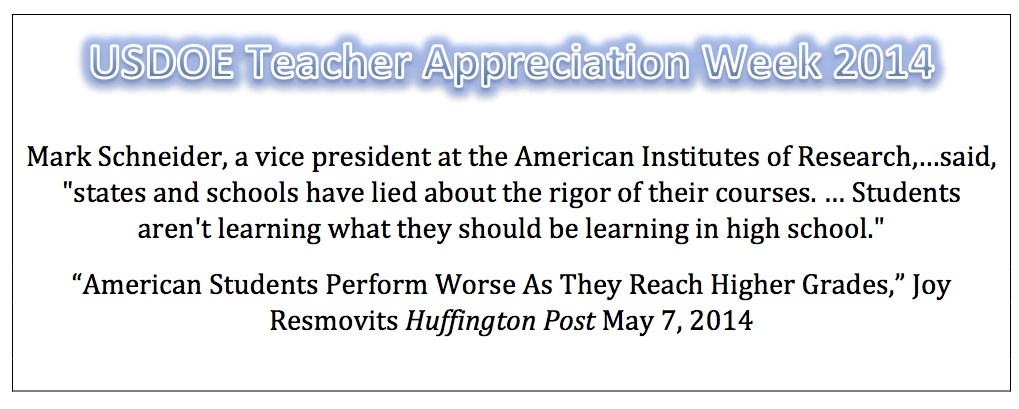
In fact, the U.S. Department of Education has just released a hot-off-the-press bumper sticker that celebrates Teacher Appreciation Week 2014 by acknowledging recent NAEP data:
Well, the claim made above by Schneider (“a vice president at the American Institutes of Research who previously led the government arm that administered NAEP”)—a truly ugly claim about education and teachers that appears to have been accepted without any request for evidence (Evidence? Secretary Duncan, You Can’t Handle the Evidence).
U.S. Secretary of Education Arne Duncan said in a statement about the results, “We project that our nation’s public schools will become majority-minority this fall—making it even more urgent to put renewed attention into the academic rigor and equity of course offerings and into efforts to redesign high schools. We must reject educational stagnation in our high schools, and as [a] nation, we must do better for all students, especially for African-American and Latino students.”
Amongst the ugliness and baseless pontificating by political leaders are absent some key points that the media will fail (again) to uncover:
NAEP data are released and pronouncements made, but no one really knows the cause of the data concerns. Why scores appear stagnant and why racial/socioeconomic gaps persist are often complex (although a huge and evidence-based source of both is likely inequity and poverty). The initial reactions to NAEP this time in EdWeek and HuffPo are overwhelmingly speculation by people with political agendas. If we are genuinely interested in people who are likely telling lies, it appears we may want to look at the people cited in these articles.
“Achievement gap” is a misnomer for “opportunity gaps,” and using standardized tests to measure and examine that gap is inherently flawed since standardized testing remains biased by race, class, and gender; and thus, the tests themselves not only measure but create the gaps. Furthermore, for any gap to close, identified populations of students would need to be treated differently, but the current policy is a common core of what students experience in schools. And another dirty little secret is that the current era of accountability has damned high-poverty and minority students to test-prep course work that in fact asks less of them (thus, it is not “states and schools” that are telling lies, but politicians who shape accountability policy who are in fact telling lies).
Throughout the 20th and into the 21st centuries, we have found no correlation between how U.S. students do on test comparisons (among states or internationally) and claimed goals such as international competitiveness or the robustness of the U.S economy. None. And while we are at it, over the last three decades of accountability, we have found no correlation between the existence or quality of standards and measurable student outcomes. None. Again, it is a political lie to continue to cry “crisis” over test scores. A lie.
While I remain certain that accountability built on standards and high-stakes testing is a fundamental flaw in education reform, political leadership and the media are not doing us any favors either. This latest “high school achievement crisis” based on a rush to misread NAEP data is but more of the same—lamentably so as we certainly could do a better job even within the flawed test-based culture of U.S. education, as Matthew Di Carlo has outlined.
Childhood is steeped in a series of lies—what Kurt Vonnegut has labeled “foma,” although many of these lies are not so harmless: the Easter bunny, Santa Claus, work hard and be nice.
But one truism from our youths must be accepted as fact: Action speaks louder than words.
If we apply that to the USDOE, then we are likely to recognize just who is telling lies and about what:
Lie: U.S. schools, teachers, and students are failing because of low standards and expectations.
Lie: New standards and new tests will save public schools.
Lie: State X is worse than State Y because NAEP (or SAT) scores say so; the U.S. is falling behind Country X because PISA scores say so.
Lie: Poverty is not destiny.
Lie: Arne Duncan (or Bill Gates or Michelle Rhee) knows what he is talking about.
Lie: Education reform is the Civil Rights issue of our time.
Lie: U.S. education is struggling because of “bad” teachers who are too hard to fire.
When Mary Catherine Bradshaw, a teacher since 1984 in Nashville, TN, announced her retirement from public schools, Bradshaw pointed her finger at one major reason, standardized testing:
[S]he says standardized testing is the reason….
Testing, she said, has taken away from instructional time and taken the joy out of learning.
Much has changed, she said, since she took her first job as a teacher at Hillsboro in 1984 when she said she was attracted to its diversity and commitment to academic reputation.
“There was more of a focus on the whole student, the joy of learning, building a community and finding one’s own passion in the midst of the K-12 experience,” she said.
“Now, with the focus on testing, data collection and closing a too narrowly defined gap among learners, I have found myself ready to retire from public education.”
Now nearly 100 leading educational figures from around the world have issued an unprecedented challenge to Pisa – and what they call “the negative consequences” of its rankings – in a letter to its director, Andreas Schleicher….
“Education policy across the world is being driven by the single aim of pushing up national performance levels on Pisa,” says one signatory, Stephen Ball, professor at London university’s Institute of Education. “It’s having a tremendously distorting effect, right down to the level of classroom teaching.” Another signatory, Sally Tomlinson, research fellow at Oxford university’s education department, says that, though the Pisa league tables appear to be scientifically based, “you really can’t compare a country the size of Liechtenstein with one the size of China and nor can you compare education systems that developed over the years in different political, social and cultural contexts”.
The signatories are particularly concerned about the UK, the US and other countries imitating schools in Asian countries that come high in the Pisa rankings. They are suspicious of Shanghai’s success. “Shanghai’s approach is an incredibly strategic one,” says Ball. “Their students practise the tests. It’s difficult to see what their maths teachers can say to ours except ‘teach to the test’.”
While international rankings based on test scores have influenced public perception of U.S. public education for at least 60+ years (see Hyman Rickover’s books lamenting U.S. rankings, for example), state rankings based on NAEP and SAT/ACT scores have also been central to perception as well as policy, especially since the early 1980s.
As I have addressed often about the SAT (see HERE and HERE), even when a comparison of states appears fair and accurate—South Carolina with Mississippi, for example, since the states share a similar high-poverty demographics of students—the reality is far more complex: MS has a higher SAT average score than SC because the test-taking populations of students are significantly different despite the overall student populations being similar:
Two Southern states, Mississippi and South Carolina, share both a long history of high poverty rates (Mississippi at over 30% and SC at over 25%) and reputations for poor schools systems. Yet, when we compare the SAT scores (pdf) from Mississippi in 2010 (CR 566, M 548, W 552 for a 1,666 total) to SAT scores in SC (CR 484, 495, 468 for a 1,447 total), we may be compelled to charge that Mississippi has overcome a higher poverty rate than South Carolina to achieve, on average, a score 219 points higher.
This conclusion, based on a “few data points”, is factually accurate, but ultimately misleading once we add just one more data point: the percentage of students taking the exam. Just 3% of Mississippi seniors took the exam, compared to 66% in South Carolina. A fact of statistics tells us that SC’s larger percentage taking the exam is much closer to the normal distribution of the all seniors in that state, thus the average must be lower than a uniquely elite population, such as in Mississippi. Here, the statistics determined by the populations taking the exam trump the raw data of test averages, even when placed in the context of poverty. (The truth about failure in US schools)
Even if the open letter about PISA prompts reform by the OECD, we have evidence that the problem will persist. For example, The College Board struggles with both the statistical complexity of SAT data (see here about the recentering) and the misleading use of SAT data to rank states:
Educators, the media and others should:
8.1 Not rank or rate teachers, educational institutions, districts or states solely on aggregate scores derived from tests that are intended primarily as a measure of individual students. Do not use aggregate scores as the single measure to rank or rate teachers, educational institutions, districts, or states.
The open letter about PISA implores, “Slow down the testing juggernaut,” adding:
OECD’s narrow focus on standardised testing risks turning learning into drudgery and killing the joy of learning. As Pisa has led many governments into an international competition for higher test scores, OECD has assumed the power to shape education policy around the world, with no debate about the necessity or limitations of OECD’s goals. We are deeply concerned that measuring a great diversity of educational traditions and cultures using a single, narrow, biased yardstick could, in the end, do irreparable harm to our schools and our students.
Once we apply the brakes, we must then take a close look at the fundamental policy errors—high-stakes standardized testing, labeling, sorting, and ranking—and then abandon those practices for alternatives that address inequity both outside and inside schools and that honor the essential dignity and humanity of students and their teachers.
The term “digital divide” is commonly used in education as a subset of the “achievement gap”—representing the inequity between impoverished and affluent students. Both terms, however, tend to keep the focus on observable or measurable outcomes, and thus, distract attention away from the inequity of opportunity that is likely the foundational source of those outcomes.
Currently, South Carolina appears poised to, yet again, make another standards shift—dumping the Common Core the state adopted just a few years ago—but in the coverage of that continuing debate, two points are worth highlighting: (1) “Computer testing allows for a better assessment of both students’ abilities and teachers’ effectiveness….,” and (2) “Democrats say the bill forces the Legislature to spend money on technology in classrooms….,” including “[b]oth the House and Senate budget proposals would spend about $30 million on technology next school year, focusing on rural districts.”
As I have examined before, the educational advantages of technology are at best mixed, technology creates equity concerns as well as outcome disparities (efforts to close the digital divide in schools often increase the achievement gap), and investments in technology are by the nature of technology an endless commitment of precious taxpayers’ dollars.
Capitalism and consumerism are hidden in plain sight in the U.S. Consumerism has a symbiotic relationship with technology in the broader economy and a related symbiotic relationship among technology and the perpetually changing standards movement in education.
In the context of consumerism, then, that technology is perpetually upgrading and that standards (and related high-stakes testing) are perpetually changing are warranted and even necessary: New replaces old, to be replaced by the soon-to-come newer.
But when we shift the context to a pursuit of equity and teaching/learning, technology as a constantly moving (and therefore never finished) investment is exposed as a different sort of “digital divide”—the gap between the technology we have accumulated now and the technology upgrades we have committed to in the future (and mostly a commitment based on new without any mechanism for determining better).
Let me offer here a few concerns about the technology gold rush—and argue that we should curtail significantly most of the technology investments being promoted for public schools because those investments are not fiscally or educationally sound:
Cutting-edge technology has a market-inflated price tag that is fiscally irresponsible for tax-funded investments, especially in high-poverty schools where funds should be spent on greater priorities related to inequity.
Technology often inhibits student learning since students are apt to abdicate their own understanding to the (perceived) efficiency of the technology. For example, students using bibliography generating programs (such as NoodleBib) consistently submit work with garbled bibliographies and absolutely no sense of citation format; they also are often angry at me and technology broadly once they are told the bibliographies are formatted improperly.
Technology often encourages teachers/professors to abdicate their roles to the (perceived) effectiveness of technology. For example, many professors using Turnitin to monitor plagiarism are apt not to offer students instruction in proper citation and then simply punish students once the program designates the student work as plagiarized.
Technology requires additional time for learning the technology (and then learning the upgrades)—time better spent on the primary learning experiences themselves.
Computer-based testing may be a certain kind of efficient since students receive immediate feedback and computer programs can adapt questions to students as they answer, but neither of these advantages are necessarily advantages in terms of good pedagogy or assessment. Efficient? Yes. But efficiency doesn’t insure more important goals.
In many cases, advocacy for increasing technology as well as the amount of programs, vendors, and hardware (all involving immediate and recurring investments of funds) is driven by a consumer mindset and not a pedagogical grounding. I have seen large and complex systems adopted that offer little to no advantage over more readily available and cheaper uses of technology; I can and do use a word processor program in conjunction with email in ways that are just as effective as more complex and expensive programs. As Perelam notes:
Whatever benefit current computer technology can provide emerging writers is already embodied in imperfect but useful word processors. Conversations with colleagues at MIT who know much more than I do about artificial intelligence has led me to Perelman’s Conjecture: People’s belief in the current adequacy of Automated Essay Scoring is proportional to the square of their intellectual distance from people who actually know what they are talking about.
Technology-for-technology’s sake is certainly central to the consumer economy in the U.S. and the world. It makes some simplistic economic sense that iPhones are in perpetual flux so that grabbing the next iPhone contributes in some perverse way to a consumer economy.
Education, however, both as a field and as a public institution should be (must be) shielded from that inefficient and ineffective digital divide—that gap between the technology we have now and how the technology we could have makes the current technology undesirable.
Especially if you are in public education and especially if you have been in the field 10 or 20 years, I urge you to take a casual accounting of the hardware and software scattered through your school and district that sit unused. Now consider the urgency and promise associated with all that when they were purchased.
It’s fool’s gold, in many ways, and the technology we must have to implement next-generation tests today will be in the same closed storage closets with the LaserDisks tomorrow.
The technology arms race benefits tech vendors, but not students, teachers, education, or society.
Computer-graded essays will not improve the teaching of writing and computer-based high-stakes testing will not enhance student learning or teacher quality.
But falling prey to calls for both will line someone’s pockets needlessly with tax dollars.
Technology has its place in education, of course, but currently, the rush to embrace technology is greatly distorted, driven by an equally misguided commitment to ever-changing standards and high-stakes tests.
Investing in new technology while children are experiencing food insecurity—as just one example—is inexcusable, especially when we have three decades of accountability, standards, testing, and technology investment that have proven impotent to address the equity hurdles facing schools and society.
This is my 53rd year of living in South Carolina, the totality of my life.
This is my 31st year as an educator in SC—18 years as a high school English teacher and 13 years now in higher education.
My teaching career, coincidentally, began the exact year SC officially stepped into the accountability/standards/testing arms race that grew out of the early 1980s.
Over the past 30 years, SC has created, implemented, revised, and changed a nearly mind-boggling array of standards and tests:
SC Frameworks
SC state standards (revised multiple times)
BSAP and exit exams
PACT
PASS
HSAP and EOC (end-of-course) tests
Common Core and high-stakes tests TBD
Two concurrent and competing sets of school report cards (the long-standing state version and the federal letter-grade based version)
That’s right, before SC schools, teachers, and students can actually make the transition from the repeatedly revised (and obviously failed) standards-and-tests Merry-Go-Round of state-based accountability to the all-mighty Common Core gravy train of world-class and college-ready standards and next-generation high-stakes tests [insert trumpet]:
The Senate on Thursday unanimously approved a bill that replaces Common Core education standards with those developed in South Carolina by the 2015-16 school year.
The bill, which passed 42-0, is a compromise of legislation that initially sought to repeal the math and reading standards that have been rolled out in classrooms statewide since their adoption by two state boards in 2010. Testing aligned to those standards must start next year, using new tests that assess college and career readiness, or the state will lose its waiver from the all-or-nothing provisions of the federal No Child Left Behind law.
But the state won’t be able to use tests South Carolina officials helped create with 21 other states. A bid must go out by September for their replacement.
As ridiculous and muddled as that all is (and I think “heaping stumbling-bumbling mess of ineptitude” may be understating the level of ridiculousness), Seanna Adcox’s coverage of this likely next-move for SC is chock-full of even more ineptitude so let me counts the ways:
“‘We’re back on track,’ said Sen. Mike Fair, R-Greenville.” Fair has built a political career on his yearly efforts to dismantle SC’s science standards by inserting an endless series of not-so-clever Creationism edits to the evolution elements of those standards. [HINT: He may not be the best authority on SC’s decisions about standards.]
“Democrats say the bill forces the Legislature to spend money on technology in classrooms….” Ironically and sadly, SC is an equal-opportunity state in terms of political party ineptitude. SC is notorious for our Corridor of Shame, a swipe of high-poverty communities that roughly follows I-95 across the state. I will simply ask that you return to the Kids Count report on childhood opportunity and consider where tax dollars may be better spent than on technology investments for computer-based high-stakes testing that will further stigmatize the growing number of poor children of color in SC. [HINT: It ain’t on more technology that will fail and become obsolete.]
“Computer testing allows for a better assessment of both students’ abilities and teachers’ effectiveness….” And nothing like baseless and inaccurate claims to help! [HINT: Nope.]
“‘This is about maintaining control,’ said Campsen, R-Isle of Palms. ‘We shouldn’t cede our authority over children’s education to an outside process.'” See above and consider the smashing good job SC has done on its own for three decades. [HINT: That last sentence is sarcasm.]
“Both the House and Senate budget proposals would spend about $30 million on technology next school year, focusing on rural districts.” $30 million on technology. [HINT: $30 million on technology.]
Unless that technology plan includes a provision for turning the iPads purchased into food trays once they are obsolete in a few months, I would posit that this entire farce is beyond ineptitude.
And I must add: SC is not some looney example of ineptitude in the world of education reform (although we do tend to be on the outer edges of looney in many things); in fact, the series of fits and starts that constitute SC’s heaping stumbling-bumbling mess of ineptitude are being replicated all across the U.S. as political manipulation of education collides with Tea Party lunacy.
SC must step off the accountability Merry-Go-Round, but this latest effort suggests we are enjoying the circus too much to make any reasonable decisions.
At NCTE’s Connected Community, Joseph Robertshaw posed the question: What do college composition instructors want from incoming high school graduates?
The essence of this question has been at the center of my work as a teacher for over three decades—18 years as a high school English teacher in rural upstate South Carolina, two years as lead instructor for the summer institute of the Spartanburg Writing Project, and my current position that in part includes teaching writing-intensive first year seminars and a small administrative position as Faculty Director, First Year Seminars.
Let me start with a caveat about teaching with the next phase of formal education in mind.
Justifying classroom practices in the context of future educational expectations can be very dangerous because I have witnessed too many teachers implementing bad pedagogy because they justify those practices as “what students will need next year.” For example, when the SAT added the writing section in 2005, the one-draft and prompted sample essay as well as the return of isolated multiple-choice testing of writing changed classroom practices, as Thomas Newkirk warned in “The New Writing Assessments: Where Are They Leading Us?”:
[The 2005 addition of writing on the SAT] and the other state-mandated writing assessments are also intended as a message to high schools about the importance of writing instruction. It is worth asking, then, what kind of message these assessments will send. What kind of writing will they promote? (English Journal, November 2005, p. 21)
However, having an awareness and critical insight into future expectations for students does provide both teachers and their students grounding for better preparing students to be self-actualized and autonomous learners. Recognizing expectations for students as writers (even when those expectations are misguided) helps foster student empowerment so that they control their learning instead of education happening to them.
To address well what college professors expect from recent high school graduates in terms of those students as writers, we need to consider both learning experiences provided for students and the quality of student writing artifacts.
Now to the opening question.
College-bound high school students need to understand that writing is central to all disciplines—not something students do in English courses only. Many colleges have expectations that writing will be assigned and directly taught across the disciplines (for example, interdisciplinary first year seminars replacing traditional English 101/ composition courses). Thus, students need experiences with and understanding of both universal characteristics of effective writing and disciplinary conventions of effective writing (see Writing for Specific Fields).
When I was teaching high school, students often complained because I stressed the use of present tense verbs when analyzing literature and the U.S. history teacher required past tense verbs for writing about history. Those students wanted one rule.
But, students viewing writing as bound by rules is the results of classroom practices that foster that perspective. Instead, students need to understand the conventionality of writing and that those conventions are discipline- and purpose-based.
An excellent avenue to helping students move away from seeing their writing within the “one rule” context is to foster genre awareness [1] instead of genre acquisition:
GENRE ACQUISITION [is] a goal that focuses upon the students’ ability to reproduce a text type, often from a template, that is organized, or ‘staged’ in a predictable way….Using well-established pedagogies, practitioners follow a teaching/learning cycle as students are encouraged to acquire and reproduce a limited number of text types (‘genres’) that are thought to be basic to the culture (Macken-Horarik 2002).
A quite different goal is GENRE AWARENESS, which is realized in a course designed to assist students in developing the rhetorical flexibility necessary for adapting their socio-cognitive genre knowledge to ever-evolving contexts….After my many years of teaching novice tertiary students who follow familiar text templates, usually the Five Paragraph Essay, and who then fail when they confronted different types of reading and writing challenges in their college and university classrooms, I have concluded that raising genre awareness and encouraging the abilities to research and negotiate texts in academic classrooms should be the principal goals for a novice literacy curriculum (Johns 1997). (pp. 238-239)
At its core, promoting genre awareness is an alternative to setting students up for what Scheele labels “the good student trap”—students who have received high grades and praise as good students based on their ability to comply with highly structured assignments (such as answering an essay prompt, conforming to a rubric, or tapping out a five-paragraph essay).
To offer a negative to the opening question, just as art professors at the college level do not want students who have done only paint-by-number, college professors who ask students to write do not want students who can write only canned essays and students who believe “never use ‘I’” or “don’t start sentences with ‘and.’”
And here, I note, is the key quality college professors want from students in all aspects of academics (and life), including writing: Students who are purposeful, thoughtful, and autonomous. Too often the best students approach professors with “What do you want?” instead of having the background and confidence to make their own informed decisions.
As writers, then, students need ample experiences in high school with choice—choosing what texts they read and then choosing what types of writing they produce. Those choices need to be monitored and supported by the expertise of their teachers guiding them to greater and greater genre awareness grounded in the varied expectations of the disciplines: What is an Op-Ed in a newspaper and how does that differ from a Supreme Court Justice’s dissent on a ruling? What makes a poem, a poem, and how is that distinguishable from a short story? And why are there so many different citation styles?
This approach to teaching writing and increasing student agency is particularly challenging if English teachers are the primary or even sole writing teachers in a high school (teaching writing across the curriculum should be a hallmark of secondary education). But the goals noted above grounded in choice and attaining genre awareness across the disciplines do suggest English teachers must consider balancing the types of writing students produce (less literary analysis, more genre and mode/form variety) as well as moving away from teaching MLA (the citation model preferred in the humanities) only and toward raising students’ awareness of the conventionality of citing across disciplines (Why are there no citations in journalism and only hyperlinks in Web-based writing, but students have to cite for academic settings?)
Within the groundings above, then, here are some experiences that high school students need before entering college as young writers:
A balance of prompted reading and writing with choice reading and writing.
Numerous and extended experiences with writing workshop and multiple-draft essays that receive both teacher and peer feedback. Students need to expect feedback, to embrace drafting, and to know how to respond to feedback in the revision process.
Experiences with a wide range of research-based writing that incorporates a variety of citation styles (including hyperlinks as a form of citation). Students should not be encouraged to memorize citation styles or to see MLA as “the” citation style; citation is specific to disciplines and style sheets should be used when citing.
Experiences with writing beyond traditional text-only communication (images, embedded video, etc., with academic purpose).
Awareness of the larger concepts of effective writing (coherence, for example), of a sophisticated understanding of the “essay” form (beyond the five-paragraph essay and the narrow thesis sentence), and of the conventionality of grammar, mechanics, and usage (beyond seeing surface features as “rules”). I recommend Style: Lessons in Clarity and Grace(Williams and Bizup) as an effective resource for these broader and more complex approaches to writing and language.
Purposefulness, richness, and variety are the key concepts that guide me as I seek ways to prepare students for successful college writing. So for one of the initial sessions of my writing-intensive first year seminar, I ask students to brainstorm “rules” they learned in high school that they cannot do in essays, and then we unpack that list (for example, no fragments or never use “I”) to discover that many writers in fact do those taboo things. I help them begin to see that, for example, when a student’s writing is marked for a fragment, the problem is often that the student was unaware of the fragment, had not used the fragment with purpose or intent.
But we also need to confront the negatives—both what students should not do and what expectations college professors have for students that we likely would prefer they did not have.
When students have experienced mostly or almost exclusively writing for A.P. literature exams or literary analysis, they fall into bad habits, such as seeing all texts as a source of identifying literary technique. When they have had their writing mostly corrected and graded (and have not received feedback designed to prompt revision), they see writing as an act of trying to avoid making mistakes.
These, for example, are bad habits that inhibit student success in college as well as presenting to professors qualities often rewarded in high school but discouraged in college.
Another foundational exercise I do with first year students in my writing seminar is identify behaviors that students do that are unlike how people behave outside of school, and then I narrow that discussion to how do students as writers act in ways unlike how professional writers act (and concurrently, we compare “the student essay” with an “authentic essay”).
I then explain to them that my first year seminar is about learning not to act like a student anymore, but to become a writer, and specifically, to become a scholar who writes.
I believe students can begin to learn this lesson before college, as well, and I also think students must be armed with an understanding of the expectations they’ll face in college that are, to be blunt, misguided.
What do college professors want from incoming high school graduates? Too often, professors want students to already know and be able to do those things that many of us would argue are still the job of professors to teach—and in the context of writing, college professors often want students to be grammatically finished before they enter college.
There remains in higher education a narrow and misguided attitude toward surface features and “correctness.” Of course, high school teachers need to address surface features (grounded in the students’ writing), but students as writers will continue to grow in that awareness throughout college and their lives. To be direct, grammatical awareness is simply not something a human can “finish.”
Students need to develop a healthy understanding of language, but also have an awareness that many people continue to judge others based on grammar, mechanics, and usage (see Weaver’s table on status marking, pp. 112-114). Ultimately, and as a college professor myself, I would argue that college professors want students who appreciate and love learning and language, students who have had rich and varied experiences as readers and writers. Students who have confidence in their own voices and ideas along with a balancing humility that they have much left to learn are a joy to teach and are likely to thrive in college.
But I end by noting that high school teachers must not feel burdened to do everything and high school students cannot be expected to be “finished” as prerequisites for entering college. What work left to be done, I think, is a better coordination between high schools and colleges in terms of what it means to be a writer in academic settings, which, I think, is the goal both levels share.
For me, I would prefer dropping the need to ask students to set aside lessons learned about writing in high school as part of continuing in college their journey as scholars and young people who write. And above are some of they ways in which we can all make that happen.
Adaptation as Investigations: Critically Rethinking Medium, Genre, and Text
P. L. Thomas, editor
[A]s we put into practice an education that critically provokes the learner’s consciousness, we are necessarily working against myths that deform us. As we confront such myths, we also face the dominant power because those myths are nothing but the expression of this power, of its ideology. (Freire, 2005, p. 75)
Throughout the 1980s, music fans began to debate music videos as the popularity of MTV increased. Those debates often involved arguments about both the film quality of each video and whether or not the adaptation of song to video remained true to the original song.
As pop culture, music videos created a text for students to investigate media and genre as well as their own reading, re-reading, writing, and re-rewriting of the world. As Johns (2008) explains, students as both readers and writers need to gain genre awareness—in their roles as students but also in their emerging agency and autonomy. Text adaptations—multiple text versions across media and forms developing from one foundational text (see here for examples)—are ideal contexts for investigating how medium, genre, form, creator, and audience all interact to create meaning(s).
This volume seeks chapters that begin with an adaptation unit (texts across media and genres) in order to investigate medium, genre, form, reading, writing, text, and voice as elements of critical literacy. Chapter authors will be encouraged to investigate boundaries of texts and media by confronting texts such as traditional print texts, film, comics/graphic novels, songs, web-based texts, and emerging forms as they are represented in text adaptations (for example, Ray Bradbury’s Fahrenheit 451 as a traditional novel adapted into film and graphic novel).
Chapters should address the following points of emphasis:
The role of critical literacy in the broader focus on literacy in formal schooling.
The traditional assumptions about text as they are challenged and reshaped by a wide-range of media and genres.
School-based assumptions about reading and writing as they contrast with pop culture representations of reading and writing.
Traditional norms of “literary” texts as those inform and marginalize popular texts (among a wide range of media).
The tensions created when an original text is adapted or re-booted and how those multiple forms investigate “quality” texts in terms of remaining true to the original and as unique texts.
How adaptation, allusion, fan fiction, and sampling (for example) complicate traditional views of plagiarism and citation in formal academic settings (as opposed to pop culture).
How adaptation and collaborative texts (film, comics/graphic novels) confront text analysis and “ownership” of texts.
The role of the New Media (blogging, Twitter, etc.) in understanding text, reading, and writing as well as medium and genre.
Interested chapter authors are invited to submit proposals and the following information by May 31, 2014 (an initial list of contributors is needed before a contract can be issued):
300-word proposal with title.
50-75 word author(s) bio.
10 key words.
Preferred deadline for first full draft ( a final timeline for the project will be designed once proposals have been accepted).
Preliminary plans are for including about 15 chapters of 6000-7000 words. Citations will be in the most recent edition of APA.
Send proposals and any queries to paul.thomas@furman.edu.
References
Freire, P. (2005). Teachers as cultural workers: Letters to those who dare to teach (D. Macedo, D. Koike, & A. Oliveira, Trans.). Boulder, CO: Westview Press.
Johns, A M. (2008). Genre awareness for the novice academic student: An ongoing quest. Language Teaching, 41(2): 237-252.
Thomas, P. L. (in-press). Adventures in adaptation: Confronting texts in a time of standardization. In P. Paugh, T. Kress, & R. Lake, eds., Critical and new literacies: Teaching towards democracy with/in/through post-modern and popular culture texts. TBD.
Thomas, P. L. (2012, Fall). Lost in adaptation: Kurt Vonnegut’s radical humor in film and print. Studies in American Humor, 3(26), 85-101.
The role of causality in educational research needs to be questioned on the basis that education is not the same as medicine. As Biesta says: “Being a student is not an illness, just as teaching is not a cure.” (2007, p8) We should never assume that education is a “push and pull” process of simply linear causal relationships.
“Batman has officially been kicking the ass of Gotham’s villains for 75 years,” explains Ryan Kristobak, “and so to honor the Dark Knight, the Warner Bros. panel unveiled the ‘Batman Beyond’ animated short at this year’s WonderCon.”
For long-time and recent fans of Batman, however, the legends of the Dark Knight are complicated by the many versions that exist among the DC comic book and graphic novel universe, films, TV, animated series, and video games.
The Batman Myth has several foundational characteristics and common themes that are nested in the Caped Crusader’s first appearance in Detective Comics 27 in 1940: Batman’s essential nature as a detective and crime fighter, the ambiguous relationship between Batman and the Gotham police department and city officials, and the larger themes about justice that are contrasted by Batman’s vigilante tendencies.
In The Dark Knight Rises, the final installment of the film trilogy directed by Christopher Nolan and starring Christian Bale, the opening scene framing the film also highlights a central message reflecting how justice is traditionally characterized in the U.S. The mayor of Gotham and Commissioner Gordon preside over Harvey Dent Day, named for the district attorney who is killed as Two-Face in The Dark Knight:
[the Mayor is giving a speech being at hosted at Wayne Manor]
Mayor: Harvey Dent Day may not be our oldest public holiday, but we’re here tonight because it’s one of the most important. Harvey Dent’s uncompromising stand against organized crime has made Gotham a safer place than it was at the time of his death, eight years ago. This city has seen a historic turn around. No city is without crime, but this city is without organized crime because of Dent’s act gave law enforcement teeth in its fight against the mob. Now people are talking about repealing the Dent Act, and to them I say, not on my watch.
[the audience claps]
Mayor: I wanna thank the Wayne Foundation for hosting this event, and I’m told, Mr. Wayne couldn’t be here tonight. I’m sure he’s with us in spirit….
Mayor: Jim Gordon, can tell you the truth about Harvey Dent. He could…but I’ll let him tell you himself. Commissioner Gordon!
[the audience claps as Gordon makes his way to the stand, Gordon looks down at his prepared speech and says to himself as he remembers the real truth of what happened to Dent]
Commissioner Gordon: The truth…
[he addresses the audience]
Commissioner Gordon: I have a speech telling the truth about Harvey Dent. Maybe the time isn’t right.
[he puts the speech away in his jacket pocket]
Commissioner Gordon: Maybe right now, all you need to know is that there are one thousand inmates in Blackgate Prison as the direct result of the Dent Act. These are violent criminals, essential cogs in the organized crime machine. Maybe, for now, all I should say about the death of Harvey Dent is this; it has not been for nothing. (transcript found here)
Justice in Nolan’s Gotham reflects the central elements of justice found in the U.S.: the right laws, the right people to enforce those laws, and the evidence those laws are working represented by a growing prison population.
Reagan Era Mass Incarceration and Education Accountability
As I have detailed in Education Reform in the New Jim Crow Era, the 1980s and the Reagan administration planted the seeds of both an era of mass incarceration, labeled the New Jim Crow by Michelle Alexander, and the high-stakes accountability era in public education.
The most troubling aspects of both mass incarceration and high-stakes education accountability are that the policies have created, not ended, the claimed problems they were designed to address.
Over the past thirty years, the criminal justice system in the U.S. has filled prisons with a disproportionate number of African American men as part of our most recent war on drugs—despite whites and African Americans using recreational drugs at the same rates.
Prohibition turned law-abiding citizens into criminals, made a mockery of the justice system, caused illicit drinking to seem glamorous and fun, encouraged neighborhood gangs to become national crime syndicates, permitted government officials to bend and sometimes even break the law, and fostered cynicism and hypocrisy that corroded the social contract all across the country. With Prohibition in place, but ineffectively enforced, one observer noted, America had hardly freed itself from the scourge of alcohol abuse – instead, the “drys” had their law, while the “wets” had their liquor.
The recent legalization of marijuana suggests a possible social recognition that traditional views of the right laws enforced by the right people and resulting in the right people sitting in prison is the wrong formula for either justice or a peaceful and equitable society.
Along with a growing number of states legalizing or decriminalizing marijuana is a concurrent discussion of releasing prior drug offenders from prison, again suggesting a social admission that the laws we establish create criminals, but rarely deter crime.
Seeking justice must not be separated from seeking equity. If the shift in how people in the U.S. view marijuana signals anything, I think, it shows a broader concern for equity: Just as changing inequitable laws surrounding powder cocaine and crack came to represent an inequitable criminal justice system, legalizing marijuana is yet another effort to move the pursuit of justice in the U.S. toward a pursuit of equity.
Legalizing Marijuana: A Lesson for Changing Course in Education Reform
The war on drugs and the resulting mass incarceration have proven to be the wrong policies for achieving justice or equity in the U.S. Directly, we know that mass incarceration negatively impacts children (see Holly Yettick and Children of the Prison Boom).
But the parallel era of high-stakes education accountability shares the central flaws now being recognized in mass incarceration: high-stakes accountability creates failure in schools, teachers, and students (see FairTest’s Reports: High Stakes Testing Hurts Education).
Under Barack Obama and Secretary of Education Arne Duncan, federal and state education policies have remained focused on identifying the right standards and the right tests, most recently Common Core standards and so-called “next generation” tests. Unlike the move toward legalizing marijuana, education reform remains trapped and unable to see the Bitter Lessons from Chasing Better Tests, as Duncan proclaimed in 2009:
Until states develop better assessments—which we will support and fund through Race to the Top—we must rely on standardized tests to monitor progress—but this is an important area for reform and an important conversation to have.
Debating the quality of Common Core and the related tests, however, are the wrong arguments because high-stakes accountability is the wrong policy paradigm just as the war on drugs and mass incarceration are the wrong policies for justice.
Adopting and implementing Common Core as yet another round of seeking the right standards and the right tests will not work. We have three decades of evidence on that approach revealing that there is no correlation between the existence or quality of standards and student achievement (see Mathis, 2012).
The war on drugs has proven to be finding ourselves in a hole and continuing to dig. Legalizing marijuana is dropping the shovel and choosing instead to acknowledge that failure and to try another approach, one more rightly attuned to equity.
This is a lesson high-stakes accountability advocates need to learn.
Common Core and the related high-stakes tests are the wrong approach to equity and high-quality education; they are finding ourselves in a hole we created and continuing to dig.
As legalizing marijuana signals a possible turn to the end of mass incarceration, we need also to end the era of high-stakes accountability in education.
“This country was founded on the idea of concentrating wealth in the hands of a few white men,” Mychal Denzel Smith asserts in “We Built This Country on Inequality,” adding, “That that persists today isn’t a flaw in the design. Everything is working as the founders intended.”
Smith’s claim has two parts that challenge the Great American Myth of meritocracy: those two parts being then and now.
At the turn of the twentieth century, from 1899 until 1908, the buildings that constitute Clemson University in South Carolina were built by convict labor, as explained in Lyn Riddle’s report detailing the research of Clemson assistant professor of English Rhondda Thomas:
So far, [Thomas] has documented the names of 572 men, all but 29 of them African Americans.
They made a million bricks to build Tillman Hall. They built Hardin Hall, the oldest classroom building, and Trustee House, home to the first chemistry professor. They cleared the land and built dikes. The oldest was 67, the youngest 12.
“They made it possible for South Carolina to get back on its feet, to educate young men to make a contribution,” Thomas said.
They were but a step away from the sharecroppers and slaves who preceded them, Thomas said. Some likely were former slaves and most certainly the sons of former slaves.
“Their labor was valued but not their lives,” she said. “It is carrying on the slavery institution.”
In fact, she said, the convicts were legally known as slaves of the state.
Smith’s assertion about then is disturbingly grounded in stories such as this one—an American infrastructure and economy built on the backs of slaves, prisoners, and exploited workers. To deny that past requires ignoring the facts of history, a history not peculiar to the South but certainly prevalent here.
But what of Smith’s argument about inequity now?
It is 2014 and there are two Americas: one America inhabited by George W. Bush and another America inhabited by Neil deGrasse Tyson.
In George W. Bush’s America, the birth right of privilege creates a set of circumstances in which being white and wealthy equals a person having to try repeatedly to fail—and even then, the safety net of privilege is likely to work.
Bush himself has joked about his mediocre academic achievement at Yale, but few ever discuss how a C student from Yale eventually went to Harvard graduate school. Bush’s privilege powered him straight through minimal effort as a student (even though he enjoyed a legacy entrance to Yale virtually anyone would covet), his own personal struggle with alcohol, and (again by his own admission) a relatively unimpressive career until he entered politics. The son of a president and a child of an extremely powerful and wealthy family of “old” money suggest his successful runs to be governor of Texas and two-time president of the U.S. were inevitable.
To be blunt, George W. Bush had only to get out of his own way on his journey, one that is now being punctuated by his having an art showing that almost no one else would be afforded. In fact, the George W. Bush art showings are the ideal examples of the America that runs on privilege: It isn’t what you do, but who you are (and money doesn’t hurt). “That gentle, civilised art can wipe away a surprising quantity of blood,” Jonathan Jones muses.
I’ve never been female. But I have been black my whole life, and, so, let me perhaps offer some insight from that perspective, because there are many similar social issues related to access to equal opportunity that we find in the black community as well as in the community of women, in a white male dominated society, and I’ll be brief, ’cause I want to try to get more questions.
When I look at, throughout my life, I’ve noticed that I’ve wanted to do astrophysics since I was nine years old, my first visit to the Hayden Planetarium. (I was a little younger than Victor at the time, although he did it before I did.) And so I got to see how the world around me reacted to my expression of these ambitions, and all I can say is, the fact that I wanted to be a scientist, an astrophysicist, was, hands down, the path of most resistance through the forces of nature, the forces of society. Any time I expressed this interest, teachers would say, “Oh, don’t you want to be an athlete? Oh, don’t you want to”– I wanted to become something that was outside of the paradigms of expectation of the people in power. And so, fortunately my depth of interest was so deep, and so fueled, enriched, that every one of these curveballs that I was thrown, and fences built in front of me, and hills that I had to climb, I just leaped for more fuel and I kept going.
In this America, the momentum of privilege is replaced by the anchors of bias—racism, classism, sexism. Tyson continues:
I walked out of a store one time, and the alarm went off, and, so they came running to me. I walked through the gate at the same time a white male walked through the gate, and that guy just walked off with the stolen goods, knowing that they would stop me and not him. That’s an interesting exploitation of this — what a scam that was! I think people should do that more often….
So my life experience tells me that when you don’t find blacks in the sciences, you don’t find women in the sciences, I know that these forces are real, and I had to survive them in order to get where I am today. So before we talk about genetic differences, you’ve got to come up with a system where there’s equal opportunity, then we can have that conversation.”
[T]he architects and gatekeepers of American racism have always worn neckties. They have always been a part of the American political system….
It’s easy to focus on the most vicious and dramatic forms of racist violence faced by past generations as the site of “real” racism. If we do, we can also point out the perpetrators of that violence and rightly condemn them for their actions. But we can’t lose sight of the fact that those individuals alone didn’t write America’s racial codes. It’s much harder to talk about how that violence was only reinforcing the system of political, economic and cultural racism that made America possible. That history indicts far more people, both past and present.
On Sunday, I took my son to see two movies at a French film festival that was in town. The local train was out. We walked over to Amsterdam to flag down a cab. The cab rolled right past us and picked up two young-ish white women. It’s sort of amazing how often that happens. It’s sort of amazing how often you think you are going to be permitted to act as Americans do and instead receive the reminder—”Oh that’s right, we are just some niggers. I almost forgot.”…
I think of that cab driver passing me by on Amsterdam. We are not on the block anymore. We are in America, where our absence of virtue is presumed, and we must eat disrespect in sight of our sons. And who can be mad in America? Racism is just the wind, here. Racism is but the rain.
There was a time in the U.S., then, when the criminalization of powder cocaine and crack were distinctly different, an ugly snapshot of the two Americas detailed above. Once that inequity became too much for political leaders to ignore, those same leaders used that inequity to make distracting and mostly symbolic efforts to address the race- and class-based differences in punishment.
But now? Now continues the two Americas because, as Michelle Alexander details in depth, the U.S. remains in an era of mass incarceration that disproportionately impacts African Americans, notably males:
Although rates of drug use and selling are comparable across racial lines, people of color are far more likely to be stopped, searched, arrested, prosecuted, convicted and incarcerated for drug law violations than are whites. Higher arrest and incarceration rates for African Americans and Latinos are not reflective of increased prevalence of drug use or sales in these communities, but rather of a law enforcement focus on urban areas, on lower-income communities and on communities of color as well as inequitable treatment by the criminal justice system. We believe that the mass criminalization of people of color, particularly young African American men, is as profound a system of racial control as the Jim Crow laws were in this country until the mid-1960s. (Race and the Drug War)
Two Americas exist, but not as one of then and one of now.
Two Americas exist now, and as Thomas concludes about convict labor building Clemson University, “‘History is hidden in plain sight,'” and Riddle adds:
Consider that a building built by convicts is named for Ben Tillman, a former governor who as a U.S. senator in 1900 said in a speech in Congress, “We of the South have never recognized the right of the Negro to govern the white man, and we never will.”
I must add that the history of inequity continues in plain sight as a condition of now, although too many choose instead to gaze at the inadequate portraits of a privileged past president with too much time on his paint-stained hands.
educator, public scholar, poet&writer – academic freedom isn't free




 dr. p.l. (paul) thomas