This is the story of a religiously and politically conservative couple who committed to changing how children are taught in the U.S. (see HERE or HERE):
The Gablers’ views are straight-forward and comprehensive. They believe that the purpose of education is “the imparting of factual knowledge, basic skills and cultural heritage” and that education is best accomplished in schools that emphasize a traditional curriculum of reading, math, and grammar, as well as patriotism, high moral standards, dress codes, and strict discipline, with respect and courtesy demanded from all students. They feel the kind of education they value has all but disappeared, and they lay the blame at the feet of that all-purpose New Right whipping boy, secular humanism, which they believe has infiltrated the school at every level but can be recognized most easily in textbooks.
Though they have gained most of their notoriety for protests that reflected ultra-conservative political and religious views, the Gablers have consistently — and rightly, in my view — stressed basic academic skills, with particular attention to the use of intensive phonics to teach reading. Their handbook on phonics is a helpful collection of articles and references that thoroughly documents the superiority of the phonetic over the “look-say” method of reading instruction, a method whose wide use in American schools seems to me not only to negate the chief advantage of an alphabet over pictographs but also to deserve much of the blame for the depressingly high rate of functional illiteracy in this country.
But the Gablers also feel that even those students who learn to read through intensive phonics, memorize their “times tables,” diagram sentences perfectly, and win spelling bees and math contests must still cope with an educational system that is geared to undermining their morals, their individuality, their pride in America, and their faith in God and the free enterprise system. Much of this corrosive work is accomplished through textbooks in history, social sciences, health, and homemaking.
First, this is from 1982 and concerns the Gablers’ activism reaching back two decades before this news article:
Norma and Mel Gabler entered the field of textbook reform twenty years ago, after their son Jim came home from school disturbed at discrepancies between the 1954 American history text his eleventh-grade class was using and what his parents had taught him. The Gablers compared his text to history books printed in 1885 and 1921 and discovered differences. “Where can you go to get the truth?” Jim asked.
Second, the religious and conservative crusade of the Gablers represents that reading wars emphasizing the lack of phonics and the need for systematic phonics as well as conservative censorship of what students can read and learn are historical patterns found over many decades in the U.S.
The “science of reading” movement and the anti-CRT/book banning movements of the 2020s are nothing new in 20th- or 21st-century America.
And third, most controversially, phonics-centric reading wars and censorship have deep overlaps as conservative movements—as I have noted about the current literacy movements.
Compare this graphic from the 1982 article to the reading war and censorship today:
The rhetoric used by the Gablers sounds disturbingly familiar. They justified their censorship by calling for textbooks that are “‘fair, objective and patriotic'” (although these terms are contradictory). And they were unapologetically “protective of Christianity.”
The Gablers also fought for traditional (unequal) gender roles, again based on their Christian beliefs: “When texts note that the desire of women to earn pay equal to that of men, the Gablers complain that such equality could come only if women ‘abandon their highest profession— as mothers molding young lives.'”
Eerily similar to the attitudes of journalists and parents in the “science of reading” movement, the Gablers were expert at erasing actual expertise:
Norma says she has read so many textbooks that “I figure I know enough to be a Ph.D.” It is clear, however, that they have little appreciation or understanding of the life of the mind as it is encouraged and practiced in many institutions of learning. They tend to cite the Reader’s Digest as if it were the New England Journal of Medicine and to regard a single conversation with a police chief or a former drug user as an incontrovertible refutation of some point they oppose.
The Gablers were also early versions of conservatives who frame being privileged as an oppressed group: “‘When we try to get changes made,’ Norma said, ‘it’s called censorship. When minorities and feminists do the same thing, nobody complains.'”
As we reach the end of 2022, if we care about universal public education and academic freedom as essential for a free people, we need to recognize that the essentially conservative and ideological elements of the “science of reading” and anti-CRT/censorship movements are antithetical to those foundational principles.
Reading wars and culture wars fought over education are often driven by misinformation, melodramatic narratives, and the erasure of expertise and historical context; and ultimately, these movements are destined to do far more harm than good, regardless of anyone’s sincerity or intentions.
The “science of reading” (SOR) movement consisting of the media, parents, and politicians has painted itself into a corner. And like cornered animals, they often react with anger:
The SOR self-inflicted corner is demanding a narrow use of “science” for everyone else but not following that demand themselves:
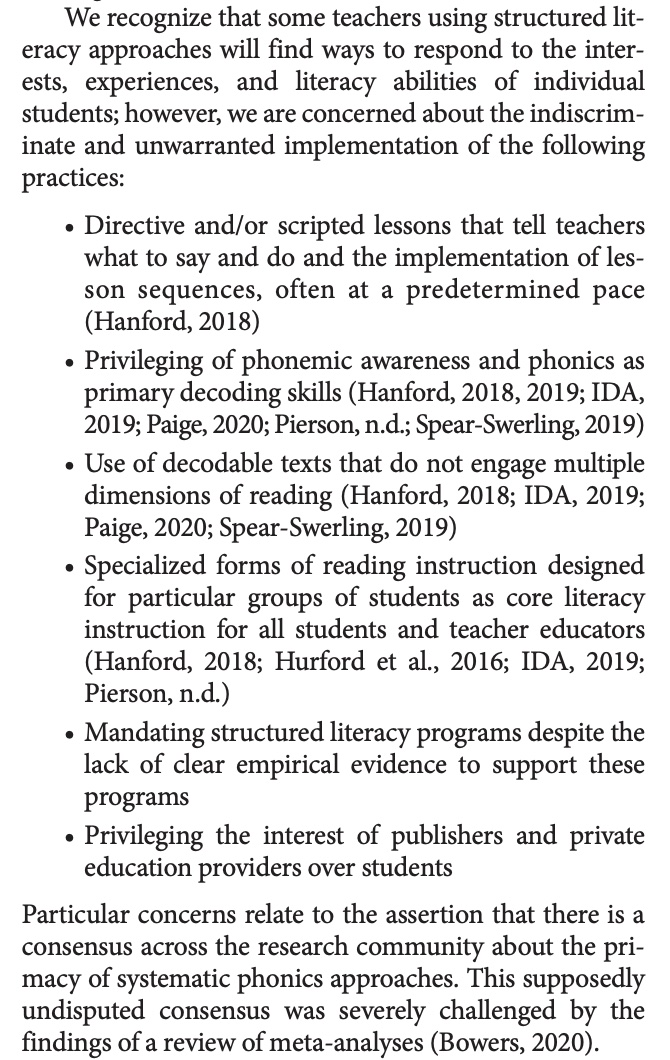
It is clear that the repeated critiques of literacy teacher preparation expressed by the SOR community do not employ the same standards for scientific research that they claimed as the basis for their critiques. However, to dismiss these critiques as unimportant would ignore the reality of consequences, both current and foreseen, for literacy teacher preparation. Consider the initiatives under- way despite the fact that there is almost no scientific evidence offered in support of these claims or actions.
Hoffman, J.V., Hikida, M., & Sailors, M. (2020). Contesting science that silences: Amplifying equity, agency, and design research in literacy teacher preparation. Reading Research Quarterly, 55(S1), S255–S266. Retrieved July 26, 2022, from https://doi.org/10.1002/rrq.353
Increasingly scholars have shown the SOR movement is a misinformation movement that depends on bullying, not “science.” And for a few years now, I have experienced and witnessed SOR advocates responding to evidence-based Tweets with anger, mischaracterizations, and personal attacks.
And thus, this passage from Bertrand Russell and panels from Daredevil 6 (v.7) resonate with me:
The SOR social media anger is grounded, I think, in the impossible corner SOR advocates have created. When I have posted scientific research about dyslexia (notably Orton-Gillingham) or LETRS, I have been visciuously attacked simply for noting that O-G and LETRS do not have scientific support but are embraced by the SOR movement.
I have never said O-G or LETRS is ineffective; I have never rejected or endorsed either. I simply have noted that if we are saying any program or approach must be scientific, neither of these meet that standard.
Detrich, Keyworth, and States provide an excellent example of why the SOR movement is doomed by its own standards, how even high-quality “science” fails its own standards, and why this reading war is yet another cycle of the same misguided claims and idealistic solutions.
“Policy without evidence is just a guess and the probability of benefit is likely to be low,” Detrich, Keyworth, and States explain, adding, “Evidence without policy is information that is unlikely to have impact as it has limited reach.”
When I stated LETRS fails scientific scrutiny, several SOR advocates responded by noting the lack of fidelity in implementing LETRS. And thus, what we know from implementation science:
The development of evidence-informed policy is not sufficient to assure the benefits of the policy will be realized. Policies must actually be implemented well if they are to have impact. Many education policies have been enacted without any meaningful impact on educational outcomes. Often this was because there was no comprehensive, coherent plan for implementing the policy. Implementation science is defined as the study of factors that influence the full and effective use of innovations (National Implementation Research Network, 2015) and brings coherence to the implementation of policies. It is the third leverage point that can be utilized to turn policy into meaningful action, thus achieving desired outcomes. It is the bridge between policy, evidence-based practices, and improved outcomes for students. Without implementation science, the aspirations of evidence-informed policy, no matter how well intentioned, are not likely to result in benefit for students.
That last sentence is extremely important because it speaks to the very high stakes involved in reform as well as the nearly impossible task of implementing reform in ways that can be identified as successful.
Some of the inevitable traps of reform are identified in implementation science:
Policy is made broadly but implemented locally. Policy is generally made at a distance removed from the local context in which it is to be implemented and all of the differences across implementation settings cannot be anticipated. … It has been argued that because of the complexities of differing contexts, the concept of evidence-informed policy is not realistic (Greenhalgh & Russell, 2009). The concern is that the research context is so different from the local context as to make research evidence irrelevant.
Evidence-informed policy can prescribe what to do, but not how to do it in a specific context. Those with the best understanding of that context are in a better position to make those decisions. At the local level decisions about how to best implement an evidence-informed policy requires professional judgment and a clear understanding of the values of the local community. Conceptualizing evidence-informed policy as a decision-making framework addresses many of the concerns about the feasibility of it being realistic to address issues of context (Greenhalgh & Russell, 2009).
…[T]here are complex issues to be solved if evidence is to influence policy. There is an implication that policymaking is a rationale process in the sense that if the evidence is available policymakers will act on it; however, the formulation of policy is influenced by a number of factors other than evidence. A challenge for those advocating evidence-informed policy is that policymakers bring their own political and personal biases to the task. In instances when evidence conflicts with political and personal preferences, preferences usually prevail and evidence is discounted [emphasis added](Gam- brill, 2012).
What the SOR movement demonstrates is the essential flaw of advocacy grounded in missionary zeal; and thus, “If evidence is to play a central role in influencing policy, then the challenges of overcoming personal biases, political considerations, advocacy groups, and financial incentives must be confronted.”
In short, when SOR advocates challenge existing market forces driving reading program adoption, they seem incapable of seeing how that same market dynamic is shaping their own movement.
As well, the SOR movement is trapped in an idealistic and simplistic use of “science” (along with a misunderstanding of meta-analyses):
A limitation of experimental evidence is that one experimental study is never sufficient to definitively answer a question about what should be done and is a poor basis for formulating policy. If there is a body of literature, the common approach by education scholars has been to review the extant literature and make a reasoned judgment about what should be done. Policymakers are not necessarily prepared to conduct a review of the literature and come to reasonable conclusions about what should be done as a matter of policy. An alternative to the narrative type of review is a systematic review or meta-analysis that summarizes a body of research and can inform policymakers about the general effect of a practice. A significant advantage of meta-analysis for policymakers is that it provides a single score (effect size) that best estimates the strength of an intervention across populations, settings, and other contextual variables. Program evaluation is another type of evidence that is valuable to policymakers. It provides feedback about the effectiveness of a program or practice and can provide insights about how policies can be changed to increase benefit.
Often, little weight is allowed for teacher-based evidence because that doesn’t meet the narrow definition of “science” that has painted SOR advocates into a corner:
Similarly, practitioners seeking answers to challenges they are facing can collect data about the frequency of occurrence, the contexts in which they are most likely to occur, and the differences between the contexts in which the problem occurs and does not occur. Practice-based evidence is the essence of data-based decision making (Ervin, Schaughency, Mathews, Goodman, & McGlinchey, 2007; Stecker, Lembke, & Foegen, 2008). Single participant designs are commonly used in data-based decision making. The unit of analysis can be an individual to determine if she is benefiting from an intervention and is common in response to intervention approaches (Barnett, Daly, Jones, & Lentz, 2004). The unit of analysis can also be larger such as a whole school. Practitioners of school-wide positive behavior support rely on single participant designs to make decisions regarding the effectiveness of whole school interventions (Ervin et al., 2007).
But the limitations of “scientific” or “evidence-based” policy and practice have occurred in recent history, specifically No Child Left Behind (NCLB):
There were a number of implicit assumptions in the use of this approach with NCLB (Detrich, 2008). First, it was assumed that there was an established body of evidence-based interventions. Secondly, it was assumed that educators were aware of the evidence supporting different practices. A third assumption was that educators had the expertise to implement a specific practice. A final assumption was that the necessary resources were available to support effective implementation. The experience with NCLB would suggest that these assumptions are not justified. When NCLB was enacted, there was no organized resource for educators that provided information about the evidentiary status of various interventions. More recently, there are a number of organizations that summarize and evaluate the evidence supporting educational interventions such as the What Works Clearinghouse and Best Evidence Encyclopedia.
The irony of the failures of evidence-base policy in education is that we have implementation science that can and should guide how policy is crafted and implemented: “The stages of implementation science are exploration and adoption, installation, initial implementation, and full implementation (Blasé, Van Dyke, Fixsen, & Bailey, 2012).”
The SOR movement fails the very first stage: “Exploration and adoption is the phase in which all stakeholders (teachers, administrators, etc.) are involved in the decision-making in terms of defining the problem they are trying to solve and identifying possible solutions.”
This is, in fact, what I call for in my policy brief on the current policy failures in the SOR movement:
Develop teacher-informed reading programs based on the population of students served and the expertise of faculty serving those students, avoiding lockstep implementation of commercial reading programs and ensuring that instructional materials support—rather than dictate—teacher practice.
Thomas, P.L. (2022). The Science of Reading movement: The never-ending debate and the need for a different approach to reading instruction. Boulder, CO: National Education Policy Center. http://nepc.colorado.edu/publication/science-of-reading
The SOR movement is a media-based movement that has resulted in very bad and often harmful policy (see HERE, HERE, HERE, and HERE).
And thus the paradox of implementation science: “The fundamental goal of implementation science is to make sure that at each phase of implementation the necessary steps are taken to assure that an intervention is implemented with integrity.”
Most if not all reforms must be implemented with such a high degree of fidelity (likely one not possible in the real world) that all reform is doomed necessarily to be identified as a failure.
The SOR movement will be declared a failure exactly like all the similar reading reform movement before it:
It is abundantly clear that policy alone is not sufficient to improve students’ academic achievement. Since the publication of A Nation at Risk (Gardner, 1983) there has been a steady stream of policy initiatives with the intent to reform the U.S. education system. In the time period covered by these various policy initiatives there is almost 50 years of data suggesting that academic performance in reading and math as measured by NAEP has not changed in any significant way despite all of the policies and money spent (Nations Report Card, 2015).
Regardless of the identified problems and regardless of the policy solutions, education is a steady march of failed reforms—most of which are indistinguishable from the others.
One example offered by Detrich, Keyworth, and States demonstrates the fatal gap between evidence and policy:
An additional shortcoming in the development of the policy to reduce class size was that all available evidence from Tennessee suggested that class size should be 17 or less and the teacher should be credentialed and have experience. California reducing class size to 20 was without support in the available evidence so even with fully credentialed teachers, the effects may have been minimized.
In reality, even when policy is identified as “scientific” or “evidence-based,” the actual practice is distorted by ideology or practical issues of implementation (evidence-based policy tends to be too politically or financially expensive to implement with fidelity).
And there is an unintended message in Detrich, Keyworth, and States—how researchers themselves fall into ideological traps.
Similar to the flaws in media coverage of SOR (see HERE and HERE), Detrich, Keyworth, and States misrepresent the whole language movement in California (see HERE and HERE) and uncritically cite NCTQ reports that do not meet a minimum bar of scientific research (see HERE, HERE, and HERE).
SOR advocates, then, find themselves in a very real dilemma. They often resort to anger and bullying because, I think, unconsciously they recognize the corner they have painted themselves into, the hypocrisy they are trafficking in.
Education and reading reform are cycles of doomed failure because we are too often lacking historical context, we are prone to ideological and market bias, and we commit to standards that no one can achieve.
The anger and bullying of SOR advocates isn’t justifiable, but it is predictable.
Again, as Detrich, Keyworth, and States explain: “Without implementation science, the aspirations of evidence-informed policy, no matter how well intentioned, are not likely to result in benefit for students.” LETRS training, for example, increases teacher confidence but doesn’t raise student achievement.
In a few years, just as we are experiencing a few years after NCLB’s “scientifically-based” mandate, there will be hand wringing about reading, charges of failure, and calls for new (read: the same) solutions that we have cycled through before.
It seems the one science we are determined to ignore is implementation science because it paints a complex picture that isn’t very politically appealing.
A powerful but often harmful relationship exists among research/science, mainstream media, and public policy.
One current example of that dynamic is the “science of reading” (SOR) movement that is driving reading legislation and policy in more than 30 states (see HERE and HERE).
Mauren Aukerman, who has posted two of three planned posts on media coverage of SOR (HERE and HERE), identifies in that second post a key failure of media: Error of Insufficient Understanding 3: Spurious Claims that One Approach is Settled Science.
For example, Aukerman details with citations to high-quality research/science: “In short, there is insufficient evidence to conclude that any single approach, including the particular systematic phonics approach often elided with ‘the science of reading,’ is most effective.” And therefore, Aukerman recommends: “Be skeptical of ‘science of reading’ news that touts ‘settled science,’ especially if such claims are used to silence disagreement.“
What makes media a dangerous mechanism for translating research/science into policy is that journalists routinely oversimplify and misrepresent research/science as “settled” when, in reality, most research/science is an ongoing conversation with data that presents varying degrees of certainty about whatever questions that research/science explores.
In education, research/science seeks to identify what instruction leads best to student learning—such as in the reading debate.
The other problem with media serving as a mechanism between research/science and policy is that journalists are often trapped in presentism and either perpetuate or are victims of fadism.
Despite no settled research/science supporting media’s coverage of the current reading “crisis,” the initial “science of reading” narrative created by Emily Hanford has now become standard media narratives without any effort to check for validity (again, I highly recommend Aukerman’s first post).
Regretfully, education (and students, teacher, parents, and society) is regularly the victim of fadism at the expense of research/science. The list of recent edu-fads that were promoted uncritically by media only to gradually lose momentum because, frankly, they simply never were valid policies is quite long: charter schools (notably no-excuses models), value-added methods for evaluating/paying teachers, school choice, Common Core, etc.
Two fads that represent well how the misuse of “science” helps this failed cycle in education are “grit” and growth mindset. Both gained their introduction to mainstream education because media portrayed the concepts are research/science-based (even justified, as “grit” was, by the Genius grant).
While schools fell all over themselves, uncritically, to embrace and implement “grit” and growth mindset, the research community gradually revealed that both concepts have some important research and ideological problems. Scholars have produced research/science that complicates claims about “grit” and growth mindset, and many critical scholars continue to call for interrogating the racist/classist groundings of both concepts.
Growth mindset has been in the news again (and discussed on social media) because two recent meta-analyses reach different conclusions; see this Twitter thread for details:
Does growth mindset work? Join me for a tale of two meta-analyses. @chrisjb1
The issue raised about meta-analyses parallels the exact problem with media coverage of research/science—scientific methodologies that fail due to oversimplification. See this Tweet, for example, about meta-analyses:
Perhaps it is wise to remember what the founder of meta-analysis said about computing average treatment effects for education interventions: pic.twitter.com/LLhTyW39PG
Especially in education, when individual student needs greatly impact what is “best” for teaching and learning in any given moment, Tipton’s final Tweet cannot be over-emphasized:
And please, can we stop with the “either/or”, “good/bad”, “yes/no” thinking about interventions? I’m tired of writing commentaries.
The use of “science” in research is necessarily limiting (see HERE) when that “science” is restricted to experimental/quasi-experimental designs seeking proof of cause (does instructional approach X cause students to learn better than instructional approach Y).
While causal conclusions and research methods that address populations and controls are the Gold Standard for high-quality research/science, this type of “science” is often less valuable for the practical day-to-day messiness of teaching and learning.
Educators are better served when research/science is used to inform practice, not to mandate one-size-fits-all practice (see HERE).
The media and journalists more often than not turn research/science into oversimplified truisms that then are used as baseball bats to beat policy advocates into submission. The conversation and nuance are sacrificed along with effective policy.
The public and policymakers are left with a challenge, a way to be critical and careful when either the media or researchers present research/science.
As Aukerman warns, if journalists or researchers start down the “simple, settled” path, then they are likely not credible (or they have an agenda) because the real story is far more complicated.
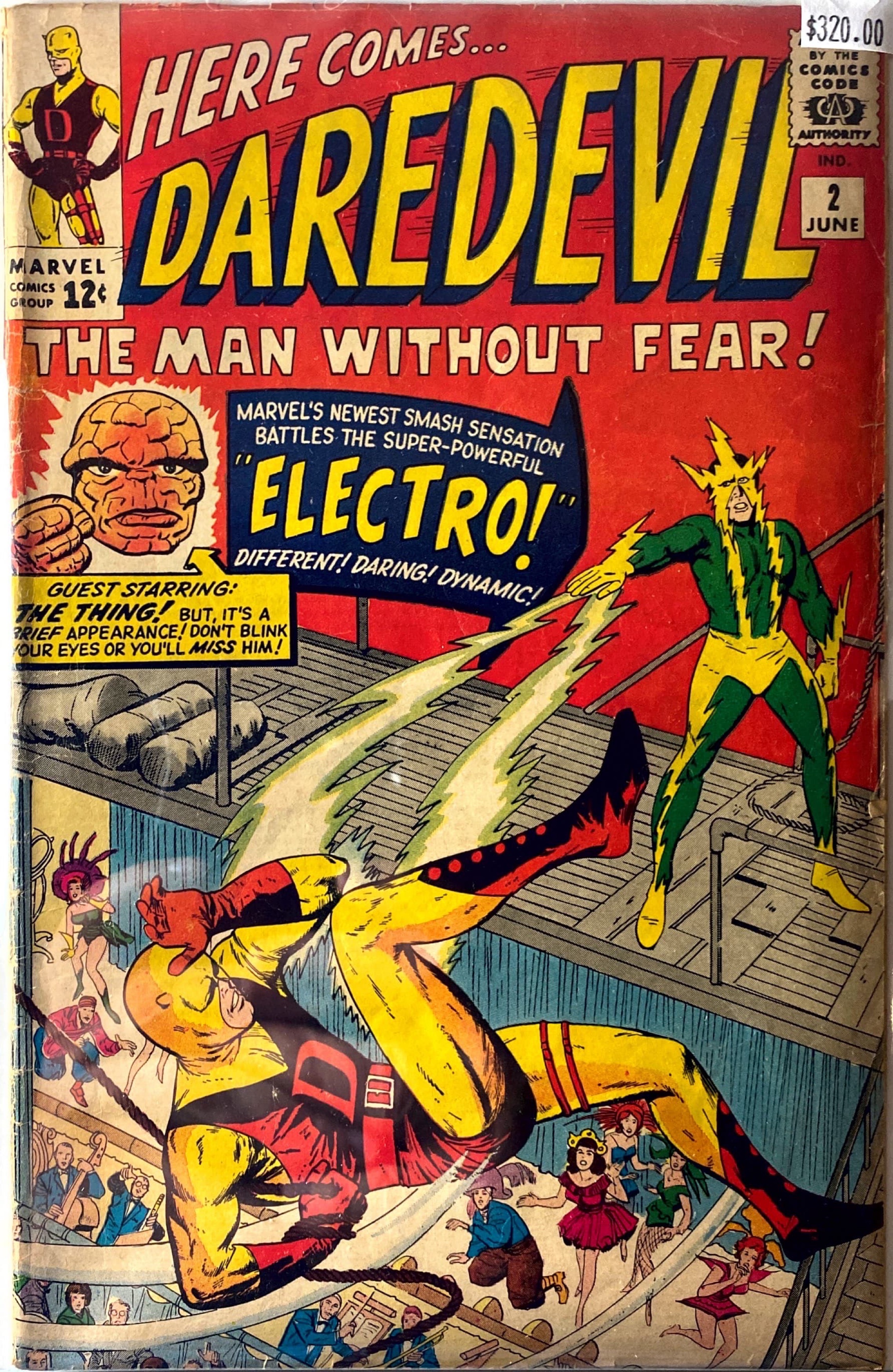
[Header and all images property of Marvel and artists]
This origin story is set in rural Upstate South Carolina during the 1970s, and there are plenty of uncomfortable parallels with the scrawny nerd-to-hero Peter Parker (the origin story of Spider-Man, 1962, occurring a bit over a year after my birth, 1961).
This origin story isn’t about nerd-to-hero, however; it is about an anxious rail-thin teenager being diagnosed with scoliosis and stumbling into reading, drawing from, and collecting Marvel comic books.
From 1975 until I graduated high school in 1979, I managed to collect about 7000 Marvel comic books, the greatest bilk of what was published in the 1970s. One huge part of that collection was buying a collection from an ad in our local newspaper.
As I have written about often, my parents turned themselves inside out to support their son resigned to spending his adolescence wearing a full body brace to correct a crooked spine. Buying comics and even attending a comic-con in Atlanta were stressful for my working-class family, but my parents never wavered.
While my collecting—and drawing from comic books—gradually faded while I was in college and then married in the early 1980s, I held onto that collection until my then-wife and I decided to buy a townhouse before having our only child.
Here, I allowed the normal life expectations to prompt a really bad decision—selling the entire collection to a comic book store in Charlotte (who mainly wanted the X-Men titles, and the full original run of Conan) for enough money to make a small downpayment on that townhouse.
While the money for us then was enough, looking back, I essentially threw away a wonderful collection because of impatience to start the sort of life I believed I was supposed to follow.
Over the next 40 years, I was a former comic book collector—although I popped back into collecting a few times because of students I taught and the growing wider interest in superheroes grounded in films featuring Batman and then the X-Men.
Also over those 40 years, my life—as life does—changed dramatically and in ways I could have never envisions.
In 2002, I moved from K-12 teaching to higher education, and it is then, that I turned to comic book scholarship/blogging and began once again filling my office with comic books used in that work as well as starting (without any initial purpose) collection Daredevil, focusing on my favorite Alex Maleev run.
The 2010s included the greatest changes in my life. Grandchildren, another serious cycling versus car accident (on Christmas eve 2016), the death of both parents in 2017, and then a major life change in 2019 after spending two years in therapy.
This may seem trivial to many people, but a key to coming to embrace my true self, and thus, true life, was to allow myself to return to the joys of my teenage years.
For a few years now, I have recommitted to comic book collecting, focusing on Daredevil and Black Widow along with a few other Marvel (and some DC) titles.
I moved my small collection from my office into a very small apartment already overwhelmed by two occupants and way too many high-end bicycles.
But in 2022, we moved into a larger apartment allowing us to dedicate a small bedroom to those bicycles and that growing collection—along with another new avocation, Lego.
Something unexpected happened in 2022.
First, I was able to complete my Black Widow solo series collection while I also wrote an 8-blog series on Black Widow and recently submitted a book proposal on the character (currently under review).
Next, I gradually began to make huge dents in the more daunting Daredevil collection since his solo series began in 1964 and includes nearly 700 issues.
After connecting with a local comic book store, where they targeted Daredevil issues for me, I began making some large purchases and eventually believed I could complete the entire run.
A tipping point in 2022 was making the big leap to buy Daredevil 1, 2, and 3 from that store, and then realizing I had dwindled my needed issues from about 100 to just about 10.
In that final 10, I was faced with a few key issues that were experiencing the usual market inflation connected to the MCU so I was patient and watched for dropping prices at local stores and on ebay.
This post in December 2022, then, is a magical one for me, surreal as I announce with acquiring Daredevil v.1 issue 7 (the first issue with his red uniform), I have a full run of Daredevil.
Since around 2013 and then increasingly since 2018, states have been adopting new or revised reading legislation often prompted by or identified as the “science of reading” (SOR).
As a result districts, schools, and teachers are experiencing major changes to reading programs and materials. Some states and districts have banned and removed materials that teachers have been using for decades, and many reading teachers are required to attend new PD as well as training in new reading programs.
This upheaval is not only common in K-12 education, but also highly disruptive to teaching as well as learning by students.
At a fundamental level, this cycle of crisis and reform has never worked, and only serves to de-professionalize educators and, once again, fails to address the individual literacy needs of all students.
In this policy brief, I offer an overview of the current SOR movement and recommend a different approach to reading policy and practices, including:
On a more local level, school- and district-level policymakers should do the following:
• Develop teacher-informed reading programs based on the population of students served and the expertise of faculty serving those students, avoiding lockstep implementation of commercial reading programs and ensuring that instructional materials support—rather than dictate—teacher practice.
• Provide students struggling to read and other at-risk students with certified, experienced teachers and low student-teacher ratios to support individualized and differentiated instruction.
Thomas, P.L. (2022). The Science of Reading movement: The never-ending debate and the need for a different approach to reading instruction. Boulder, CO: National Education Policy Center. http://nepc.colorado.edu/publication/science-of-reading
In order to achieve my recommendations, local districts and schools must have access to high-quality research and resources in order to support well informed teachers who can then be tasked with developing the sort of reading programs that match the unique and individual needs of the student populations they serve.
Additionally, journalists and mainstream media have been recycling the original claims (see Aukerman below) made by Hanford’s Hard Word, despite a lack of science behind those claims.
Therefore, below I am providing a resource collection by topic that matches the current media, parent, and political pressure that educators, schools, and districts are facing.
Links to resources are being provided for PD and educational purposes only and anyone accessing these resources are asked to respect fair use of scholarship. Further, I am available for educators or journalists who want to investigate the “science of reading” movement critically.
Betts, E., Dolch, E., Gates, A., Gray, W., Horn, E., LaBrant, L., . . . Witty, P. (1942). What shall we do about reading today?: A symposium. The Elementary English Review, 19(7), 225-256. http://www.jstor.org/stable/41382636
Seidenberg, M.S., Cooper Borkenhagen, M., & Kearns, D.M. (2020). Lost in translation? Challenges in connecting reading science and educational practice. Reading Research Quarterly, 55(S1), S119-S130. Retrieved July 26, 2022, from https://doi.org/10.1002/rrq.341
Yaden, D.B., Reinking, D., & Smagorinsky, P. (2021). The trouble with binaries: A perspective on the science of reading. Reading Research Quarterly, 56(S1), S119-S129. Retrieved July 26, 2022, from https://doi.org/10.1002/rrq.402
Johnston, P., & Scanlon, D. (2021). An examination of dyslexia research and instruction with policy implications. Literacy Research: Theory, Method, and Practice, 70(1), 107. Retrieved July 26, 2022, from https://doi.org/10.1177/23813377211024625
Stevens, E. A., Austin, C., Moore, C., Scammacca, N., Boucher, A. N., & Vaughn, S. (2021). Current state of the evidence: Examining the effects of Orton-Gillingham reading interventions for students with or at risk for word-level reading disabilities. Exceptional Children, 87(4), 397–417. https://doi.org/10.1177/0014402921993406
Hall, C., et al. (2022, September 13). Forty years of reading intervention research for elementary students with or at risk for dyslexia: A systematic review and meta-analysis. Reading Research Quarterly. Retrieved October 17, 2022, from https://doi.org/10.1002/rrq.477
[UPDATE]
Odegard, T. N., Farris, E. A., Middleton, A. E., Oslund, E., & Rimrodt-Frierson, S. (2020). Characteristics of Students Identified With Dyslexia Within the Context of State Legislation. Journal of Learning Disabilities, 53(5), 366–379. https://doi.org/10.1177/0022219420914551
Hoffman, J.V., Hikida, M., & Sailors, M. (2020). Contesting science that silences: Amplifying equity, agency, and design research in literacy teacher preparation. Reading Research Quarterly, 55(S1), S255–S266. Retrieved July 26, 2022, from https://doi.org/10.1002/rrq.353
Hoffman, J.V., Hikida, M., & Sailors, M. (2020). Contesting science that silences: Amplifying equity, agency, and design research in literacy teacher preparation. Reading Research Quarterly, 55(S1), S255–S266. Retrieved July 26, 2022, from https://doi.org/10.1002/rrq.353
MacPhee, D., Handsfield, L.J., & Paugh, P. (2021). Conflict or conversation? Media portrayals of the science of reading. Reading Research Quarterly, 55(S1), S145-S155. Retrieved July 26, 2022, from https://doi.org/10.1002/rrq.384
Compton-Lilly, C.F., Mitra, A., Guay, M., & Spence, L.K. (2020). A confluence of complexity: Intersections among reading theory, neuroscience, and observations of young readers. Reading Research Quarterly, 55(S1), S185-S195. Retrieved July 26, 2022, from https://doi.org/10.1002/rrq.348
Simple View of Reading (SVR) and Structured Literacy [access materials HERE]
Compton-Lilly, C.F., Mitra, A., Guay, M., & Spence, L.K. (2020). A confluence of complexity: Intersections among reading theory, neuroscience, and observations of young readers. Reading Research Quarterly, 55(S1), S185-S195. https://doi.org/10.1002/rrq.348
Duke, N.K. & Cartwright, K.B. (2021). The science of reading progresses: Communicating advances beyond the simple view of reading. Reading Research Quarterly, 56(S1), S25-S44. https://doi.org/10.1002/rrq.411
Filderman, M.J., Austin, C.R., Boucher, A.N., O’Donnell, K., & Swanson, E.A. (2022). A meta-analysis of the effects of reading comprehension interventions on the reading comprehension outcomes of struggling readers in third through 12th grades. Exceptional Children, 88(2), 163-184. https://doi.org/10.1177/00144029211050860
Barber, A.T., Cartwright, K.B., Hancock, G.R., & Klauda, S.L. (2021). Beyond the simple view of reading: The role of executive functions in emergent bilinguals’ and English monolinguals’ reading comprehension. Reading Research Quarterly, 56(S1), S45-S64. https://doi.org/10.1002/rrq.385
Cervetti, G.N., Pearson, P.D., Palincsar, A.S., Afflerbach, P., Kendeou, P., Biancarosa, G., Higgs, J., Fitzgerald, M.S., & Berman, A.I. (2020). How the reading for understanding initiative’s research complicates the simple view of reading invoked in the science of reading. Reading Research Quarterly, 55(S1), S161-S172. https://doi.org/10.1002/rrq.343
Burns, M. K., Duke, N. K., & Cartwright, K. B. (2023). Evaluating components of the active view of reading as intervention targets: Implications for social justice. School Psychology, 38(1), 30–41. https://doi.org/10.1037/spq0000519
[UPDATE]
Reading a philosophical investigation, Andrew Davis
Bowers, J.S. (2020). Reconsidering the evidence that systematic phonics is more effective than alternative methods of reading instruction. Educational Psychology Review, 32(2020), 681-705. https://link.springer.com/article/10.1007%2Fs10648-019-09515-y
Wyse, D., & Bradbury, A. (2022). Reading wars or reading reconciliation? A critical examination of robust research evidence, curriculum policy and teachers’ practices for teaching phonics and reading. Review of Education, 10(1), e3314. https://doi.org/10.1002/rev3.3314
Bowers, J.S. Yes Children Need to Learn Their GPCs but There Really Is Little or No Evidence that Systematic or Explicit Phonics Is Effective: a response to Fletcher, Savage, and Sharon (2020). Educ Psychol Rev33, 1965–1979 (2021). https://doi.org/10.1007/s10648-021-09602-z
Connor C. M. (2016). A Lattice Model of the Development of Reading Comprehension. Child development perspectives, 10(4), 269–274. https://doi.org/10.1111/cdep.12200
Flanigan, K., Solic, K., & Gordon, L. (2022). The “P” Word Revisited: 8 Principles for Tackling Today’s Questions and Misconceptions about Phonics Instruction. The Reading Teacher, 76, 73– 83. https://doi.org/10.1002/trtr.2101
[UPDATE}
Bowers, J. S. (2023, September 29). There is still little or no evidence that systematic phonics is more effective than common alternative methods of reading instruction: Response to Brooks (2023). https://doi.org/10.31234/osf.io/5ut7x
As a career educator for about 40 years, including almost two decades in K-12 teaching, I am advocating for teacher autonomy and professionalism to serve the individual needs of students.
Therefore, I think curriculum and instruction must be driven by classroom teachers—not media narratives, parental advocacy, or political mandate.
Regretfully, media, parental, and political pressure for policy and practice are too often oversimplified and misleading, but honored over teacher experience and expertise.
I am not a high-profile journalist with platforms at APM, Education Week, and the New York Times.
So I have to imagine that hearing from teachers and parents raising concerns about how the “science of reading” (SOR) movement isn’t representing them and even silencing and bullying them is only a fraction of those experiencing the same thing.
Of course, I too have regularly experienced the visceral anger and bullying coming from SOR and dyslexia zealots (a substantial percentage of the entire SOR movement).
Here, then, I want to focus on how the SOR parental rights bullying has a current and parallel cousin—the anti-CRT, curriculum ban, and book censorship movement driven by conservative culture warriors.
The overlap, in fact, between the SOR movement and the culture war linked to education and attacks on marginalized groups is becoming more and more direct:
[House Speaker] Renner [FL – R] also lodged attacks against measures conservatives and DeSantis have derided as “woke” movements. Ideologues are pushing their politics as a religion and at the expense of education, he said.
“They spend more time defending drag queen story time than promoting phonics and the science of reading,” Renner continued. “In this election, moms and dads sent a clear message to these ideologues: our children are not your social experiment.”
First, a typical pattern I experience on social media is that when I post research that challenges and contradicts SOR talking points the bullying begins. That bullying tends to gravitate to asking why I want to ignore (or accusing me of ignoring/discounting) the voices of parents and teachers who are being elevated by Emily Hanford’s articles and podcast.
Well, I have to be clear here that I understand that parents and teachers have quite valid concerns, and I would never silence or ignore those concerns. But the SOR movement isn’t limited to raising their voices; the movement is using those voices to bully and to ram through policies and practices that ironically deny other parents and teachers their voices and concerns.
As I have pointed out numerous times, there is a singular message to Hanford’s work; she has never covered research that contradicts that singular message.
And not a peep about schools having success with one of Hanford’s favorite reading programs to demonize.
At the root of this problem, also, is that Hanford has a habit of switching back and forth between claiming “science” and “research” while depending on anecdote:
Hanford critiqued approaches named as balanced literacy and whole language without citing any evidence around these claims. She continued with anecdotes on how a focus on the SOR has improved student performance, but there is not a single citation of evidence in support of this claim.
Hoffman, J.V., Hikida, M., & Sailors, M. (2020). Contesting science that silences: Amplifying equity, agency, and design research in literacy teacher preparation. Reading Research Quarterly, 55(S1), S255-S266. Retrieved July 26, 2022, from https://doi.org/10.1002/rrq.353
And thus:
It is clear that the repeated critiques of literacy teacher preparation expressed by the SOR community do not employ the same standards for scientific research that they claimed as the basis for their critiques.
Hoffman, J.V., Hikida, M., & Sailors, M. (2020). Contesting science that silences: Amplifying equity, agency, and design research in literacy teacher preparation. Reading Research Quarterly, 55(S1), S255-S266. Retrieved July 26, 2022, from https://doi.org/10.1002/rrq.353
The fundamental concern I have is not that Hanford and the SOR movement is elevating the concerns of parents and teachers, but that far too many SOR advocates are misrepresenting and oversimplifying reading science and then using that bully pulpit to mandate “all students must” policy and practice
Simply stated, reading science is not settled, brain research on reading isn’t fully formed in ways that can or should inform practice, and mandating universal policies erases the need to hear all voices and serve the individual needs of students.
For example, many SOR advocates call for systematic phonics for all students (regardless of need), universal dyslexia screening (which isn’t supported by research), and specific practices that also are not supported by research—Orton-Gillingham (see here and here), LETRS (see here), grade retention (see here), and both structured literacy (see here) and the “simple view” of reading (SVR) (see here and here).
It is entirely different to call for the needs of your child or the needs of yourself as an educator than to demand that all students and teachers need what you are demanding from your singular although shared experiences. [1]
Teachers across the US are being bullied and silenced through LETRS training and by administrators for simply asking questions about SOR or correctly pointing out that SOR is being misunderstood and misused (see how Gov. Youngkin (R – VA) frames SOR as phonics).
Where is the podcast for those educators?
Where is the podcast for parents thrilled by the education their children have received through Reading Recovery, Units of Study, or Fountas and Pinnell?
Missionary zeal and righteous anger are cancers for productive discourse and effective systemic reform (such as addressing reading policy needs).
Not all beginning readers are the same.
Not all struggling readers are the same.
Not all children labeled with dyslexia are the same (although dyslexia may be most strongly associated with out-of-school factors, which SOR advocates fail to acknowledge).
Therefore, policy must not demand that teachers conform to scripted approaches as if individual students are not being served.
Let’s then add the parallel dynamic occurring with anti-CRT movements, curriculum bans, and book censorship.
Republicans are (like Hanford) only reaching out and elevating a narrow type of parental voices, those righteously angry about what teachers teach, what students learn, and what anyone can read.
Censorship and bans that are universal erase the rights of those parents who want those lessons and those books for their children.
It is one thing to request that a child not be assigned a book or not have access to materials, but it is quite another thing to demand that no child can be assigned a book or have access to materials because a loud parent or parental group is offended.
Not a single recent bill (just as there is no podcast) protects the rights of parents and students to have access through the publicly funded school system curriculum and books that someone else may find offensive.
The SOR movement and the anti-CRT/curriculum and book ban movement are ultimately not about parental rights, student needs, or reading and literature as well as academic freedom.
They are ideological bullying that forefronts a narrow set of mandates at the expense of what likely is the silenced majority of parents and teachers who want children taught as individuals and teaching and learning to honor the sacred foundation of academic freedom.
Parental rights is not being honored when some parents have rights and a voice that deny other parents their rights and voices.
[1] A trap and flaw of the SOR movement is shouting “Science!” and then using anecdote. I want to be clear that (1) anecdotes are not science, and (2) I actually think we should drop the “science” tyranny and spend more time on anecdotes because qualitative data are quite valuable in education.
Since I am a man of a certain advancing age—creeping north of 60—I am bombarded on social media with push-ads for a variety of supplements claiming to address the various and common challenges of growing older.
These supplements are often advertised by first discrediting other supplements or earlier versions of the supplements being sold. Next, of course, comes the sales pick: But our supplement works the way no other supplement does or ever has!
Regretfully, this dynamic in the supplement world (where virtually no products have ever “worked” or will ever “work”) is replicated in the on-going reading programs war that is a subset of the incessant reading war that has plagued public and political debate since at least the 1940s (see an overview of the reading wars included here).
In fact, one of the least credible and most harmful aspects of the current “science of reading” (SOR) movement is blaming dominant reading programs for failing to teach students to read, and then, uncritically offering a new program/approach as a silver bullet for “fixing” low student achievement in reading (see an important challenge to that blame here).
Since the panic around low literacy rates among draftees in WWII, the US has experienced a recurring cycle of reading wars that are grounded in overstatements about the lack of phonics instruction, the persistent and “normal” but unsatisfying level of reading achievement among US children (notably even more dire among children living in poverty, minoritized students, second-language learners, and special needs students), and impassioned blame focused on simplistic agents of that failure.
SOR advocates, especially in the media and among parents, are today placing blame on balanced literacy (BL) and a few dominant reading programs. One problem is that these programs didn’t even exist during most of the decades before that had the exact same low and unsatisfying reading achievement (read literacy scholar Jeanne Chall’s work addressing the lack of scientific research, absence of systematic phonics, and failure to address dyslexia starting in the 1960s, examined well here).
Even more frustrating is that many of the demonized reading programs today are not even identified as BL and that most critics of BL—nearly universally in the media—mischaracterize BL (similar to the attack on whole language in the 1990s).
SOR advocates, then, turn immediately to championing a new approach!—usually structured literacy (SL to replace BL) or Orton-Gillingham approaches.
Like the supplement wars, the reading programs wars are entirely trapped in a futile paradigm grounded in misidentifying the problem, shouting misguided blame, and offering nearly the exact same solution as the blame-agent being attacked.
Reading programs, regardless of the program, are likely very small factors in how well students learn to read in terms of the quality of the program itself (teaching/learning conditions and living conditions of students far outweigh program quality).
And if we are being honest about teacher practice, over the last 80 years and every single day, there is a tremendous variety in how teachers teach students anything—even when teachers are in rooms side-by-side and teaching the same required reading program.
Since I have a long record of opposing all reading programs, I want to emphasize that the problem is not any specific reading program, but how and why the program is implemented.
Let’s go back then to the 1940s when Lou LaBrant accurately identified the reading program problem:
It is not strange, in view of the extensive literature on language, that the teacher tends to fall back upon the textbook as authority, unmindful of the fact that the writer of the text may himself be ignorant of the basis for his study. (pp. 88-89)
Regardless of the reading program, if and when that program becomes the instructional authority, instead of the teacher and despite the demonstrated needs of the students, we have failed students and we have failed teachers and we have failed the promise of learning to read.
At best, a reading program is one dynamic resource for the professional autonomy and expertise of the teacher to serve the individual needs of all of their students.
At worst (which is historically and currently common), reading programs are scripts for teachers to follow and ways to hold teachers accountable for implementing the program (regardless of the needs of the students, regardless of the professional authority of the teacher).
SOR advocates are no different than supplement hucksters. In their righteous anger about Lucy Calkins and Fountas and Pinnell, they are jumping out of the frying pan and into the fire by waving the structured literacy! flag and claiming SL will save children, save reading.
Let me take a commercial break and throw a very chilly and unwelcome blanket on the SL party: SL will not work, and in a decade or so, we will start the panic, blame game, and new! reading program/approach all over again.
Why?
Because many are too damn stubborn, and too filled with missionary zeal, to step back and admit we have been going about this all wrong.
Reading achievement by students is a metric strongly linked to poverty and inequity; if we had the political will to address poverty and inequity, reading achievement would increase (but since human behaviors are mostly idiosyncratic, we will never have universal success among humans for anything because there is some truth to human behaviors falling on a range something like the bell-shaped curve).
Next, we are focusing on the reading programs themselves instead of how they are implemented.
The real problem with all the currently adopted reading programs in the US is that they are implemented badly, often in lock-step ways that put implementing the program with fidelity over student learning and teacher autonomy.
So the great and sad irony of the SOR assault on reading programs is that SOR advocates are calling for SL, which is often scripted curriculum that defaults to treating students monolithically (see a powerful critique here):
The collateral damage, then, of the reading programs wars will always be students, teachers, and the promise of reading—because the real concern isn’t the reading programs themselves (although reading programs as resources can and should be better).
It is easy and effective to whip up emotional responses with anecdotes in order to manufacture a problem and put a face on all-that-is-evil (makes for clickable podcasts).
But in the end, the real story being sold is no different than the supplement sales pitch that points an accusatory finger at those other failed supplements before holding up the new! and improved! product (uh, program) that in all honesty is the same useless shit in a different package and under a different name.
In early and mid-twentieth century, pro-phonics advocates misrepresented and attacked John Dewey and progressivism (neither of which had much real influence in public education).
By the late twentieth century, whole language became the target of misinformation and attacks (although NAEP data in the 1990s showed a strong correlation between whole language approaches and higher student scores on reading [1]).
During the NCLB/NRP era of the turn of the century, attacks and misinformation focused on balanced literacy.
The current reading war driven by the “science of reading” movement is also mired in emotional anecdotes, personal attacks, and a steady diet of mainstream media misinformation.
As Hoffman, Hikida, and Sailors have documented [2], Emily Hanford at APM and mainstream media such as Education Week are following the same “big lie” approach to covering reading and education repeated throughout the last 80 years:
Hanford critiqued approaches named balance literacy and whole language without citing any evidence around those claims. She continued with anecdotes on how a focus on the SOR has improved student performance, but there is not a single citation of evidence in support of this claim. … Stirring public opinion further, Education Week has taken up critiques on literacy teacher preparation with numerous articles and blogs related to the SOR, with implications for reform in teacher preparation. The bulk of these articles and reports have been negative toward current practices and have drawn on the work of Moates and the NCTQ.
It is clear that the repeated critiques of literacy teacher preparation expressed by the SOR community do not employ the same standards for scientific research that they claimed as the basis for their critiques.
Hoffman, J.V., Hikida, M., & Sailors, M. (2020). Contesting science that silences: Amplifying equity, agency, and design research in literacy teacher preparation. Reading Research Quarterly, 55(S1), S255-S266. https://doi.org/10.1002/rrq.353
I have documented the same careless journalism—calling for the “science of reading” and then switching to anecdotes, misinformation, and unsupported claims—as Hanford recycles her original articles into an overreaction to Mississippi’s 2019 NAEP scores.
The newest recycling of Hanford’s misinformation is a podcast, Sold a Story, which itself is selling a false story, a “big lie.”
Boosted by overzealous and often angry and hateful advocates of SOR and dyslexia, the misinformation is mostly allowed and excused in an “ends justify the means” environment around the SOR movement.
That many SOR advocates continue to use anecdote while calling for “science,” that many SOR advocates are comfortable misrepresenting practices, scholars, and programs—this erodes their credibility even as many if not most people in the literacy community agree that students should be better served in their literacy education and that teachers should be better prepared and better supported as professionals.
Simply put, the ends do not justify the means, especially when SOR advocates means are creating ends that are in fact harmful.
To be clear, identifying misinformation is not endorsing the people and programs being attacked and misrepresented. I am a strong critic of both reading programs [3] and teacher education [4].
But that someone or something deserves criticism does not justify emotional attacks, hateful rhetoric, or easily refuted misinformation.
Here, then, I am collecting evidence to correct the misinformation:
[2] Hoffman, J.V., Hikida, M., & Sailors, M. (2020). Contesting science that silences: Amplifying equity, agency, and design research in literacy teacher preparation. Reading Research Quarterly, 55(S1), S255-S266. https://doi.org/10.1002/rrq.353
As one of my sabbatical projects I have been completing my online annotated bibliography of English educator Lou LaBrant.
My doctoral dissertation was an educational biography of LaBrant, but since the late 1990s, I have returned often to her work in my teaching, my scholarship, and my public advocacy and writing.
LaBrant’s recognition of the power and dangers of the “big lie” in the wake of WWII reads incredibly prescient in 2022 in the wake of Trump and the garbled rise of “fake news” in post-truth America.
However, LaBrant’s idealism about America now feels inexcusably naive—for her America and ours.
The “big lie” is not just a feature of politics; in fact, the “big lie” has become mainstream media’s primary approach to a wide range of topics. And the “big lie” is a recurring way the media, the public, and politicians batter universal public education—one of the essential elements of a free people committed to democracy.
Those without historical context may think “fake news” and the “big lie” concerning education either doesn’t exist or is a very recent phenomenon.
In the nineteenth century, in fact, the Catholic church established an assault on public education that sounds eerily similar to today:
[P]ublic schools … [are] a “dragon … devouring the hope of the country as well as religion.” Secular public education … [is filled with] “Socialism, Red Republicanism, Universalism, Infidelity, Deism, Atheism, and Pantheism—anything, everything, except religion and patriotism.”
This initial assault on public education was grounded in the “big lie,” and to be blunt, it was about market share: the Catholic Church feared the allure of universal public education drawing students from their schools.
Here is a fact of history few people acknowledge: There hasn’t been a day since then that anyone has been satisfied with student achievement in the U.S.
The media, the public, and political leaders love few things more than lamenting students’ scores on our sacred standardized tests—the SAT/ACT since early twentieth century, ITBS, and then the onslaught of state accountability tests and NAEP since the 1980s and 1990s.
And here is another fact: Throughout a century-plus of characterizing public education as failing, classroom instruction, student demographics, teacher demographics, school compositions, state standards and assessments, etc., have all changed dozens and dozens of times.
However, at any point of education crisis, there is ample room to blame singular causes for failure, and that, of course, is the “big lie.”
The “big lie” approach to criticizing education is currently driving two powerful and harmful movements—the anti-CRT/book banning movement and the “science of reading” movement.
Are teachers (well over 75% white women) indoctrinating students with anti-whiteness by hiding CRT in the curriculum? No. It is a manufactured crisis, a “big lie.”
Are teachers and librarians grooming students to become LGBTQ+ by assigning books that portray alternatives to so-called traditional families and sexuality? No. It is a manufactured crisis, a “big lie.”
Are teachers failing to implement reading science in their reading instruction (because teacher educators either willfully ignore or don’t know reading science) and therefore allowing students to fail to acquire reading proficiency? No. It is a manufactured crisis, a “big lie.”
Are major reading programs dependent on three-cueing and lacking systematic phonics cheating students out of acquiring reading proficiency? No. It is a manufactured crisis, a “big lie.”
However, all of these are examples of not only the “big lie,” but also how effective the “big lie” can be.
Let’s consider reading proficiency for a moment to unpack the “big lie” behind the “science of reading” movement.
Here are NAEP reading scores for grade 4 since 1992:
Notice that national data hover within a few points of 220 for thirty years—what in many ways can fairly be called a flat longitudinal data line.
Most people associate the “science of reading” movement starting at the earliest around 2013 and specifically around 2018.
Yet, those recent scores are little different than the two decades before (and we must acknowledge that the “science of reading” is not resistant to powerful social forces such as the pandemic).
Also, across thirty years, students and teachers have been held accountable for several different sets of standards, many different reading programs have been adopted and implemented, and the demographics of students have shifted in significant ways (public schools are increasingly populated by higher poverty students, and minoritized students constitute over 50% of students).
Nothing is consistent except student achievement.
It is nonsensical to ascribe blame (or credit) to any one instructional approach, any one adopted program, any one set of standards, etc.
So if we address one of the elements of the “big lie” in the “science of reading” movement—that Lucy Calkins’s Units of Study is a primary way we fail students learning to read—this seems preposterous in the grand scheme of educational crisis rhetoric, but also, that program is only the third most used.
But further, since I taught in public schools for 18 years, I can attest that students in two different classes taught by different teachers are not receiving the same instruction regardless of the official curriculum or programs.
The “big lie,” then, is always grounded in oversimplification and relies on crisis rhetoric to stir emotional responses.
Once we add context such as acknowledging that Jeanne Chall made the same exact arguments about the failures of reading instruction and achievement from the late 1960s into the 1990s and then the National Reading Panel made the same exact claims and offered the same exact solution (scientifically based instruction) just twenty years ago, the “big lie” is exposed as a house of cards.
Why, then, does the “big lie” repeat itself so often in education discussions and why is it so effective?
First, educational effectiveness is mostly driven by out-of-school factors (60%-80% of measurable student achievement) and not teacher instruction, curriculum, standards, or adopted programs. However, Americans resist systemic explanations and ideologically are attracted to blaming individual behavior.
Therefore, blaming Lucy Calkins is more compelling to American ideology than acknowledging poverty and inequity as the causal reasons behind student learning.
Second, we as a society have a dysfunctional relationship with statistics.
On one hand, Americans trust or believe in the bell-shaped curve, which predicts that human behaviors (including learning) will fall on a continuum that includes a few failing, many achieving “normally,” and a few excelling.
A perfect example of that dysfunction is that George W. Bush’s crowning legislation, No Child Left Behind (NCLB), included the self-defeating requirement that all student be proficient by 2014.
One reason that NCLB was replaced by the Every Student Succeeds Act (ESSA) is that politicians eventually realized such a requirement cannot be mandated by caveat, legislation, and such an expectation defies human behavior.
Wanting and trying to foster proficient readers so that all students achieve the literacy they deserve (what we absolutely must do) is far different than requiring and expecting that all students meet that lofty goal—especially since we do not have the political will to address the out-of-school factors that would have the greatest impact on that achievement.
As LaBrant noted, the “big lie” is an ugly reality in politics, but it also is an ugly and effective way to make sure our schools continue to fail to meet the needs of all students.
The anti-CRT/book banning movement and the “science of reading” movement are selling the “big lie” and, ironically, lots of people are cashing in (the really nasty hypocrisy coloring all of this).
We can and should do better for our students, especially those who need us the most (those trapped in the lower end of that bell-shaped curve).
But the “big lie” serves the political and financial interests of those dedicated to those lies.
Keep in mind when people point an accusatory finger, three more are pointing back.
Those screaming that someone else is selling a story, well, are selling a different story, the “big lie.”
My foundations of American education course serves as an introduction to public education and our education majors, but the course also fulfills a general education requirement.
The class comprises mostly first- and second-year students, and those considering education as a major or career can be most of the class or very few. None the less, virtually all of them are a bit disoriented when we begin the course reading philosophers—Foucault, Deleuze, and Freire specifically.
I invite them to read some relatively brief passages from all three, warn them that reading philosophy is challenging, and then reassure them that we are simply using these ideas to begin our semester-long interrogation of how we have public schools and why.
When 2022 NAEP data were released, I immediately thought about a few things.
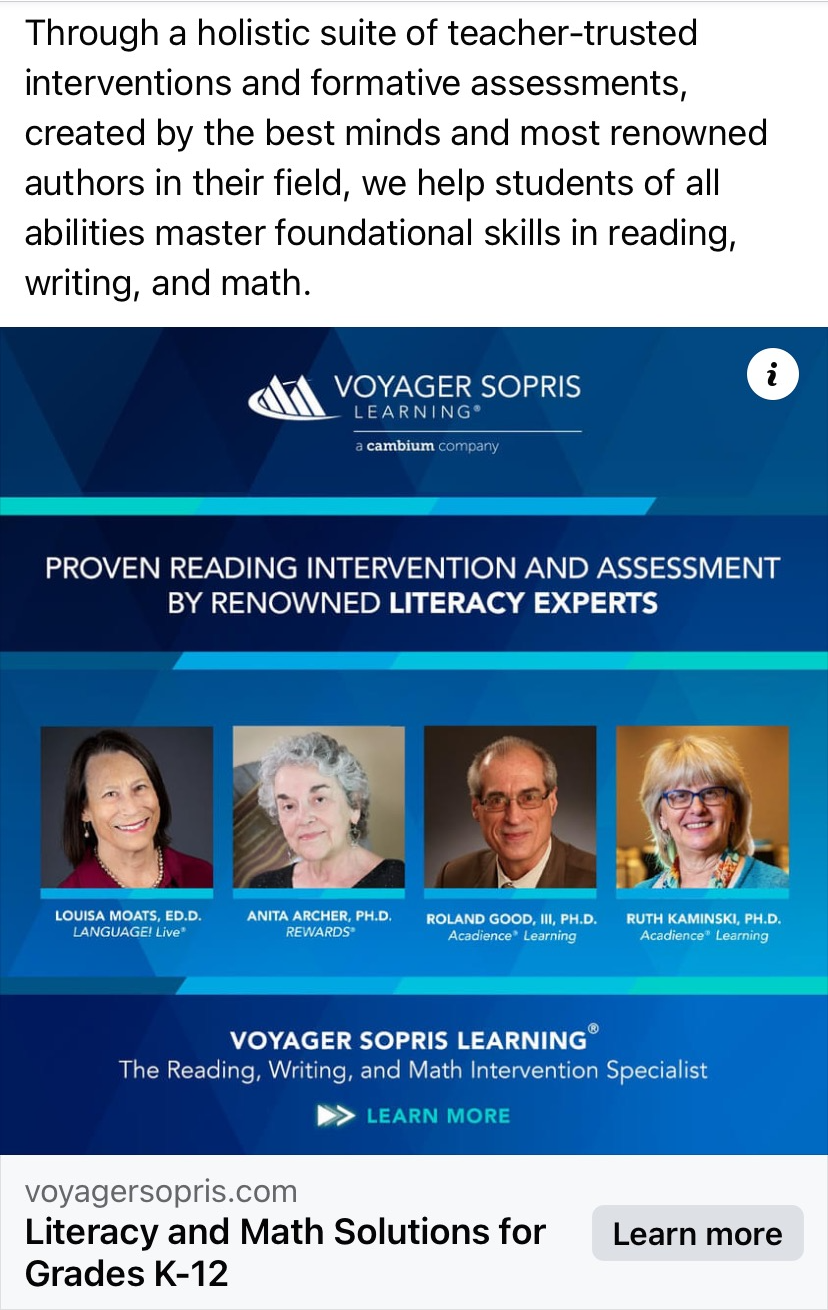
First, with the dramatic coverage of math scores dropping (see HERE and HERE), I told a few friends to brace themselves for the inevitable next step. And it took only about one day for my prediction to happen with an ad popping up on Facebook:
In the U.S., notably since the release of A Nation at Risk (see HERE and HERE) in the early 1980s, the easiest thing to predict is that the education market place is going to profit from educational crisis.
This fits into my second thought, which is the current and ongoing “science of reading” crisis that was prompted in 2018 by Emily Hanford, but was significantly boosted by the cries of “reading crisis” after the release of the 2019 NAEP data (see HERE, HERE, HERE, and HERE).
Now, I regret to note, math will be the next over-reaction, as the ad above shows now that edu-businesses scramble to add math to their offering for reading—solutions need a problem, and high-stakes testing is a problem machine. [1]
And the big picture thing I thought about was Deleuze, from the reading I have students consider:
We are in a generalized crisis in relation to all the environments of enclosure—prison, hospital, factory, school, family….The administrations in charge never cease announcing supposedly necessary reforms: to reform schools, to reform industries, hospitals, the armed forces, prisons….In disciplinary societies one was always starting again (from school to the barracks, from the barracks to the factory), while in the societies of control one is never finished with anything—the corporation, the educational system, the armed services being metastable states coexisting in one and the same modulation, like a universal system of deformation. (pp. 3-4, 5)
Deleuze builds to a powerful and prescient warning:
For the school system (emphasis in original): continuous forms of control, and the effect on the school of perpetual training, the corresponding abandonment of all university research, the introduction of the “corporation” at all levels of schooling. (p. 7)
As a key example, many (if not most) teachers of reading in the U.S. now are being told that their university training was useless, and that they need new training in the “science of reading.” And education corporations are lining up to sell schools that training, a story sold with the “science of reading” label (see about LETRS).
Just to be clear, this is not about the failure of teacher certification or about teaching teachers to teach or students to read; this is about profit through perpetual crisis and (re)training.
And here is the disconnect.
While I carefully help students over the course of a semester examine the claimed democratic foundations of public education (well documented in the writings of Thomas Jefferson and key figures in American education such as John Dewey), we quickly uncover that those democratic ideals are often secondary—or even erased—by market commitments.
So here we are in 2022 still riding the wave of accountability, standards, and high-stakes testing that began with A Nation at Risk and built to George W. Bush’s No Child Left Behind (NCLB).
As early as the 1990s, however, many education scholars warned that this education crisis was manufactured—essentially a political lie that was bolstered by a media frenzy and a market grab.
The education crisis/education market place dynamic has been in full swing for over forty years now, and the ugly truth is that all of the crisis rhetoric used to justify incessant accountability layered onto a constant process of new standards and new tests is, as Berliner and Biddle documented, manufactured, a lie.
As compelling as it is, we simply do not now have a reading crisis; we have never had a reading crisis.
And NAEP 2022 data do not expose a math crisis.
“Crisis” suggests something new, immediate, and pressing to address.
Student learning has been about the same for nearly a century. Some students thrive (mostly correlated with affluence and being white), many students learn in spite of the system, and too many students are neglected or mis-served (correlated strongly with poverty, minoritized race, multi-language learning, and special needs).
Just to swing back to reading, there is no decade (or even year) over the last 80 years that public, media, and political opinions expressed satisfaction in reading achievement; student reading proficiency has always been characterized as failing, and a crisis.
Always.
As we creep toward an election, we need to admit a few things.
First, the market and commercialism matter more in the U.S. than democracy or even freedom.
We not only want schools to produce (compliant) workers, but also have turned public education into a crisis-based education market place.
Take a little journey to Education Week‘s web site and note that flurry of ads for the “science of reading,” for example:
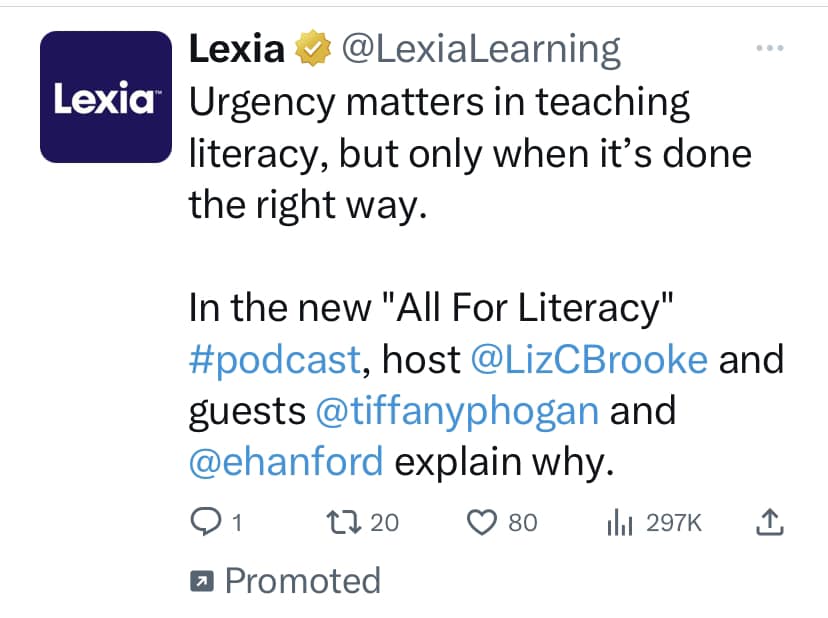
[Update] Or see what pops up “promoted” on Twitter:
And monitor over the coming weeks; you’ll see more and more addressing math.
Since 2018, media has generated millions of clicks with coverage of the “science of reading,” journalists are winning cash awards and receiving huge speaking fees to discuss the “science of reading,” and education corporations are pulling in millions for software, programs, and training labeled the “science of reading.”
Please take just a brief historical overview since the 1980s. Not a single reform has worked, not a single crisis/reform cycle has been deemed a success.
As Deleuze explains, the point of crisis/reform is to remain always in crisis/reform because that cycle creates a market, and for some people, that market generates profit.
But that crisis/reform cycle has a high cost for students, teachers, and society.
The “science of reading” crisis ironically follows just about two decades after the reading crisis identified by the National Reading Panel and at the center of NCLB—which mandated that teachers had to implement only scientifically-based practices (notably in reading).
That failed (apparently) and the current response is to shout (once again) “crisis!” and demand that mandates restrict teaching to the “science of reading.”
Four decades-plus into a crisis/reform hole and we continue to dig.
Part of me feels sorry for what is about to happen to math, and part of me feels really bad that I hope the coming math nonsense will relieve a little pressure from reading.
But mostly, I hate the lies, political, media, and commercial interests that are eager to shout “crisis!” because in the spirit of the good ol’ U.S. of A., there is money to made in all that bullshit.
Thomas, P.L. (2022). The Science of Reading movement: The never-ending debate and the need for a different approach to reading instruction. Boulder, CO: National Education Policy Center. http://nepc.colorado.edu/publication/science-of-reading
educator, public scholar, poet&writer – academic freedom isn't free






















































 dr. p.l. (paul) thomas


