Category Archives: education

The Trap: The Ends v. Means Tension in the Pursuit of Content Knowledge

Over the course of almost 40 years, I have taught writing/composition to high school, undergraduate, and graduate students. I am well aware of the cumulative toll of reading and responding to 10s of thousands of essays by students who are both learning to think and learning to write.

Those essays are often vapid and jumbled, and thus, the work of a writing teacher can be incredibly tedious.

The Onion parody of student writing, Since The Beginning Of Time, Mankind Has Discussed What It Did On Summer Vacation, is too accurate for me to laugh since, despite sharing the piece with students, I still often read essays that begin with the same sort of dramatic and over-simplified claims fictitious Jeremy Ryan offers:

For as far back as historians can go, summer vacations have been celebrated by people everywhere as a time for rest and relaxation. Many advancements have been made in summer breaks since these early times, but it is also true that many different traditions have lived on and continue to remain with us today. This is why, since the beginning of time, mankind has discussed what it did on its summer vacation.

This is what I intend to prove within the course of this essay.

Since The Beginning Of Time, Mankind Has Discussed What It Did On Summer Vacation

So when I noticed a Twitter thread about teachers/professors struggling with responding to student essays, I offered the following responses:

The trap, as I note above, results from any teacher’s perception of the role of content knowledge and the acquisition of the knowledge in the teaching/learning process.

Is that content knowledge the ends of instruction and learning, or the means of instruction and learning?

I think Rod Graham speaks for many teachers who incorporate student writing in order to assess whether or not students have acquired essential content knowledge as an ends of the lesson, unit, or course.

However, I have a different view of what constitutes “content” and I tend to place that content in the context of the means of learning.

For example, this week in my first-year writing seminars we have begun our journey toward their submitting a formally cited essay. My guiding goals for this assignment is helping students make the transition from high school thinking and writing to behaving and thinking as writers and scholars (especially in ways that are expected in undergraduate education).

First, I cautioned students about what it means to gather sources in order to write a cited essay. Students tend to begin their search of sources with a predetermined outcome in mind (they will lament, often, that they didn’t find what they wanted to find) so I tell them they are seeking a body of evidence in order to learn more deeply about a topic (thus, start with a question, not a conclusion/claim); and then, their job as student-scholars is to credibly represent what the evidence shows (whether that is what they “wanted” to find or not).

Next, I introduce them to the difference between mainstream approaches to topics (the “both sides” approach) and scholarly approaches to topics (more nuanced, and often resulting in only one credible “side”).

To engage with the problems of “both sides” approaches, I shared the current controversy in Texas: Books on Holocaust should be balanced with ‘opposing’ views, Southlake school leader tells teachers.

Several students were visibly shocked by the “both sides” mandate about the Holocaust (much to my relief) so we explored exactly what those “sides” might be, and then applied that to other topics such as slavery in the U.S., sexual assault, etc.

However, when I shared my own work on corporal punishment and the negative backlashes I experience for my public work against corporal punishment, the student reactions shifted dramatically; as is typical, several students argued for corporal punishment (although I clearly noted the evidence overwhelmingly rejects any positive outcome for corporal punishment).

Of course, this is an ideal example of the power of cultural norms and ideology (specifically religious training and beliefs) to trump empirical evidence, and it serves my larger instructional goals, but this dynamic is troubling none the less.

This lesson as well as the cited essay assignment represents my practice of using content as a means to acquiring authentic ways of thinking and writing (a different type of “content”) regardless of the content knowledge being interrogated or explored.

Students are free to choose any topic for this essay, and ultimately, I will be assessing how well they explore and incorporate sources and then how credibly they represent their sources over the course of synthesizing a coherent essay; I also trust that these students will acquire content knowledge (ends) as a result of interacting with that content as a means.

I do recognize that many teachers will and should continue to use writing as a mechanism for assessing the acquisition of content/knowledge, but I also must stress that this dynamic will necessarily be tedious for teachers and students—and that it likely inhibits many important goals for students as independent thinkers/scholars and writers.

As I Tweeted above, students experience content as an ends far too often, and are invited to use content as a means far too rarely.

Prompts and rubrics do most of the work for students, and in effect, infantilize those students, guaranteeing any acquisition of content is superficial and transitory.

If we want students to think and write with sophistication and nuance, we must provide students many, many opportunities to choose what content they engage with and then practice those sophisticated and nuance moves with content/knowledge as a means to their own growth as scholars and writers.

Conservatives Seeking Education as a Buffet of Ignorance

Several decades ago, the following true story about teaching in a small, conservative Southern town, seemed like a once-in-a-career experience: A new social studies teacher at my high school was challenged by a parent because this new teacher covered Middle East geography by detailing the regional tensions correlated with religion among Christians, Jews, and Muslims.

Ultimately, the parent wanted their child removed from the class because, as the parent announced to the principal, “I don’t want my son knowing religions other than Christianity exist.”

Fast forward about three decades—passing through several rounds of school choice movements (which I will connect later)—and now public school teachers and college professors across the U.S. find themselves challenged in a similar but far more extensive and organized way concerning Critical Race Theory (CRT).

Mike Gonzalez, for example, at the Heritage Foundation, has constructed Try This “Critical Race Theory” Checklist for conservative and Christian parents who, like the parent above, want to opt their children out of knowledge.

Along with explosive and even violent school board meetings about mask mandates, Covid, and, yes, CRT, parents are now organizing to opt their children out of education; for example, the Orwellian-named Families for Educational Freedom offer a CRT Lessons Letter and a Intrusive Survey Letter; the former outlines what parents want their children to have freedom from [1]:

We/I,________________________________, the parent(s) of _______________________________, grade ________, are/is exercising our/my fundamental parental rights under the First Amendment of the U.S. Constitution, Title VI of the Civil Rights Act of 1964, the Family Educational Rights and Privacy Act (FERPA), the Protection of Pupil Rights Amendment, and/or any other state and federal laws to opt our/my child out of any instruction in Critical Race Theory (CRT), including but not limited to the following ideas or principles —

• That any race, gender, sexual orientation, national origin, and/or socioeconomic status is inherently superior or inferior to any other race, gender, sexual orientation, national origin and/or socioeconomic status.

• That any race, gender, sexual orientation, and/or national origin is privileged or oppressed.

• That race-based stereotyping and labeling are acceptable as part of “anti-racism” education.

• That an individual should be discriminated against or receive adverse treatment because of the individual’s race.

• That an individual’s moral character is determined by the individual’s race.

• That America and its institutions are fundamentally racist.

• That the values, principles, and/or ideals of one’s own family or religion are fundamentally incorrect, racist, and/or preventing them from social and emotional growth. 

These teachings of CRT foster discrimination and harassment on the basis of race and are a violation of our family’s values and religious beliefs.  It is well-established that parents have a fundamental right to direct the religious upbringing and education of their children.  Wisconsin v. Yoder, 406 U.S. 205 (1972).  You are not to instruct or inculcate my child on the aforementioned or following subjects, without providing me at least fifteen (15) days prior written notice and providing me with the intended materials and lesson plans. 

The prohibition extends to any promotion, legitimization, or normalization of CRT, no matter how your program or approach is defined or packaged, including but not limited to any instruction, materials, or conversations related to “equity,” “privilege,” “intersectionality,” “diversity, tolerance and inclusion,” “anti-racism,” “microaggressions,” “white privilege,” “white adjacency,” “hate speech,” “hate crimes,” “critical social justice,” “postcolonial theory,” “postcolonialism,” “sensitivity education,” or the like.

CRT Lessons Letter

The bullet points may look familiar since they are occurring, often verbatim, in state legislation attacking CRT directly and indirectly as well as banning the use of the 1619 Project.

These misleading but purposeful strategies parents are using to censor curriculum in public schools is a logical evolution from how a minority of parents have been leveraging control over public education for decades—opting students out of sex education, book challenges and banning, a revolving door of school choice schemes that pander to what parents want their children to learn (without the price tag of private schools that are often appealing because there parents can and do monitor and control what is and isn’t taught), periodic challenges to the teaching of evolution, etc.

If polls are even remotely good indicators, the current Republican Party remains about 40% loyal to Trump, suggesting about 10-15% of Americans constitute this movement against CRT (likely a similar percentage to the Moral Majority movement coinciding with the Reagan presidency).

While this is a significant minority, the U.S. has long had a powerful and very vocal conservative and Christian influence that is solidly anti-education.

One of the great ironies (similar to the organization’s name noted above, Families for Educational Freedom) of the backlash against CRT (beyond that CRT doesn’t really exist in K-12 education) is that it rests on an old and tired argument that leftist teachers are indoctrinating students; this is projection from conservatives who are, in fact, seeking to indoctrinate students.

While leftists are extremely rare in K-12 education, marginalized in higher education, and nearly powerless in the economic/political system of the U.S., as I have noted often, true leftists, critical educators, are adamantly opposed to indoctrination and recent efforts by Republicans mirror commitments to indoctrination found in China.

Ultimately, this CRT mania isn’t about CRT, but is part of the steady and determined effort by an anti-education minority to dismantle universal public education and academic freedom because at their core, as William Ayers concludes:

Education will unfit anyone to be a slave. That is because education is bold, adventurous, creative, vivid, illuminating — in other words education is for self-activating explorers of life, for those who would challenge fate, for doers and activists, for citizens. Training is for slaves, for loyal subjects, for tractable employees, for willing consumers, for obedient soldiers. Education tears down walls; training is all barbed wire.

excerpt from To Teach, William Ayers

Conservatives and Christians embrace education as training, indoctrination, as mere preparation for work or passive compliance with the dogma of religion.

The attacks on CRT and efforts by parents to opt out of curriculum deemed “indoctrination” or claimed to cause “racial discomfort” are poised to turn education into a buffet of ignorance leaving our children and teens intellectually starved and the status quo safely protected.


[1] See:

There is more than one kind of freedom, said Aunt Lydia. Freedom to and freedom from. in the days of anarchy, it was freedom to. Now you are being given freedom from. Don’t underrate it….

We were a society dying, said Aunt Lydia, of too much choice. (pp. 24, 25)

Margaret Atwood’s The Handmaid’s Tale

Transitioning from High School to College: (Re)considering Citation Edition

My first really challenging experience with citation as a student/scholar occurred fairly late in life, during my mid- to late 30s while I was in my doctoral program.

Although I had undergraduate and graduate degrees in secondary English education, I had functioned, essentially, as an English major in my academic as well as personal writing. That means I had done mostly textual analysis and worked my way over the years through the many versions of MLA—from footnotes to endnotes to parenthetical citation.

Before entering my doctoral program, I had been teaching high school English for a decade while also actively pursuing a career as a writer (submitting literary analysis, original fiction, and original poetry for publication). Frankly, my approach to citation as a teacher and writer had been uncritical and rigidly practical.

Even my dissertation—where I certainly learned how to navigate APA since I produced a final manuscript of over 300 pages with about 10 pages of references—was nothing more than a glimpse of the social science scholar and writer I would become; writing a biography allowed me to remain primarily focused on textual analysis, often more like a humanities (history, English) scholar than a social science scholar (writing educational biography). I culled a life of Lou LaBrant out of her memoir, her published scholarship, and her personal letters, augmented with a few interviews and a couple pieces of scholarship on her published before I took on my project.

Two pivotal experiences in my doctoral program changed me profoundly—being introduced to Joseph William’s Style (and later Jacques Barzun) and transitioning to APA citation and style after many decades using only MLA.

For about 15 years now, I have been fortunate to teach first-year writing at the college level, where I have dramatically changed how I approach citation and the teaching of writing. Much of my focus for undergraduates is fostering genre awareness and disciplinary conventions (including citation).

My approaches have pulled back considerably to the wide view so that students are invited to see and navigate at the conceptual level regardless of the writing or disciplinary circumstance they find themselves in.

I see in my eager and very bright students how paralyzing a reduced high school writing experience can be. These students have written almost entirely in English, primarily doing literary analysis (especially if they took Advanced Placement Literature and Language) and, as one student announced angrily, “memorizing MLA.”

When I explain to them that many (if not most) of them will navigate college and never use MLA again, that all of them will be expected to write at a high level across all the disciplines, and that each discipline has different style sheets and conventional ways of writing, they look deflated, if not outright angry.

At the broadest level, I think students and future scholars need to understand why academia incorporates sources and uses formal citation. There are two reasons, I think. First, students and scholars serve knowledge best by having intellectual humility—starting all writing and research projects by assuming other people have examined a topic already, likely many people with a great deal more expertise and experience that the student or scholar.

If a scholar is fortunate, they can eventually find themselves as one of the or the dominant voice on a topic, but this is rare (I am likely the Lou LaBrant scholar in the world, for example).

And second, related to that first foundational concept, students and scholars establish and gain credibility by “standing on the shoulders of giants”—those scholars, thinkers, and writers who have come before and already spent many years thinking and studying a topic.

Thus, most writing by students and scholars must begin with primary and secondary sources.

Next, students and developing scholars must understand the essential concepts that constitute citation.

In the positive sense, citation is clear and adequate attribution given to other people’s words, ideas, research conclusions, original creations (writing, photography, artwork, performances, etc.), and so forth.

In the negative sense (often how formal education approaches the topic), citation is avoiding plagiarism, which falls along a spectrum from purposefully to carelessly/accidentally presenting someone else’s words, ideas, etc., as your original work.

Finally, the most tedious aspect of citation—especially for students—is navigating the various standards for proper attribution in a variety of writing contexts.

For example, print journalism has a fairly simple (compared to academia) bar for attribution; for example, see this from an article in the New York Times by Anahad O’Connor:

“Sweetened beverages are a common purchase in all households across America,” Kevin Concannon, the U.S.D.A. under secretary for food, nutrition and consumer services, said in an interview. “This report raises a question for all households: Are we consuming too many sweetened beverages, period?”

In the Shopping Cart of a Food Stamp Household: Lots of Soda

Print journalists often use direct attribution in the writing (no complex citation or bibliographies provided). However, online journalism and publications have added another level of citation, the hyperlink; see this from Joe Soss in Jacobin:

In a New York Times story over the weekend, Anahad O’Connor massages and misreports a USDA study to reinforce some of the worst stereotypes about food stamps. For his trouble, the editors placed it on the front page. Readers of the newspaper of record learn that the end result of tax dollars spent on food assistance is a grocery cart full of soda. No exaggeration. The inside headline for the story is “What’s in the Shopping Cart of a Food Stamp Household? Lots of Sugary Soda,” and the front-page illustration shows a shopping cart containing almost nothing but two-liter pop bottles.

O’Connor tells us that “the No. 1 purchases by SNAP households are soft drinks, which account for about 10 percent of the dollars they spend on food.” Milk is number one among non-SNAP households, we are told, not soft drinks.

Food Stamp Fables

I have students write in these contexts (journalism and using hyperlinks) to practice clear and adequate attribution (citation) and finding credible sources, but most students and scholars eventually must navigate formal citation such as MLA, APA, and Chicago Manual of Style.

For many students who recently graduated high school and now must write and cite in college, they must shift to disciplinary writing and recognize that each writing situation has different conventions depending on the field of study.

Academic and scholarly writing (as noted above) require evidence for all claims, often incorporating sources as that evidence. Many students enter college confusing “evidence” with “quoting” because they have written a great deal of literary analysis.

While literature and history scholars often incorporate direct quotes from primary and secondary sources and forefront the authors and titles of those sources (conventions of MLA), most disciplines prefer paraphrasing and synthesis (citing multiple sources with the same content supporting your point) as well as forefronting the content from the sources, and not the sources themselves, as in this sample of synthesis:

From the 1980s (a hot decade for rebooting origins, highlighted by Frank Miller’s Batman) and into the early 2000s, Captain America’s origin continued to be reshaped. Notable for a consideration of race is Truth: Red, White and Black from 2003, which details a remarkable alternate origin as a medical experiment on black men (echoing Tuskegee), resulting in Isaiah Bradley ascension as the actual first Captain America (Connors, 2013; Hack, 2009; McWilliams, 2009; Nama, 2011).

Thomas, P.L. (2017). Can superhero comics defeat racism?: Black superheroes “torn between sci-fi fantasy and cultural reality.” In C.A. Hill (ed.), Teaching comics through multiple lenses: Critical perspectives (pp. 132-146). New York, NY: Routledge.

Quoting, then, is simply one way to support claims and build credibility, and quoting should be confined in academic writing to textual analysis or highlighting passages from a source that demonstrates a uniquely powerful way of expressing the content.

Just as most students can navigate college without using MLA, they will incorporate many other types of evidence that are not quoting (and students will discover that some disciplines see quoting as weak stylistic choices of immature students and scholars).

Ultimately, academic and formal citation is about following a prescribed system while also understanding why each system exists. APA includes publication dates in-text because in the social sciences when research has been conducted matters; for literary scholars, when scholarship was published matters less than the credibility and stature of the critic (so all dates in MLA reside in the bibliographies, not the parenthetical citation in the text).

The mechanics of each citation system require students and scholars to pay attention to details and to copyedit carefully. Students must recognize that their credibility and authority are in part built on following those (often arcane) mechanics.

Of course, the quality of students’ original writing and the sources they depend on matter more, but citation systems exist in part to support what constitutes citation—clear and adequate attribution given to other people’s words, ideas, research conclusions, original creations (writing, photography, artwork, performances, etc.), and so forth.

On their journey to being writers and scholars, students are best served with these broad approaches to why academics depend on sources and how proper attribution/citation varies across writing situations and different disciplines.

Teaching and Learning as Collaboration, not Antagonism

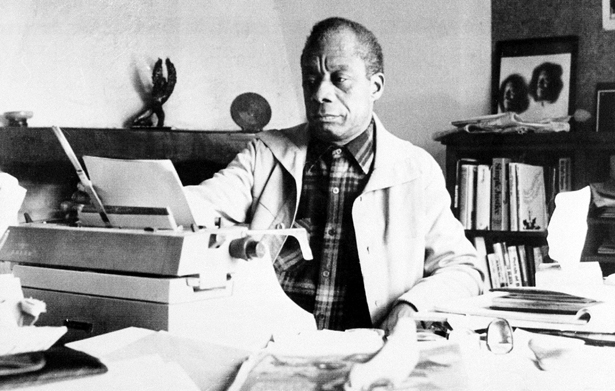
James Baldwin wrote in 1966 about the antagonistic relationship between Black Americans and the police; his willingness to interrogate that dynamic provides a powerful framework for rethinking the antagonism between educators and students. (The Nation)

Teaching in my third academic year impacted by the Covid pandemic, I am feeling nostalgic for some (but not all) of the pre-pandemic dynamics in the classroom.

My university established and followed strict protocols throughout the 2020-2021 academic year that allowed many courses to be taught face-to-face (while professors were allowed to teach remotely and courses provided many hybrid opportunities to address student needs). But last year was a very stilted teaching and learning experience with faculty and students fully masked and social distancing (maintaining the six-feet requirement typical pre-vaccine).

This fall we are face-to-face, masked, but not social distancing; therefore, I am enjoying being able to do small group work in class again. A return to semi-normalcy in the classroom means that Monday, as my first-year writing seminar students formed groups to discuss their reading of Baldwin, I waited a few minutes before strolling around the room to listen to the discussions.

Anyone who teaches knows what happened; as I approached each group, students fell silent, and several looked up, concerned.

I always take these moments to begin a discussion about the antagonistic relationship that exists between teachers and their students. Students admit that a teacher approaching makes them afraid they are doing something wrong, even when they are fully engaged in the assignment.

Many of us who went through teacher training or conduct teacher training have discussed walking toward students as a classroom management technique.

It does work, but we rarely unpack why and almost never interrogate that the technique should not “work.”

My first-year students at a selective liberal arts college (having almost all been very successful in K-12, either straight-A students or close to that) are quick to acknowledge the many ways that they feel antagonism from and toward their teachers. From dress codes to bathroom restrictions to grading policies to late-to-class rules—students find the school days filled with landmines policed by their teachers.

Of note is how difficult it is for first-year college students to shift away from student behaviors (raising hands, asking to go to the bathroom) and toward autonomous adult behaviors (we explicitly focus on the difference between access to going to the bathroom in high school and college).

Part of this reductive and dehumanizing dynamic is the prevalence of uncritical embracing of simplistic behaviorism grounded most vividly in the punishment/reward elements of school rules and grading.

Despite my commitment to creating a classroom environment driven by collaboration and not antagonism, students still primarily experience antagonistic relationships with their teachers/professors when learning formally.

As a professor, I witness that reality because of one of the worst aspects of the teaching profession—educators publicly shaming student behaviors.

When I started teaching high school in 1984, I quickly learned to avoid the teachers’ lounge, where my colleagues tended to gather and endlessly rail against (by name) students that I taught (and loved). What I noticed was a proclivity for teachers to angrily berate teenagers for behaving like teenagers.

One of my fortunate gifts as a teacher is that I chose to teach high school and that I genuinely love teenagers because they have reached an early stage of adulthood but also maintain some of the most endearing qualities of childhood. I very much enjoyed discovering and unpacking the world with teenagers who found everything to be new (even as I realized that none of it was new).

Jump about four decades later, and I see that played out just a bit differently on social media, where teachers and professors routinely hold forth in anger about a student’s email asking if they missed anything when absent. This sort of public (although anonymous) student shaming seems to be common at the beginning and end of semesters so there has been a flurry of them over the past few weeks.

Tip toeing the line of subtweeting, I Tweeted this yesterday with those type of social media posts in mind:

Later, I added this:

Throughout my career as a high school teacher and now a college professor, I have worked diligently to be student-centered in the way that honors the autonomy and human dignity of my students; I have also embraced Paulo Freire’s concepts of choosing to be authoritative and not authoritarian as a teacher, parent, and coach.

This critical commitment has often been well embraced by my students (although not all of them) but rebuffed by many, if not most, of my colleagues. A typical criticism I hear (which I confront in the second Tweet above) is that if adult authority figures are not authoritarian, students will take advantage of them.

The nasty (and false, I think) Puritanical belief that humans (especially children and teenagers) left alone will behave in base and selfish ways seems to be how many teachers/professors view their students. This deficit perspective is pervasive in education, often manifested as racism, classism [1], sexism, and agism but masked as “necessary” lest we lose all control!

I firmly reject that my job as a teacher is to “fix” inherently flawed young humans and instead embrace that to teach is to provide the guidance necessary for young people to develop their autonomy and recognize their and other’s basic human dignity.

Over almost 40 years of teaching, I have had very few students attempt to take advantage of me, and most of them have suffered the consequences they deserved for that behavior while many of them have directly reached out to me over the years to apologize.

A low-stakes teaching and learning environment has allowed me to be very demanding, having extremely high standards for students, and I have found that students respond well to high expectations couched in clear expectations, detailed support and feedback, and patience paired with firm guidelines for student behavior and artifacts of their learning.

I have documented on social media several times that my students submit work on time at well over 90-95% rates although I do not grade assignments and do not record or deduct for late work. Almost all the work that is late can be traced tp legitimate reasons (the types of real-world justifications for late work that adults enjoy).

Students and educators deserve a teaching/learning environment grounded in collaboration and not antagonism—where everyone has their autonomy and human dignity honored, and even celebrated.

If K-12 and undergraduate students already knew and behaved in all the ways adults want, why would they need to be in our classes?

When Student Y sends a preposterous email, our job as educators is to teach the student why it is preposterous, and how to engage with another human in ways that show respect to both the student and the teacher.

And that teaching—even when our last nerve is tested—must be as patient as possible, although firm, and our students must trust that we are here to work with them for their success, not to police them for their flaws until they are properly “fixed.”

At its core, I think James Baldwin’s view of policing serves us well here: “The law is meant to be my servant and not my master, still less my torturer and my murderer.”

And so, many days while teaching, I explain to students that I work for them, and when all is going as it should, I actually am there to work with them.

None the less, every time I walk toward a small group of students, they fall silent and look up, faces expecting antagonism and not yet sure we are there for the same thing—whatever any student needs to live autonomous lives where their human dignity is seen and appreciated.


[1] See:

The return of the deficit signifies a depressing symmetry in demographic trends and public policy. Deborah Stone (1997), writing on the art of political decision­making, argues that “political reasoning is [about] metaphor­making and category­making . . . strategic portrayal for persuasion’s sake, and ultimately for policy’s sake” (p. 9). Portraying disproportionate school failure among Black and Hispanic youth in terms of “personal troubles” (Mills, 1959) or cultural deficiencies sustains public policies that emphasize individual self interest and personal responsibility (e.g., welfare reform, high stakes testing), leaving no reason to consider the effects of poverty and discrimination or underfunded schools and deteriorating facilities on children’s learning.

Dudley-Marling, Curt (2007) “Return of the Deficit,” Journal of Educational Controversy: Vol. 2 : No. 1 , Article 5.
Available at: https://cedar.wwu.edu/jec/vol2/iss1/5

Drama and the Struggling High School Reader

In my current trends in literacy course for our MAT program, I have 7 students across several content areas. Our discussion yesterday confronted how too often teachers (notably ELA teachers) assign texts and reading that discourage students as readers.

One candidate in ELA shared a story of a teacher who declared that most of their students “can’t read Shakespeare” so that teacher has the class listen to an audio recording of the play Macbeth.

I noted that required reading lists often do more harm than good for students as readers and added if I had to choose between required texts that students don’t read or choice texts that students actually read, I always want the latter.

Further, this example triggered a pet peeve of mine about how we teach different forms and genres of writing.

I asked the class what type of text Macbeth is, and they all identified it as a play. I followed up with asking how plays/drama are intended to be experienced, and again, they all noted that plays are written to be viewed, preferably as live performances.

Next, I shared with them recurring experiences I have with my first-year writing students (high-achieving students—disproportionately white and affluent—admitted to a selective liberals arts college).

Often on the first day of class, I ask students what novels they read in high school English, and several students will say A Raisin in the Sun, Hamlet, and such. I then point out that these are plays, and not novels. But the students have mostly read these plays in bound books that look identical to the novels they were assigned.

Also in the first few days, I have students do a writing exercise where they write a mimic passage from a chapter in Sandra Cisneros’s The House on Mango Street, “A House of My Own.” Students are told to mimic the grammar and style of the chapter exactly while changing the content.

The assignment is designed as a first transition to reading like a writer [1] (as opposed to reading text for literary analysis) so that students develop the skills needed to compose and revise with attention to not just what they express but also how they express their messages.

Invariably, several students email me their piece and identify it as their “poem,” despite my noting in class that they are mimicking a prose chapter from a novel.

In other words, very bright and often “A” students demonstrate over and over that they have garbled and often inaccurate knowledge about genre and form—and they learn these flawed lessons in school, typically in English, because of careless approaches to text like the one above concerning Macbeth.

I want to focus here on two aspects, interconnected, about how we teach text to students, particularly in high school.

First, concerning having students listen to or read plays, I always see lessons involving text as essentially lessons in genre awareness, a concept endorsed by Ann Johns instead of genre acquisition (her discussion forefronts composition, but this applies to reading as well):

Russell [and] Fisher (in press) distinguish between two approaches to genre pedagogy, two basic goals for a course or tutorial. The first is GENRE ACQUISITION, a goal that focuses upon the students’ ability to reproduce a text type, often from a template, that is organized, or ‘staged’ in a predictable way. The Five Paragraph Essay pedagogies, so common in North America, present a highly structured version of this genre acquisition approach. …

A quite different goal is GENRE AWARENESS, which is realized in a course designed to assist students in developing the rhetorical flexibility necessary for adapting their socio-cognitive genre knowledge to ever-evolving contexts. …I have concluded that raising genre awareness and encouraging the abilities to research and negotiate texts in academic classrooms should be the principal goals for a novice literacy curriculum (Johns 1997).

This juxtaposition of two quite different goals, genre acquisition and genre awareness, is reminiscent of another pedagogical contrast mentioned by Henry Widdowson years ago (1984) and, later, by Flowerdew (1993): that pedagogies are designed to either TRAIN for specific tasks (i.e., text types) or EDUCATE, to cope with an almost unpredictable future. It is my argument here that education should, in the end, be our goal for novice academic literacy courses, for a genre awareness education will prepare students for the academic challenges
that lie ahead. (pp. 238-239)

Johns, A.M. (2008). Genre awareness for the novice academic student: An on-going quest. Language Teaching, 41(2), 237-252.

Therefore, when I teach a genre or form, I typically invite students to ask questions and develop or refine their internalized rubric for what constitutes that genre or form (or medium): What makes a poem, a poem? What makes a comic book, a comic book? What makes a film, a film? What makes an essay, an essay? etc.

Reading and critical literacy require that the reader come to a text with some awareness of form and genre, and that awareness helps the reader navigate the text for meaning.

Sitting down to read Naomi Shihab Nye’s “Gate A-4,” for example, often challenges people since I have seen it identified and heard students refer to the work as a poem, a story, and a non-fiction essay (it is a prose passage, fictional, in Nye’s Honeybee: Poems & Short Prose).

Finally, we must confront why Macbeth was taught to these students through an audio recording—the conclusion that high school students couldn’t read Shakespeare.

I am deeply skeptical of the rush to identify high school students as struggling readers for several reasons:

  • Many high school students are non-readers and it is too easy to conflate non-readers with struggling readers.
  • Often, even in ELA courses, lessons and assessments are designed in ways that allow students to pass or even excel in a course without having to read [2] (students can access information on novels and plays or simply depend on the teacher to cover everything to be assessed in class, which most teachers do).
  • Students who are non-readers are not necessarily demonstrating they have decoding, vocabulary, or comprehension problems, but that they lack motivation to read texts assigned to them and to perform in ways that are not authentic. Many non-readers in the classroom go home and perform complex and advanced literacy that teachers do not see and traditional schooling does not acknowledge (video and board gaming, binge-watching TV, reading and collecting comic books, reading novels they choose such as YA lit or science fiction and fantasy).
  • Students who “struggle” with assigned texts and performing in ways that are often required in school (narrow analysis and multiple choice testing) may be struggling due to those expectations as well as lacking adequate experience reading (since they have passed courses without reading). I think “struggling” is a misnomer for that phenomenon.

Lou LaBrant warned in 1949, “We should not, under the guise of developing literary standards, merely pass along adult weariness” (p. 276).

And LaBrant (1937) held that belief because “the adolescent has much greater power to read and to think intelligently about reading than the results of our conventional program have led us to believe” (p. 34).

We ask too little of students when we fail to honor the fidelity of genre, form, and medium, but we ultimately fail students when we assume their lack of reading lies in a fault with them (“struggling”) instead of interrogating what we require them to read (or not read) and our reductive approaches to text and literacy.


[1] See here and here.

[2] I saw a former students several years after he was a marginal and combative AP Literature student of mine. He smiled and announced that he expected I would be surprised to know he earn a degree in English in college. Then, he added that he did so without ever reading a book assigned to him.

Sources

LaBrant, L. (1949, May). Analysis of clichés and abstractions. English Journal, 38(5), 275-278. Stable URL: http://www.jstor.org/stable/807545

LaBrant, L. (1937, February 17). The content of a free reading program. Educational Research Bulletin, 16(2), 29–34. Stable URL: http://www.jstor.org/stable/1471836

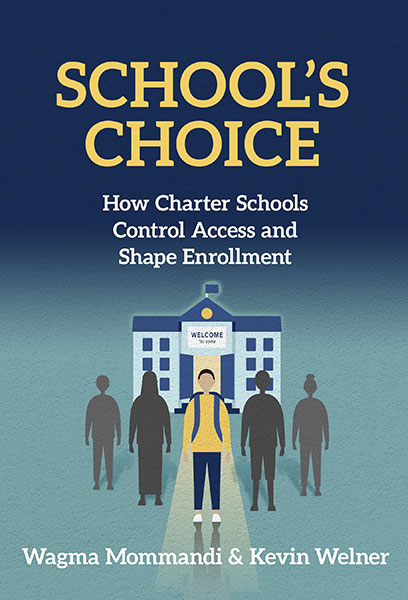
Recommended: School’s Choice: How Charter Schools Control Access and Shape Enrollment (TCP)

School’s Choice: How Charter Schools Control Access and Shape Enrollment

School’s Choice 9780807765814

Wagma Mommandi, a former public-school teacher, is a PhD candidate in education policy at the University of Colorado Boulder School of Education. 

Kevin Welner is a professor and the director of the National Education Policy Center, which is housed at the CU Boulder School of Education.

Access issues are pivotal to almost all charter school tensions and debates. How well are these schools performing? Are they segregating and stratifying? Are they public and democratic? Are they fairly funded? Can apparent successes be scaled up? Answers to all these core questions hinge on how access to charter schools is shaped. This book describes the incentives and pressures on charter schools to restrict access and examines how charters navigate those pressures, explaining access-restricting practices in relation to the ecosystem within which charter schools are created. It also explains how charters have sometimes responded by resisting the pressures and sometimes by surrendering to them. The text presents analyses of 13 different types of practices around access, each of which shapes the school’s enrollment. The authors conclude by offering recommendations for how states and authorizers can address access-related inequities that arise in the charter sector. School’s Choice provides timely information on critical academic and policy issues that will come into play as charter school policy continues to evolve.

Book Features:

  • Examines how charter schools control who gains and retains access.
  • Explores policies and practices that undermine equitable admission and encourage opportunity hoarding.
  • Offers a set of policy recommendations at the state and federal level to address access-related issues.

Beware the Roadbuilders 2021

I entered the classroom as a high school English teacher in Upstate South Carolina in the fall of 1984, coinciding with the start of the high-stakes accountability movement in my home state as well as across the U.S.

Many people identify the Nation at Risk report under Ronald Reagan as ground zero for the accountability movement that entrenched patterns of school reform lasting until today—ever-changing standards, ever-changing high-stakes tests, and a never-ending refrain that schools are failing.

George W. Bush brought state-level education reform/accountability to the federal level with the bi-partisan No Child Left Behind, and then Barack Obama doubled down on the same basic concepts and approaches despite decades of accountability measures not working.

As a result, when I entered the world of blogging and public commentary during Obama’s administration, I found two enduring and powerful metaphors for the essential flaws of the accountability/education reform movement.

One is from Oscar Wilde: “But their remedies do not cure the disease: they merely prolong it. Indeed, their remedies are part of the disease.”

And the other is inspired by a scene from Alice Walker’s The Color Purple, detailed in a letter from Nettie to Celie:

The first thing I should tell you about is the road. The road finally reached the cassava fields about nine months ago and the Olinka, who love nothing better than a celebration, outdid themselves preparing a feast for the roadbuilders who talked and laughed and cut their eyes at the Olinka women the whole day. In the evening many were invited into the village itself and there was merrymaking far into the night. I think Africans are very much like white people back home, in that they think they are the center of the universe and that everything that is done is done for them. The Olinka definitely hold this view. And so they naturally thought the road being built was for them [emphasis added]. And, in fact, the roadbuilders talked much of how quickly the Olinka will now be able to get to the coast. With a tarmac road it is only a three-day journey. By bicycle it will be even less. Of course no one in Olinka owns a bicycle, but one of the roadbuilders has one, and all the Olinka men covet it and talk of someday soon purchasing their own.

Well, the morning after the road was “finished” as far as the Olinka were concerned (after all, it had reached their village), what should we discover but that the roadbuilders were back at work. They have instructions to continue the road for another thirty miles! And to continue it on its present course right through the village of Olinka. By the time we were out of bed, the road was already being dug through Catherine’s newly planted yam field. Of course the Olinka were up in arms. But the roadbuilders were literally up in arms. They had guns, Celie, with orders to shoot!

It was pitiful, Celie. The people felt so betrayed! They stood by helplessly—they really don’t know how to fight, and rarely think of it since the old days of tribal wars—as their crops and then their very homes were destroyed. Yes. The roadbuilders didn’t deviate an inch from the plan the headman was following. Every hut that lay in the proposed roadpath was leveled. And, Celie, our church, our school, my hut, all went down in a matter of hours. Fortunately, we were able to save all of our things, but with a tarmac road running straight through the middle of it, the village itself seems gutted.

Immediately after understanding the roadbuilders’ intentions, the chief set off toward the coast, seeking explanations and reparations. Two weeks later he returned with even more disturbing news. The whole territory, including the Olinkas’ village, now belongs to a rubber manufacturer in England. As he neared the coast, he was stunned to see hundreds and hundreds of villagers much like the Olinka clearing the forests on each side of the road, and planting rubber trees. The ancient, giant mahogany trees, all the trees, the game, everything of the forest was being destroyed, and the land was forced to lie flat, he said, and bare as the palm of his hand.

The Color Purple

From this, I drew a conclusion that has served as a guiding metaphor for my criticism of the education reform movement and the title of one of my books, Beware the Roadbuilders: Literature as Resistance (Garn Press): “Beware the roadbuilders. They are not here to serve you, they are on their way to bulldoze right over you.”

I have come back to this metaphor as both ongoing criticism and confirmation that accountability is a failed approach to education reform.

One element of the tension between the accountability/education reform movement and those of us committed to education and social reform grounded in equity (and not accountability) is the shared acknowledgement that universal public education has a long history of failing marginalized and oppressed populations of students, reflecting the larger failures of communities, states, and the broader U.S. to serve marginalized and oppressed people.

It is 2021, and in my home state of SC, the metaphor I have depended on is being vividly and callously brought to reality:

The dismantling of Black communities for state and federal highways is not just a thing of the past. It’s happening now a few miles north of Charleston with the proposed West I-526 Lowcountry Corridor, at a time when President Biden and his transportation secretary have vowed to stop it.

South Carolina is proposing to sweep aside dozens of homes, and potentially hundreds of people, to widen a freeway interchange choked with traffic in this booming coastal region. The $3 billion project is expected to begin about two years after the plan becomes final. …

Under the state’s preferred proposal for the interchange upgrade, 94 percent of people and structures that would be displaced live in environmental justice communities mostly composed of Black and Brown residents.

Black people are about to be swept aside for a South Carolina freeway — again

It is 2021, and I must reach the same conclusion I drew in 2014: Beware the roadbuilders. They are not here to serve you, they are on their way to bulldoze right over you.


Recommended

‘White Men’s Roads Through Black Men’s Homes’: Advancing Racial Equity Through Highway Reconstruction, Deborah N. Archer

Abstract

Racial and economic segregation in urban communities is often understood as a natural consequence of poor choices by individuals. In reality, racially and economically segregated cities are the result of many factors, including the nation’s interstate highway system. In states around the country, highway construction displaced Black households and cut the heart and soul out of thriving Black communities as homes, churches, schools, and businesses were destroyed. In other communities, the highway system was a tool of a segregationist agenda, erecting a wall that separated White and Black communities and protected White people from Black migration. In these ways, construction of the interstate highway system contributed to the residential concentration of race and poverty, and created physical, economic, and psychological barriers that persist.

Today, the interstate highway system is on the verge of transformational change as aging highways around the country are crumbling or insufficient to meet growing demand and must be rebuilt or replaced. The possibility of significant infrastructure development offers an opportunity to redress some of the harm caused by the interstate highway system, to strengthen impacted communities, and to advance racial equity. Still, there is a risk that federal, state, and local highway builders will repeat the sins of the past at the expense of communities of color whose homes, businesses, and community institutions again stand in the path of the bulldozers. Moreover, there is reason to believe that traditional civil rights laws, standing alone, are insufficient to redress the structural and institutional racism that shaped the interstate highway system and continues to threaten communities of color as the highways are rebuilt.

This Article is the first in the legal literature to explore in depth the racial equity concerns and opportunities raised by modern highway redevelopment. It also builds upon the work of legal scholars who advocate for addressing systemic racial inequality by requiring that policymakers conduct a thorough and comprehensive analysis of how a proposed action, policy, or practice will affect racial and ethnic groups. The Article concludes by proposing a way forward for highway redevelopment projects: requiring jurisdictions to complete comprehensive racial equity impact studies prior to any construction. Racial equity impact studies have been used or proposed in various contexts to reform racialized institutions and structures. This Article argues that highway redevelopment projects should join this growing list.

Archer, Deborah N., ‘White Men’s Roads Through Black Men’s Homes’: Advancing Racial Equity Through Highway Reconstruction (February 18, 2020). 73 Vanderbilt Law Review 1259 (2020), NYU School of Law, Public Law Research Paper No. 20-49, Available at SSRN: https://ssrn.com/abstract=3539889

Indoctrination by Omission

While attacks on Critical Race Theory (CRT) by Republicans and conservatives have many different claims, one consistent element of these attacks is misinformation.

One of those false associations can be found at the persistently misleading Discovery Institute (infamous for stoking the evolution debate): Critical Race Theory – The Marxist Trojan Horse writes Walter Myers III for the “institute.”

Recently I gave a presentation for a learning in retirement session at my university—The 1619 Project:  Should we “reframe” our country’s history to include the consequences of slavery?”

In the opening of the presentation I explain what CRT is, focusing on the Big Lie of the attacks by assuring everyone that CRT is not taught in K-12 schools.

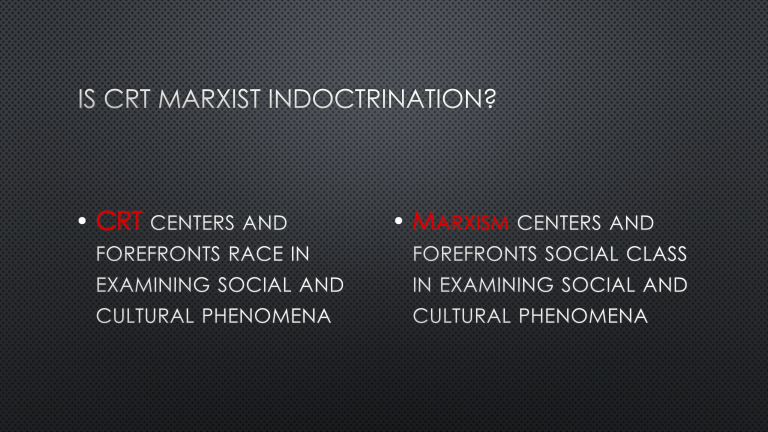
But I also focused on the claim that CRT is Marxist indoctrination:

While some overlap does exist among CRT scholars and Marxist scholars, there often is considerable tension between the focus on centering race and centering social class.

While this slide sparked some important dialogue among the audience, I had begun the presentation (not planned) by noting that the session began with a short video that included a dramatic reading that included the phrase “black-on-black crime.”

I noted that while crime in the U.S. is overwhelmingly within race—the white-on-white crime rate is about the exact same as the black-on-black rate—media, public, and political discourse only utters “black-on-black crime.”

This is indoctrination by omission, and this phenomenon in education raises an important question:

Similar to what I have raised before—Who’s indoctrinating whom?—”Are we worried about ideology or just one ideology?” is an important question to confront, and we are left with only one real answer.

Conservatives are seeking ways to indoctrinate students within the parameters of their ideology; therefore, the attacks on CRT and the 1619 Project are not calls for academic freedom, the marketplace of ideas, or even “both sides.”

Republicans and conservatives are seeking indoctrination by omission.

As I responded to the Tweet above, I noted that since I teach many students with private religious K-12 schooling, I regularly am asked to “go over” evolution because these very bright and high-achieving students were never taught evolution in biology while attending private religious schools.

Whether its our schooling or our political, media, or public discourse, what is not spoken is just as powerful as what is spoken.

Poet Adrienne Rich writes in her “Arts of the Possible,” the eponymous essay of her 2001 collection of essays:

The matrix of a poet’s work consists not only of what is there to be absorbed and worked on, but also of what is missing, desaparecido, rendered unspeakable, thus unthinkable. It is through these invisible holes in reality that poetry makes it way—certainly for women and other marginalized subjects and for disempowered and colonized peoples generally, but ultimately for all who practice art at any deep levels. The impulse to create begins—often terribly and fearfully—in a tunnel of silence.

On Lies, Secrets, and Silence: Selected Prose 1966-1978

In the Bizarro world of conservative thought, simply exposing students to ideas that do not conform to a narrow conservative ideology is a type of indoctrination.

Republicans are trying to control K-12 and higher education in ways that honor mythologizing/idealizing the past and speaking of U.S. history and day-to-day realities of the U.S. through aspirational language—from “Founding Fathers” to “the U.S. is not a racist country.”

Ultimately, what offends Republicans/conservatives about academic freedom and critical approaches to history, literature, etc., is that being critical is inherently a challenge to power and a rejecting of indoctrination.

There is no such thing as objective history, no such thing as de-politicized “facts.”

Contemporary historians are well aware that history tends to be written by the winners, by those with power and authority, and that these versions of history are in the interests of those with that power and authority.

Current attacks on CRT have included direct attacks on the work of Howard Zinn, who popularized seeing history from the perspectives of the losers and marginalized.

Returning to the Tweet above, conservatives are not angry that Zinn’s history is ideological, but that Zinn’s history challenges their singular ideology of mythologizing, idealizing, and aspiring to the detriment of marginalized populations in the U.S.

If we in the U.S. genuinely value individual freedom, each child and young adult deserves education grounded in academic freedom, and academic freedom requires that we attend to not only what is taught but also what is omitted.

K-12 and higher education are not indoctrinating children and teens, certainly not into Marxist ideology, but Republicans/conservatives are endorsing indoctrination by omission—something that if we want to be aspirational is not very American.


Recommended

Conceptualizing color-evasiveness: using dis/ability critical race theory to expand a color-blind racial ideology in education and society

Moving from “All Students Must” to “Each Student Deserves”

Since publishing my book, How to End the Reading War and Serve the Literacy Needs of All Students, that examines the current “science of reading” (SoR) version of the Reading War, I have given several interviews and presentations on that work.

I have also continued to blog about the movement, and in all of these experiences, I am forced to rethink and think more complexly through what I know and understand about the SoR movement as well as how to teach reading and literacy.

The most recent interview, by literacy expert Sam Bommarito, proved to be an enlightening experience on several levels.

First, Sam’s experience and expertise in the field of literacy were a welcomed change from being interviewed by generalists and journalists because his questions dove directly into the core of the issues surrounding SoR and those questions challenged me to think more deeply and carefully.

Our exchange between people with similar levels of expertise on the subject allowed (or even required) us to focus on how best to offer any viewers nuanced but clear explanations of a deeply complex topic; as I noted (and emphasize often now), the evidence on teaching reading is not simple, and not settled.

But the larger take-away for me after the interview was that Sam’s third question—Does it make any sense to effectively ban selected practices found in balanced approaches to reading, e.g., reading recovery, workshop teaching or guided reading?—prompted me to explain in greater detail a core concept that grounds a fundamental reason I reject the SoR movement.

Whether I am addressing literacy specifically or teaching pedagogy broadly, I have relied for many years on the best practice concepts expressed by Zemelman, Daniels, and Hyde.

Each chapter in their book (now in its fourth edition) ends with a chart that suggests instructional practices that teachers should increase or decrease; for example, on writing instruction (download sample here):

Key to note is that best practice is grounded in broad and diverse bodies of research on teaching and learning, and that best practice philosophy neither requires nor bans any specific instructional approach; whether a teacher uses any pedagogy is directly linked to student need (not a prescription form some authority such as standards or an adopted program).

When SoR advocates call for “all students must” (for example, systematic intensive phonics for all students and universal screening for dyslexia), they are misrepresenting what we know about teaching and learning: There is no universal silver bullet for “all students.”

Best practice structures promote research and evidence as a spectrum, a range of practices for every teacher’s toolbox; best practice also recommends that instruction begin with individual students, their demonstrated known, unknown, and misconceptions.

If we think carefully about decoding and direct instruction in phonics and phonemic awareness, teachers will face a wide diversity of students in any class in terms of where they are in their reading development; in short, there simply is no situation where “all students must” serves students well.

Literacy is not simple, and literacy development is not linear, sequential, or systematic.

For example, most people do not accumulate vocabulary in order to be able to read, but develop their vocabulary by reading.

Context (in terms of so-called literacy skills) and engagement are extremely important when students are developing their literacy; regretfully, many misguided movements during the history of the Reading War have eroded an essential aspect of literacy that must be honored—literacy as holistic.

Here, we must address a fundamental paradox in the SoR movement.

Several different kinds of advocacy are fueling the SoR movement—from parents advocating for greater awareness of dyslexia to Black and poor parents advocating for under-/un-served populations of students to advocates for the needs of emerging bilingual students.

The common denominator here is a genuine concern for the under-/un-served student, a pervasive belief that for a number of reasons, too many students are being failed by the system itself (although some elements of the SoR movement are also directly blaming teachers and teacher educators for those failures).

The paradox is that the aggressive advocacy behind the SoR movement is driving an all-or-nothing silver-bullet approach to teaching reading, which will mis-serve students as much or more than the current conditions of teaching and learning in U.S. public schools.

So this leads me to Sam’s effort to bridge the divisions in the Reading War (something I am far more skeptical about, as I address in Sam’s question 5: Cambourne and Crouch recently said we should stop using the Reading Wars metaphor and replace it with the metaphor of the Reading Quilt- with different “sides” adding different pieces to the quilt. Do you see any hope for that point of view? Do you see hope for an end to the divisive discourse?  Do you see hope for ending the reading wars? [13:20]).

I am no fan of compromise (as I explain in the interview) but I think we do have common ground in terms of two beliefs: (1) Far too many students are being under-/un-served in our current K-12 public school system (notably in their literacy), and (2) the under-/un-served are disproportionately marginalized and vulnerable populations of students (Black students, poor students, emerging bilinguals, students with special needs).

Not a compromise, but my modest proposal is that all of us concerned with reading and literacy among K-12 students need to set aside the “all students must” mandate and commit instead to “each student deserves.”

“All students must” be screened for dyslexia is a guaranteed disaster for students (consider the over-diagnosing of ADHD as one example), but “each student deserves” access to ample books and other texts in their homes and schools fulfills what we know about literacy development without being overly simplistic or harmful.

Each student deserves whatever teaching and learning experiences they need and want in order to grow and develop at the rate unique to them (not some manufactured and artificial “grade level” proficiency).

This commitment shifts our instruction and assessment gaze away from compliance to a reading program or to a set of prescribed standards and toward the demonstrated needs and wants of each student who enters any classroom.

The ultimate irony here is that the whole language (WL), reading/writing workshop, and balanced literacy (BL) movements (all falsely demonized since the 1990s) offer that exact commitment along with very high standards for teacher expertise (each of us in charge of any student must have a very complex toolbox for teaching and also must be prepared to individualized instruction).

Again, as I stated in the interview, WL, workshops, and BL did not fail our students, but we have certainly failed the core commitment of those movements—serving the learning needs of each student.

What we know about teaching reading is not simple or settled, but I think we can and must all agree that instead of falling prey to the overly simplistic and harmful “all students must,” a better way forward is a resolute commitment to “each student deserves.”