Category Archives: Educational Research

“Science of” Movements as Trojan Horse Education Reform

[Header Photo by Tayla Kohler on Unsplash]

The charter school story in New Orleans is almost two-decades long, but most people will not dig past the most recent development: After a 7-year experiment, New Orleans is an all-charter district no more.

In the wake of Katrina in 2005, Louisiana Governor Bobby Jindal (R) leveraged the natural disaster to begin the eventual shift of schools in New Orleans from traditional public schools (TPS) significantly staffed by a Black professional class of teachers to a charter school Recovery School District (RSD) run by Paul Vallas and often staffed by young, white, and affluent Teach for America (TFA) recruits.

This moment was acknowledged by some as disaster capitalism that had far more to do with politics than improving student achievement. The endgame was to entrench school choice schemes and create a cheaper although fluctuating teacher workforce (TFA).

Yet, as many of us warned, an all-charter school system in New Orleans never outperformed the TPS it replaced.

In fact, all across the US, charter schooling, RSD, TFA, and almost every major education reform schemes have never delivered on the academic outcomes promised.

Here, it is important to acknowledge that most education reform in the US over the past 40 years has been grounded in conservative ideology (even though the political support has been bi-partisan) and most of that reform is Trojan Horse reform—using a false veneer of reform to accomplish ideological and political agendas.

School choice schemes are not about student achievement but about publicly funding private education and “white flight” as public schools have become majority-minority populations of students.

TFA and organizations such as National Council on Teacher Quality (NCTQ) are not designed to improve teacher quality or teacher preparation but about creating a cheap workforce and eradicating teacher professionalism to make way for teachers as mere monitors for scripted programs and computer-based instruction.

Although just two examples, the key point is running through Trojan Horse education reform is not just political and conservative ideology but also a commitment to market forces.

Education reform in the US primarily creates churn—new standards, new programs, new materials, new teacher training, etc.—that serves the needs of the market, not parents or their children. That churn is promoted by education reform influencers who only gain if schools, teachers, and students are perpetually viewed as failing—permanent crisis.

Lurking underneath education reforms during George W. Bush’s tenure as governor of Texas and president of the US was the lure of scripted curriculum that shifted authority away from the teacher and to the state and primarily commercial products.

Although Bush’s reform agendas flourished with bi-partisan support, scripted curriculum and de-professionalizing teachers (see also the value-added methods schemes and the “bad teacher” attacks under Michelle Rhee) mostly lost favor and lay dormant post-Obama (even as the Obama administration double-down on most of the conservative elements established by Bush’s administration).

That is, lay dormant until the “bad teacher” myth was resurrected by Emily Hanford and the “science of reading” (SOR) movement.

As Aukerman explains, the story being sold included several elements of failure and incompetence that pits classroom teachers against teacher educators (both of which are primarily women professionals):

Now that SOR has mostly uncritically swept across the US in the form of state-level reading legislation and policy, the evidence suggests that at the core of the so-called success of SOR policies (see Mississippi and Florida) is one of the most conservative and harmful policies possible—grade retention, as Westall and Cummings explain:

Similar to the results for states with comprehensive early literacy policies, states whose policies mandate third-grade retention see significant and persistent increases in high-stakes reading scores in all cohorts. The magnitude of these estimates is similar to that of the “any early literacy policy” estimates described in Section 4.1.1 above, suggesting that states with retention components essentially explain all the average effects of early literacy policies on high-stakes reading scores. By contrast, there is no consistent evidence that high-stakes reading scores increase in states without a retention component.


Grade retention disproportionately impacts poor students, Black students, Multi-lingual learners, and other marginalized population of students. Retention is popular because it represents a type of accountability and punishment for “other people’s children” who need to be “fixed” by those in power.

Concurrent with the SOR movement, a new flurry of “science of” movements have propagated: “science of learning,” “science of writing,” “science of math.”

The mostly uncritical support for SOR by the media, the education market, parents, and politicians have provided fertile ground for a larger “science of” movement to drive our newest round of the same education reform structures we have been implementing without improving student achievement for forty-plus years.

Let’s emphasize here, Trojan Horse education reform doesn’t work to improve teaching and learning, but it does work for media, market, and political interests.

And now, the mask is coming off with the announcement of the Evidence Advocacy Center:

In the EAC’s plan for the transformation of the profession into an evidence-based system, educators will relinquish certain freedoms — notably the leeway to employ ineffective practices — but will gain guidance that empowers them to fulfill their original purpose by profoundly impacting the future of students, families and communities. The alternative is to continue rearranging the deck chairs under the guise of education reform.


“Relinquish certain freedoms” is eerily similar to the explanation handmaid’s received in The Handmaid’s Tale:

There is more than one kind of freedom, said Aunt Lydia. Freedom to and freedom from. in the days of anarchy, it was freedom to. Now you are being given freedom from. Don’t underrate it….

We were a society dying, said Aunt Lydia, of too much choice. (pp. 24, 25)


Under the Brave New World of “science of” education mandates, teachers will have freedom from professional autonomy and freedom to implement scripted programs!

And who benefits?:

Many of these groups are fundamentally conservative, but even a modicum of interrogating the Who and Why behind this agenda reveals some chilling concerns.

NCTQ was founded by the Thomas B. Fordham Institute, a conservative think tank dedicated to school choice/charter schools and market forces. Note that there is a distinct contradiction between advocating for “science” in education practices and citing NCTQ, which has never produced any scientifically valid “reports.”

The leadership of EAC includes several connections to the University of Oregon, home of DIBELS®, a phonics-centric program that was revitalized by the SOR movement.

Other leaders include Louisa Moats, creator of LETRS, which is being mandated across the US to retrain teachers in SOR even though, again, the program is not supported by science.

The Reading League has its own market connections, endorsing practices not supported by the science (decodable texts, notably).

The 95 Percent Group is also based on an aspirational claim not grounded in settled science, as one analysis concludes about the 95% claim: “This all said, it does seem there is some level of support for 96% being a benchmark goal [emphasis added], for reading proficiency rates.”

And two key comments lurking in the background of these “science of” movements must not be ignored.

First, directly from the International Dyslexia Association:

The term “Structured Literacy” is not designed to replace Orton Gillingham, Multi-Sensory, or other terms in common use. It is an umbrella term designed to describe all of the programs that teach reading in essentially the same way. In our marketing, this term will help us simplify our message and connect our successes. “Structured Literacy” will help us sell what we do so well.


And then from the Education Writers Association:

Connect the dots and connect the rhetoric: “Relinquish certain freedoms,” “sell what we do so well,” “watchdogs.”

The “science of” movements are yet another cycle of Trojan Horse education reform. We have already opened the gates and waved this in with blinders on, so now we must do our best to reclaim teaching and learning that serves the needs of our students and not the media, the market, and political/ideological agendas at the expense of those students.

Recommended

What You See Is Not What You Get: Science of Reading Reforms As a Guise for Standardization, Centralization, and Privatization | American Journal of Education, Elena Aydarova

Politics of phonics: How Power, profit and politics guide reading Policies

Deinfluencing Reading Policy

[Header Photo by Diggity Marketing on Unsplash]

My partner and I were discussing this YouTube video by Nick Lewis, who explains in the beginning how social media influencers make profits (watch the first few minutes, by the way, for his explanation):

The key point here is that social media influencers need consumers to always be interested and buying the next thing, the new thing.

Influencers are not incentivized to find for their audiences The Thing, something that lasts, something that solves a problem, because the value is in churn—consumer buying the thing and then almost immediately positioned to want to replace that thing with the new thing.

That dynamic is exactly what is working in the perpetual reading war where influencers (journalists, education reformers, politicians) are incentivized to keep the public in a constant state of crisis/reform.

Those crisis influencers must first create market space (“Reading programs X and Y have failed!”) and then promote the New Reading Program—and then in just a few years, that reading program will be declared a failure so if we will only adopt this Next New Reading Program …

Reading reform influencers are like social media influencers as well in that they lack expertise in the issue; their only expertise is the influencing and the creation of constant churn.

The “science of” movements in education are just that—influencers creating market churn—and not in most ways about addressing real educational problems and certainly not about solving them.

If education and reading were satisfactorily improved, what would they do?

We need to deinfluence reading (and education) reform if we are genuinely concerned about improving student achievement.

Ignoring Evidence in the “Science of” Era: Fidelity and Deficit Ideology Edition

[Header Photo by Isabela Kronemberger on Unsplash]

As a writer and a teacher of writing, I am well aware of the need to avoid cliches, but cliches often do, in fact, capture well something that is worth considering.

In this education reform “science of” era, reading reformers are suffering the negative consequences of missing the forest by hyper-focusing on a few trees.

The ugliest of ironies is that reading reform driven by the “science of reading” (SOR) story fails the evidence test, notably that SOR legislation is not based on science. A growing body of research has been detailing how SOR legislation and mandates are misguided and even harmful.

The cautionary tales being ignored [1] are also expanding, and possibly the most powerful evidence that the SOR movement is misguided is in the UK, where a similar reading reform movement was implemented in 2006.

Not surprising, but phonics-intensive reading reform in the UK has not achieved what was promised—and media as well as political leaders are still shouting “reading crisis.” [2]

At the core of education reform broadly and reading reform narrowly are several fatal flaws that mainstream reformers refuse to avoid: (1) manufactured crises, (2) one-size-fits-all solutions, and (3) policies and mandates that are hostile to teacher autonomy and individual student needs.

Digging deeper into the monolithic reading reform cycles over the past 40 years (and reaching back into 80 years of reading crisis rhetoric and fruitless reading wars), some of the most ignored evidence in reading crisis rhetoric and reading reform/policy concerns the failure to address how demanding teacher fidelity to policy and programs reinforces deficit ideology about language and marginalized students.

As I have noted, I was confronted with evidence about Units of Study (UoS) that has never been the focus of the outsized and misguided attacks on that program and Lucy Calkins. Teachers at a conference just weeks before the Covid shutdown explained to me that their problem with UoS was not the program itself but the excessive policing and accountability by administrators that teachers implement the program with fidelity.

Two problems exist with implementing programs with fidelity. First, that shifts the locus of authority away from the teacher and to the program itself. And thus, second, that shift institutionalizes a deficit ideology about language and students since programs tend to impose standardized versions of literacy as well as evaluate students in terms of how they fail to demonstrate standard literacy.

Fidelity to programs creates obstacles for honoring fidelity to student needs.

Few people challenge how efforts to standardized language is a way to standardize humans (and children). Formal schooling’s approach to language is almost exclusively standardizing—systematic phonics, Standard English grammar, and false concepts such as the “word gap” (see Recommended articles below).

What we in the US should not be ignoring is evidence from the UK of how policy manifests itself in the real-world classroom.

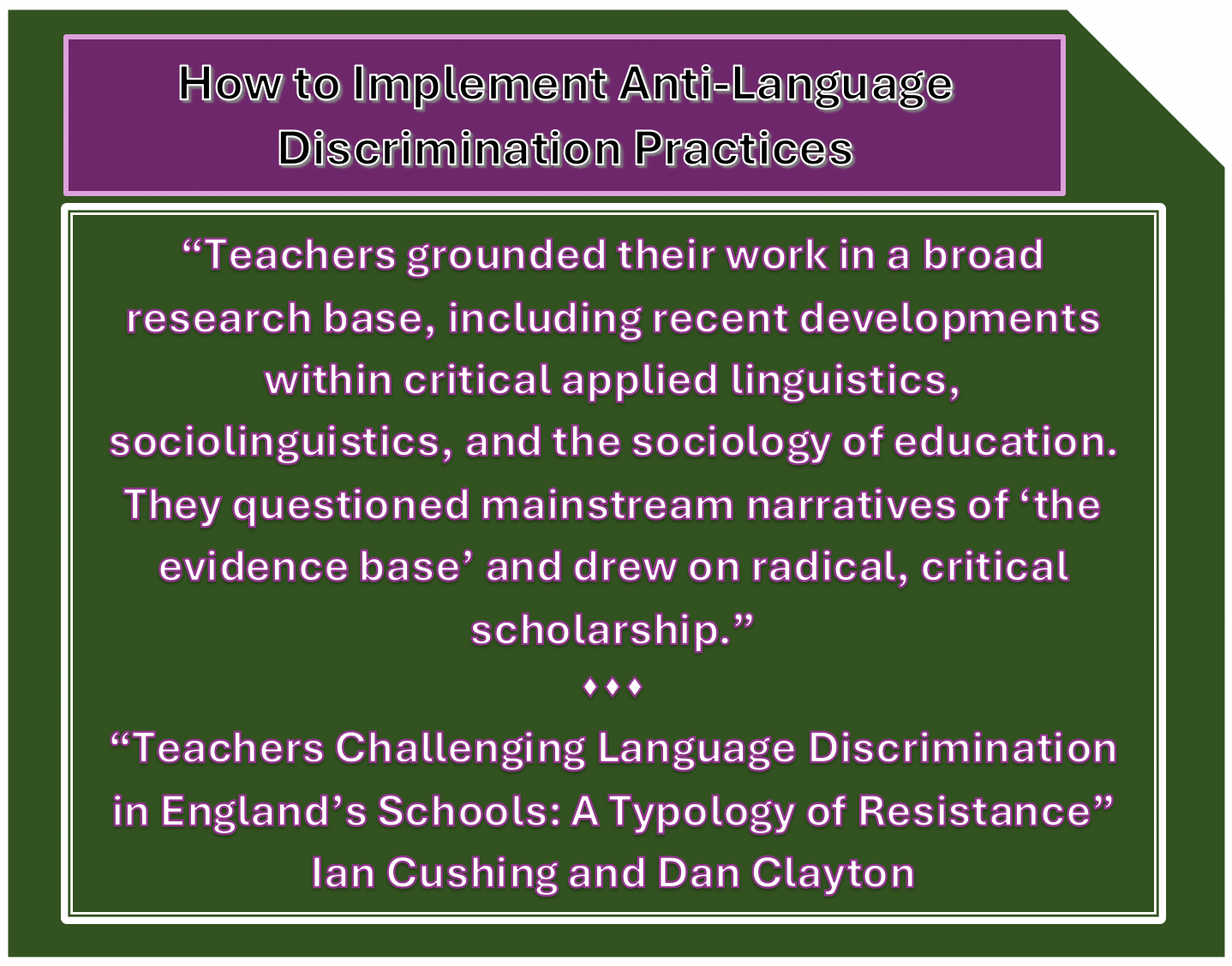
One example is a new article: Teachers Challenging Language Discrimination in England’s Schools: A Typology of Resistance by Ian Cushing and Dan Clayton.

Cushing and Clayton offer excellent data based on evidence drawn from the Critical Language Awareness group (CLAW). Here are some of the highlights of that evidence:

  • “[T]eachers work in contexts where they undoubtedly negotiate a dense array of top-down policy initiatives which may well not align with their language ideological beliefs.” Key here is that policy imposes beliefs about language, thus, there is no such thing as objective or apolitical policy.
  • And thus: “We understand language discrimination not simply as about individual attitudes which manifest in individual, malicious acts of prejudice, but as a structural phenomenon underpinned by language ideologies which stratify, rank, and hierarchically organise language varieties and the communities associated with them (Lippi-Green, 2012). Schools are particularly key sites of language ideological production and the co-construction of racial, class, and linguistic stratification.”
  • Language/reading policy legislates national ideology grounded in deficit ideology:

Attempting to justify these structural deficits, the state produced a stigmatising narrative of strivers and scroungers which framed working-class and racialised minorities as responsible for their own hardships, and thus responsible for their own welfare by modifying their individual behaviours, including language (Tyler, 2018).

Austerity, public cuts, and the 2011 nationwide uprisings that followed created an ideological space in which educational reform was deemed by the state to be urgent and necessary, and where the most marginalised members of society could begin to experience upward social mobility and educational success simply by changing their language (see Nijjar, 2018).

  • The dynamic in place in the UK is being replicated in the US:

These mechanisms include new national curricula, high-stakes standardised grammar tests for primary school students, high-stakes GCSE assessments for secondary school students, revised professional standards for teachers, and Ofsted, the schools inspectorate. These policy mechanisms place teachers into positions where they are encouraged (and rewarded) to perceive marginalised students’ language as deficient, to engage in hostile language policing, and to reproduce ideologies of linguistic correctness which bolster language discrimination. At the same time, post-2010 curriculum changes stripped away units and assessments concerned with spoken language study, leaving little room for teachers to engage in critical debates about language variation, attitudes, and ideologies. These changes coordinated with a resurgence of deficit discourses in policy, such as those clustered around the so-called word gap and an increased focus on technical grammar and vocabulary—at the expense of critical and social aspects of language.

  • Language/reading policy tends to erase how language ideologies are “intricately connected to race, class, and privilege.” In short, “language ideologies were a proxy for other forms of stigma,” and that stigma impacts both students and teachers, especially those from marginalized backgrounds and identities.
  • Reading policy ignores and even resists critical approaches to language that “challenge language discrimination.” Yet, Cushing and Clayton document “how students had ‘loved looking at how and why their language got policed’ and how the unit allowed students to see that ‘attitudes about their language were really just about their social class.'”
  • Literacy instruction not grounded in deficit ideology faces multiple obstacles, then: “internal obstacles (in the form of management) and external obstacles (in the form of Ofsted, national curricula, assessments, and examination boards).”
  • “What is important to stress here is that schools are under increasing pressure to demonstrate ideological fidelity to externally produced, state-produced education policy, themselves which are underpinned by academic scholarship subscribing to normative ideologies about language and discourses of deficit (Cushing, 2023c).”
  • Cushing and Clayton build to a typology for anti-language discrimination. Here, I want to emphasize a key component about what counts as evidence: “Teachers grounded their work in a broad research base, including recent developments within critical applied linguistics, sociolinguistics, and the sociology of education. They questioned mainstream narratives of ‘the evidence base’ and drew on radical, critical scholarship.”

The article ends by noting that teachers alone cannot change this pattern, and I want to stress that is especially true in the US where teachers are often powerless and have been publicly discredited as not knowing how to teach reading.

However, the evidence is clear that “[l]anguage discrimination is a structural phenomenon” and that reading policy and reading programs are key elements in that structure.

Mandating fidelity to deficit beliefs about language and students is at the core of the SOR movement. Once again, we are missing the evidence by focusing on a few trees and ignoring the forest.


[1] Another Cautionary Tale of Education Reform: “Improving teaching quality to compensate for socio-economic disadvantages: A study of research dissemination across secondary schools in England”; Cautionary Tales of State Reading Legislation: UK; Cautionary Tales of State Reading Legislation: Tennessee; UK PISA 2022 Results Offer Cautionary Tale for US Reading Reform; Research, the Media, and the Market: A Cautionary Tale

[2] Recommended: The Balancing Act by Dominic Wyse and Charlotte Hacking

Recommended

Tiered vocabulary and raciolinguistic discourses of deficit: from academic scholarship to education policy, Ian Cushing

Social in/justice and the deficit foundations of oracy, Ian Cushing

Teachers Challenging Language Discrimination in England’s Schools: A Typology of Resistance, Ian Cushing and Dan Clayton

Pathologizing the Language and Culture of Poor Children, Curt Dudley-Marling and Krista Lucas


Recommended: The Balancing Act by Dominic Wyse and Charlotte Hacking

The Balancing Act: An Evidence-Based Approach to Teaching Phonics, Reading and Writing, Dominic Wyse and Charlotte Hacking

Publisher’s Description

Dominic Wyse and Charlotte Hacking present a ground-breaking account of teaching phonics, reading, and writing. Created from a landmark study, new research, new theory, and cutting-edge teacher professional development, this balanced approach to teaching seeks to improve all children’s learning, and therefore life chances.

The book dismantles polarised debates about the teaching of phonics and analyses the latest scientific evidence of what really works. It shows, in vivid detail, how phonics, reading, and writing should be taught through the creativity of some of the best authors of books for children. By describing lessons inspired by ‘real books’, it showcases why the new approach is more effective than narrow phonics approaches.

The authors call for a paradigm shift in literacy education. The chapters show how and why education policies should be improved on the basis of unique analyses of research evidence from experimental trials and the new theory and model the Double Helix of Reading and Writing. It is a book of hope for the future in the context of powerful elites influencing narrow curricula, narrow pedagogy, and high stakes assessments.

The Balancing Act will be of interest to anyone who is invested in young children’s development. It is essential reading for teachers, trainee teachers, lecturers, researchers, and policy makers world-wide who want to improve the teaching of reading and writing in the English language.

Press Release


Recommended

ILEC Response: Reading Science: Staying the Course Amidst the Noise (Albert Shanker Institute)

International Literacy Educators Coalition

ILEC Vision: To promote literacy learning practices that enable all children and youth to realize their full potential as literate, thinking human beings.

Download a PDF of the response.


ILEC Response: Reading Science: Staying the Course Amidst the Noise (Albert Shanker Institute)

Repeating claims in a report on reading reform, Esther Quintero presents 4 “myths” about the “science of reading” (SOR) at the Albert Shanker Institute blog grounded as follows:

At the annual conference of the American Educational Research Association (AERA), …I witnessed the spread of serious misinformation about reading research and related reforms. In this post, I aim to address four particularly troubling ideas I encountered. For each, I will not only provide factual corrections but also contextual clarifications, highlighting any bits of truth or valid criticisms that may exist within these misconceptions.

The post, however, misrepresents valid concerns about SOR messaging and the growing reality of negative consequences for SOR-based legislation and mandates[1]. Further, many of the bullet points under “facts” do not refute but support valid criticisms framed as “myths.” The post focuses on idealized possibilities of SOR to the exclusion of the current implementation of SOR-based programs and instruction.

Positive Aspects of the Post:

  1. Under Myth #1, Quintero acknowledges the problems with misrepresenting National Assessment of Educational Progress (NAEP) data[2] on reading and minimizing the impact of poverty and inequity on student achievement[3].
  2. Quintero concedes: “Reading science (indeed, any science!) is not settled; science is dynamic and evolving.”

ILEC Concerns:

  1. Myth #1(“The reading crisis is manufactured”) is self-contradictory in that the “fact” bullets repeat the valid concerns raised among SOR critics about misrepresenting NAEP data and ignoring out-of-school factors in education reform. Once again, the SOR reading “crisis” is in fact manufactured[4].
  2. Myths #2 (individualized instruction) and #3 (SOR restricts teacher agency) misrepresent the trend across the US of banning some reading programs and mandating other programs that tend to be structured literacy and too often scripted curriculum. Scripted curriculum does in practice impose on-size-fits-all instruction and de-professionalizes teachers[5].
  3. Myth #4 (“The Science of Reading harms English learners”) fails to acknowledge concerns raised among Multilingual learner (MLL) scholars and teachers about SOR’s one-size-fits-all mandates[6] and “whitewashing”[7] the texts offered students from diverse backgrounds[8].
  4. Quintero poses a false binary between SOR reform or reverting to an inadequate status quo, ignoring credible alternatives to reading reform grounded in equity/diversity and teacher agency.

[1] Fact-checking the Science of Reading, Rob Tierney and P David Pearson

[2] Big Lies of Education: Reading Proficiency and NAEP

[3] Big Lies of Education: Poverty Is an Excuse

[4] Reinking et al. (2023); Aydarova (2023).

[5] Chaffin et al. (2023).

[6] Noguerón-Liu (2020); Ortiz et al. (2021); Mora (2023).

[7] Rigell et al. (2022).

[8] Aukerman & Schuldt (2021).


See Also

International Literacy Educators Coalition (ILEC) Responses

NEPC: Are Science of Reading Laws Based on Science?

[Reposted by permission from NEPC]

What’s scientific about the “science of reading?”

Not much, according to NEPC Fellow Elena Aydarova of the University of Wisconsin-Madison, as explained in a recent article published in the peer-refereed Harvard Educational Review. In fact, she warns that legislators are using science-of-reading legislation to distract from more serious approaches to addressing students’ needs.

Using an “anthropology of policy approach,” Aydarova zeroes in on legislative debates surrounding science of reading (SOR) reforms that have swept the nation in the past half decade. As of July 2022, 29 states and the District of Columbia had adopted this approach, Aydarova writes.

Aydarova closely examines Tennessee’s Literacy Success Act (LSA). She analyses videos of legislative meetings and debates, stakeholder interviews, and examinations of bills, policy reports, media coverage, and other documents associated with the LSA, which was passed in 2021.

This SOR bill was first introduced in 2020. As the bill underwent revisions, the phrase “science of reading” was substituted with “foundational literacy skills” to describe the same content: “Across contexts and artifacts produced by various actors, the meanings of ‘science of reading’ shifted and were frequently replaced with new signs, such as ‘foundational literacy skills,’ ‘phonics,’ and others.”

Aydarova finds little evidence that advocates, intermediaries, or legislators grounded their support in anything resembling scientific evidence. Instead, “science of reading” becomes a catch-all phrase representing a grab bag of priorities and beliefs: “[I]n advocates’ testimonies and in legislative deliberations, neuroscience as SOR’s foundational element was reduced to vague references to ‘brain’ and was often accompanied by casual excuses that speakers did not know what ‘it all’ meant.”

Motivations for supporting SOR reforms range from commercial to ideological. For instance, Aydarova notes that after the passage of The Literacy Success Act in 2021, nearly half of Tennessee’s school districts adopted curricula promoted by the Knowledge Matters Campaign. This campaign, supported by curriculum companies such as Amplify and wealthy backers such as the Charles Koch Foundation, added SOR wording to its marketing effort as the curriculum it had originally supported fell out of favor due to its association with Common Core State Standards, which had become politically unpopular in many states.

As the SOR bill reached the legislative floor, “science” was rarely mentioned.

“The link to science disappeared, and instead the sign shifted toward tradition rooted in these politicians’ own past experiences,” Aydarova writes. “During final deliberations, legislators shared that they knew phonics worked because they had learned to read with its help themselves.”

Concerningly, the bill’s supporters also positioned it as “a substitution for investing in communities and creating the safety nets that were necessary for families to climb out of poverty.”

For instance, legislators dismissed as “state over-reach” proposals that would have expanded access to early education or placed more social workers in schools in underserved communities. Yet they “emphasized the importance of proposing legislation to reform reading instruction to solve other social issues,” such as incarceration, impoverishment, and unemployment. Aydarova writes:

Based on artificial causality—poverty and imprisonment rates would decline if phonics was used for reading instruction—these reforms naturalized the widening socioeconomic inequities and depoliticized social conditions of precarity that contribute to growing prison populations. Through these material substitutions, the SOR legislation promised students and their communities freedom, and robbed them of it at the same time.

In the end, Aydarova finds that, “Science has little bearing on what is proposed or discussed, despite various policy actors’ claims to the contrary. Instead, SOR myths link tradition, curriculum products, and divestment from social safety nets.”

NEPC Resources on Education Policy and Policymaking ->


See Also

Cautionary Tales of State Reading Legislation: Tennessee

Another Cautionary Tale of Education Reform: “Improving teaching quality to compensate for socio-economic disadvantages: A study of research dissemination across secondary schools in England”

Linked in her article for The Conversation is Sally Riordan’s “Improving teaching quality to compensate for socio-economic disadvantages: A study of research dissemination across secondary schools in England.”

This analysis is another powerful cautionary tale about education reform, notably the “science of reading” (SOR) movement sweeping across the US, mostly unchecked.

As I do a close reading of Riordan’s study, you should also note that the foundational failure of the SOR movement driving new and reformed reading legislation in states is that the main claims of the movement are dramatically oversimplified or misleading. I strongly recommend reviewing how these SOR claims are contradicted by a full examination of the research and science currently available on reading acquisition and teaching: Recommended: Fact-checking the Science of Reading, Rob Tierney and P David Pearson.

This close reading is intended to inform directly how and why SOR-based reading legislation is not only misguided but likely causing harm, notably as Riordan addresses, to the most vulnerable populations of students that education reform is often targeting.

First, here is an overview of Riordan’s study:


Similar to public, political, and educator beliefs in the US, “QFT [quality first teaching] is a commonly held belief amongst school staff” in the UK, Riordan found. In other words, despite evidence that student achievement is overwhelmingly linked to out-of-school factors, teacher quality and instructional practices are often the primary if not exclusive levers of education reform designed to closed so-called achievement gaps due to economic inequities.

This belief, however, comes with many problems:


Riordan’s analysis is incredibly important in terms of how the SOR movement and overly simplistic messaging (see Tierney and Pearson) have been translated into reductive legislation, adopting scripted curriculum, and banning or mandating practices that are not, in fact, supported by science or research.

Riordan identifies bureaucracy and simplistic messaging as the sources of implementation failure:


Nonetheless, “[t]his explicit demand [belief in QFT] is an example of the growing pressure on education practitioners to ensure their practices are supported by evidence (of many kinds),” Riordan explains, adding, “School staff believe that high-quality teaching reduces SED attainment gaps and that their belief is backed by research evidence.”

The research/science-to-instruction dynamic is often characterized by narrow citations or cherry-picking evidence: “Because school leaders cited the same references to research evidence to justify very different policies and practices, I conducted a review of the literature that led to these citations.”

One key problem is that while the evidence base may be narrow and “[a]lthough there is agreement that high-quality teaching is important to tackle SED, principles of QFT are nevertheless being implemented in a myriad of ways across secondary schools in England.”

In the US, many scholars have noted that the SOR movement uses “science” rhetoric but depends on anecdotes for evidence; and, in the UK:

Although many school staff (and particularly school leaders) are aware of the EEF resources and believe that there is evidence supporting principles of QFT, no interviewee described this evidence in any further detail. When asked why QFT works, staff reasoned intuitively. The line of reasoning that can be reconstructed from their replies is independent of the research evidence.

…This intuitive argument, reasoned by school staff, is limited but I do not challenge its validity. The main point here is that this line of reasoning does not reflect the research evidence (which is described in detail below ‘The weakness of the evidence for QFT’). It is not the strength of the evidence base that has convinced school leaders to implement QFT practices. This highlights the importance of the psychological aspects of bringing research evidence to bear on practice. It also raises the possibility that a message was disseminated that was already widely believed. I turn to this bureaucratic concern next.

Improving teaching quality to compensate for socio-economic disadvantages: A study of research dissemination across secondary schools in England

That intuitive urge, again, however, is linked to limited evidence: “Just five studies are being relied upon to disseminate the message that high-quality teaching is the most effective way to reduce SED attainment gaps.”

What may also be driving a misguided reform paradigm is convenience, or a lack of political imagination:


Evidence- or science-based reform, then, tends to be reduced to a “sham” (consider the misleading “miracle” rhetoric around Mississippi, also addressed in Tierney and Pearson):


The unintended consequence is a “misdirection of energy and time of school staff” driven by “pressure to conform to the policies promoted.”

Key to recognize is Riordan identifies that QFT reforms not only fail to close gaps but also cause harm: Some “attempts to improve the quality of teaching are contributing to a large attainment gap,” including: “It is by turning to a more refined measure of SED that we find evidence that the school’s innovations in teaching and learning over the last five years have benefitted its most affluent students most of all.”

Riordan’s conclusion is important and damning:

It has reviewed the wider picture in which school leaders are choosing to implement (or at least justifying the implementation of) particular practices based on a generic message instead of the specific research supporting those practices. The problem here is that the mechanisms operating to connect research with practice are too crude to acknowledge the richness and messiness of social science research. The message, ‘high-quality teaching is the most effective way to support students facing SED’, is too simple to be meaningful. 

Improving teaching quality to compensate for socio-economic disadvantages: A study of research dissemination across secondary schools in England

For the US, education reform broadly and the SOR movement can also be described as grounded in messages that are “too simple to be meaningful” and thus too simple to be effective and even likely to be harmful.


Republish: Schools are using research to try to improve children’s learning – but it’s not working (The Conversation)

[Note: Follow links to research cited and note the recommended links after the republished article.]


Sally Riordan, UCL

Senior Research Fellow in the Centre for Teachers and Teaching Research, UCL

2 April 2024


Evidence is obviously a good thing. We take it for granted that evidence from research can help solve the post-lockdown crises in education – from how to keep teachers in the profession to how to improve behaviour in schools, get children back into school and protect the mental health of a generation.

But my research and that of others shows that incorporating strategies that have evidence backing them into teaching doesn’t always yield the results we want.

The Department for Education encourages school leadership teams to cite evidence from research studies when deciding how to spend school funding. Teachers are more frequently required to conduct their own research as part of their professional training than they were a decade ago. Independent consultancies have sprung up to support schools to bring evidence-based methods into their teaching.

This push for evidence to back up teaching methods has become particularly strong in the past ten years. The movement has been driven by the Education Endowment Foundation (EEF), a charity set up in 2011 with funding from the Conservative-Liberal Democrat coalition government to provide schools with information about which teaching methods and other approaches to education actually work.

The EEF funds randomised controlled trials – large-scale studies in which students are randomly assigned to an educational initiative or not and then comparisons are then made to see which students perform better. For instance, several of these studies have been carried out in which some children received one-on-one reading sessions with a trained classroom assistant, and their reading progress was compared to children who had not. The cost of one of these trials was around £500,000 over the course of a year.

Trials such as this in education were lobbied for by Ben Goldacre, a doctor and data scientist who wrote a report in 2013 on behalf of the Department for Education. Goldacre suggested that education should follow the lead of medicine in the use of evidence.

Using evidence

In 2023, however, researchers at the University of Warwick pointed out something that should have been obvious for some time but has been very much overlooked – that following the evidence is not resulting in the progress we might expect.

Reading is the most heavily supported area of the EEF’s research, accounting for more than 40% of projects. Most schools have implemented reading programmes with significant amounts of evidence behind them. But, despite this, reading abilities have not changed much in the UK for decades.

This flatlining of test scores is a global phenomenon. If reading programmes worked as the evidence says they do, reading abilities should be better.

And the evidence is coming back with unexpected results. A series of randomised controlled trials, including one looking at how to improve literacy through evidence, have suggested that schools that use methods based on research are not performing better than schools that do not.

In fact, research by a team at Sheffield Hallam University have demonstrated that on average, these kinds of education initiatives have very little to no impact.

My work has shown that when the findings of different research studies are brought together and synthesised, teachers may end up implementing these findings in contradictory ways. Research messages are frequently too vague to be effective because the skills and expertise of teaching are difficult to transfer.

It is also becoming apparent that the gains in education are usually very small, perhaps because learning is the sum total of trillions of interactions. It is possible that the research trials we really need in education would be so vast that they are currently too impractical to do.

It seems that evidence is much harder to tame and to apply sensibly in education than elsewhere. In my view, it was inevitable and necessary that educators had to follow medicine in our search for answers. But we now need to think harder about the peculiarities of how evidence works in education.

Right now, we don’t have enough evidence to be confident that evidence should always be our first port of call.

Sally Riordan, Senior Research Fellow in the Centre for Teachers and Teaching Research, UCL

This article is republished from The Conversation under a Creative Commons license. Read the original article.


Recommended

Close Reading: Evidence, schmevidence: the abuse of the word “evidence” in policy discourse about education, Gary Thomas

Recommended: Fact-checking the Science of Reading, Rob Tierney and P David Pearson

Big Lies of Education: International Test Rankings and Economic Competitiveness

“Human development is an important component of determining a nation’s productivity and is measured in employee skills identified by employers as critical for success in the modern global economy,” claims Thomas A. Hemphill, adding:

The United States is obviously not getting a sufficient return on investment in elementary and secondary education, as it has mediocre scores in mathematics literacy and declining scores for science literacy for 15-year-old students surveyed in 2022. The only significant improvement for 15-year-olds is in reading, where the United States finally entered the top 10 in 2022.

Commentary: We must improve students’ math, science skills to boost US competitiveness

Hemphill reaches an unsurprising conclusion:

If these educational trends continue, the United States will not have an adequate indigenous workforce of scientists, engineers and technologists equipped to maintain scientific and technological leadership and instead will become perpetually reliant on scientifically and technologically skilled immigrants. We must demand that elementary and secondary education systems reorient efforts to significantly improve mathematical and scientific teaching expectations in the classroom.

Commentary: We must improve students’ math, science skills to boost US competitiveness

However, for decades, evidence has shown that there is no causal link between international rankings of student test scores and national economic competitiveness.

This Big Lie is purely rhetorical and relies on throwing statistical comparisons at the public while drawing hasty and unsupported causal claims from those numbers.

If you really care about the claim, see Test Scores and Economic Growth by Gerald Bracey.

Bracey offers this from researchers on the relationship between international education rankings and economic competitiveness:

Such countries [highest achieving] “do not experience substantially greater economic growth than countries that are merely average in terms of achievement.”

The researchers then lay out an interpretation of their findings that differs from the causal interpretation one usually hears:

“We venture, here, the interpretation that much of the achievement ‘effect’ is not really causal in character. It may be, rather, that nation-states with strong prodevelopment policies, and with regimes powerful enough to enforce these, produce both more economic growth and more disciplined student-achievement levels in fields (e.g., science and mathematics) perceived to be especially development related. This idea would explain the status of the Asian Tigers whose regimes have been much focused on producing both economic growth and achievement-oriented students in math and science.”

Test Scores and Economic Growth

Bracey quotes further from that research:

“From our study, the main conclusion is that the relationship between achievement in science and mathematics in schoolchildren and national economic growth is both time and case sensitive. Moreover, the relationship largely reflects the gap between the bottom third of the nations and the rest; the middle of the pack does not much differ from the rest. . . . Much of the obsession with the achievement ‘horse race’ proceeds as if beating the Asian Tigers in mathematics and science education is necessary for the economic well-being of other developed countries. Our analysis offers little support for this obsession. . . .

“Achievement indicators do not capture the extent to which schooling promotes initiative, creativity, entrepreneurship, and other strengths not sufficiently curricularized to warrant cross-national data collection and analysis. Unfortunately, the policy discourse that often follows from international achievement races involves exaggerated causal claims frequently stress- ing educational ‘silver bullets’ for economic woes. Our analyses do not offer defini- tive answers, but they raise important ques- tions about the validity of these claims. In an era that celebrates evidence-based policy formation, it behooves us to carefully weigh the evidence, rather than use it simply as a rhetorical weapon.”

Test Scores and Economic Growth

A key point to note here is Bracey is writing in 2007, and the OpEd above is March 2024. The Big Lie about international education rankings and economic competitiveness is both a lie and a lie that will not die.

I strongly recommend Tom Loveless exposing a similar problem with misrepresenting and overstating the consequences of NAEP data: Literacy and NAEP Proficient.

Bracey offers a brief but better way to understand test data and economic competitiveness: “education is critical, but among the developed nations differences in test scores are trivial.”

Instead of another Big Lie, the US would be better served if we tried new and evidence-based (not ideological) ways to reform our schools and our social/economic structures.