Category Archives: Educational Research

Reading Programs Always Fail Students and Teachers

[Header Photo by Nappy on Unsplash]

Despite growing up in a working-class family with two parents who never finished college, I entered formal schooling with a turboboost provided primarily by my mom.

I was a reader, and by traditional school norms, I was a reader way above grade level.

Both my mother and my teachers taught me to read through whole-word methods that were popular in the 1960s. I am of the Dick and Jane reader generation.

I always tested in the 99th-percentile and made As and Bs, but I found school only mildly tolerable, at best; I did, however, love my teachers.

It was a jumbled journey that led to me being a high school English teacher. I recognize now that the foundation of that path included my high level of literacy that eventually drew me to literature, a love of reading, and being a writer.

When I entered the classroom in the fall of 1984, I soon realized that I was not prepared to teach. Almost all of the literature I had studied in college was not or could not be taught in public high school; I also was almost completely ill-equipped to teach adolescents to write.

My first years included what I now perceive as the fatal flaw of teaching—seeking The Way to teach students to read and write.

My saving grace came in the late 1980s and early 1990s, significantly because I entered the regional National Writing Project summer workshop (Spartanburg Writing Project) and was introduced to the workshop model.

Two books and two people were foundational for my journey into workshop teaching—Nancie Atwell’s reading workshop and Lucy Calkins’s writing workshop.

Atwell and Calkins offered a great deal of practices and structures in their seminal works, but, honestly, I paid little attention to the details—fortunately.

I did take away a philosophical structure that included a frame for teaching—time, ownership, and response—and a nearly compulsive commitment to be a student-centered teacher.

Over my 40 years as a teacher, I have witnessed wonderful concepts, theories, and philosophies in education gradually be reduced to programs, structures, and scripts that necessarily fail students and teachers.

Throughout my career, I have resisted and challenged all programs and templates for teaching and learning.

By the 1990s, I had more opportunities to publish and present as a practitioner-scholar, and then after I completed my doctorate in 1998, that credential further reinforced my ability to advocate against programs and, worst of all, educational faddism.

For many years, I had to caution teachers and administrators about the missionary zeal around Four Blocks® and 6+1 Traits of Writing.

In traditional schooling, we lack the political will to provide students and teachers with the learning/teaching conditions that could support best practice and thriving students. Instead, we remain committed to in-school only reductive practices such as adopting new standards, implementing new standardized tests, and shuffling through an ever-revolving series of reading programs.

Here’s the problem: All reading programs fail students and teachers because when we center reading programs, we de-center the individual needs of students and the professional autonomy of teachers.

Let me be very clear: All reading programs fail students and teachers.

During my teaching career across five decades, I have watched as advocates scapegoat X and promise the success of Y—whether the scapegoat is whole language or balanced literacy (the two favorites over those years).

The “science of reading” movement fits into the manufactured reading crisis cycles that have occurred in the US for a century; almost nothing new is being claimed or promised, but the outsized attack on specific reading programs (Fountas and Pinnell, Calkins’s Units of Study) does represent a disturbing lack of logic (across the US dozens of different reading programs have been implemented over decades with reading proficiency remaining stable) and another fatal mistake of centering reading programs.

To be blunt, reading programs labeled as whole language, balanced reading, or structured literacy carry no guarantee that those programs or the implementation of the program does in fact reflect the theory/philosophy of the label.

One marketed, theory/philosophy is corrupted or erased.

But more importantly, all centering of reading programs is a distraction because teachers are held accountable for teaching with fidelity to the program and students are reduced to mere metrics of that fidelity.

I have remained outside the ideology and program game for 40 years (that’s what critical pedagogy is), but all those trapped inside that game cannot hear my persistent message: Don’t depend on reading programs and reading theories to teach children to read.

I do not support or adhere to whole language, balanced literacy, or structured literacy; I do not endorse (and certainly would never create) any reading program.

As a critical scholar and educator, i recognize that the moment we reduce philosophical structures to scripts or programs, both the ideologies and the humans impacted (students and teachers) are erased.

Most literacy instruction I do these days is with college students and adults, who are still learning to read and learning to write.

I remain guided by time, ownership, and response as my philosophical structures, but I always start with and center who each student is and where is student is.

I have a teaching tool kit that is incredibly full and diverse from my many years as a practitioner, yet I continue to seek new and different ways to teach because each student is a new challenge and a new possibility.

The current media, market, and political story that Reading Program X has failed children but Reading Program Y will save those children is a lazy argument that lacks logic or evidence.

If anyone can step off the reading program merry-go round, they could see that if there was a problem with Units of Study it was that teachers were held accountable for fidelity to that program and not provided the teaching conditions to serve the needs of individual students.

If anyone can step off the reading program merry-go round, they could see that banning some scapegoated reading programs and mandating new structured literacy programs that are scripted (thus erasing teacher autonomy and individual needs of students) is jumping out of the reading program frying pan into the fire.

The rhetoric of missionary zeal exposes the failure of centering when we argue about “teaching phonics” or “teaching comprehension” or “teaching fluency,” for example, because our goal should never be a so-called reading skill, but teaching children how to be eager and critical readers.

In formal schooling we have for decades and currently are failing disproportionately marginalized and minoritized students who are over-represented in those students identified as below proficiency in reading.

As long as we center reading ideologies and reading programs, we are de-centering those students’ individual needs and de-centering the autonomy of their teachers to serve those neglected children.

Reading programs are the folly of petty adult allegiances that are manipulated for political and market purposes.

Reading and writing like teaching reading and writing are complex and unpredictable journeys that are ultimately human behaviors that should be the center of all we do—not beliefs, practices, or, especially, yet another false promise packaged as a silver-bullet reading program.


Revisiting the SOR Multiverse

Although I have made the distinction many times, the “science of reading” (SOR) as a term denotes three distinct meanings simultaneously:

  1. SOR as a movement, grounded in a pervasive yet misleading media narrative primarily associated with the journalism of Emily Hanford and then the manifestation of the narrative in political rhetoric and legislation/policy.
  2. SOR as marketing and branding, a concurrent flood of reading programs and materials (very similar to the branding of materials during the Common Core era).
  3. SOR as a blanket term for the broad and deep research base on reading than spans at least a century.

I have been contesting the most problematic aspects of SOR—the movement and the marketing/branding—because the misinformation has gained a status as “holy text”; more troubling is that nearly every state has now passed legislation and implemented SOR policy and practice.

In no uncertain terms, there is no longer a debate about the credibility of SOR because that credibility is its own odd multiverse—the movement claims are simultaneously false or misleading while existing in the real world as fact and narrow mandates (for example, structured literacy as the newest reading theory is often packaged as scripted curriculum).

The SOR movement has been driven primarily by people with no expertise or historical context for the narrative established in “Hard Words” and then amplified by “Sold a Story.”

Journalists, politicians, parents, and think tanks/advocacy groups have created a nearly unstoppable force because of a series of beliefs that have been perpetuated in the US for decades: public schools are failing, teachers are failing, and students are failing.

The SOR movement is little different than any other education movement in the US since the template is well established in crisis/miracle rhetoric that appeals to cultural and public beliefs.

Also the SOR movement has weaponized a reductive use of the term “science,” which shields the movement from criticism.

Anyone who dares to criticize—even with evidence—the SOR narrative is discounted as being against “science,” particularly effective in the wake of Covid era fraught with public and political debates about masking and vaccinations.

The missionary zeal of the SOR movement combined with market interests has erased all nuance and complexity from discussions of or implementing the broad and deep body of research on reading that is still evolving and better characterized by debate than being “simple and settled” (the earliest mantra driving the SOR movement in the media).

Over the past decades, SOR advocacy has made any criticism or debate come with great costs to the critics because of the zeal and even anger among SOR advocates on social media, a network of stake holders associated with dyslexia, phonics, and mainstream education reform (such as Jeb Bush’s ExcelinEd).

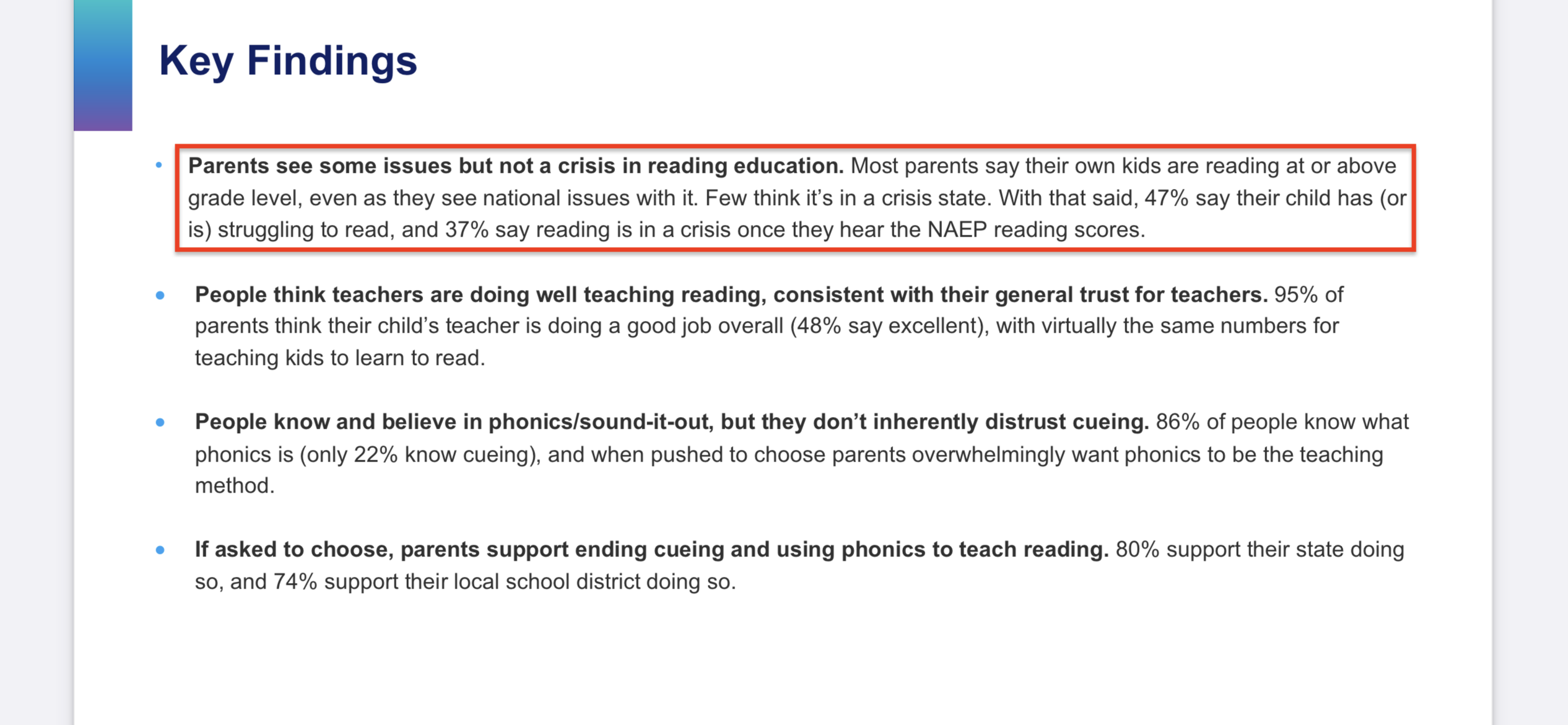
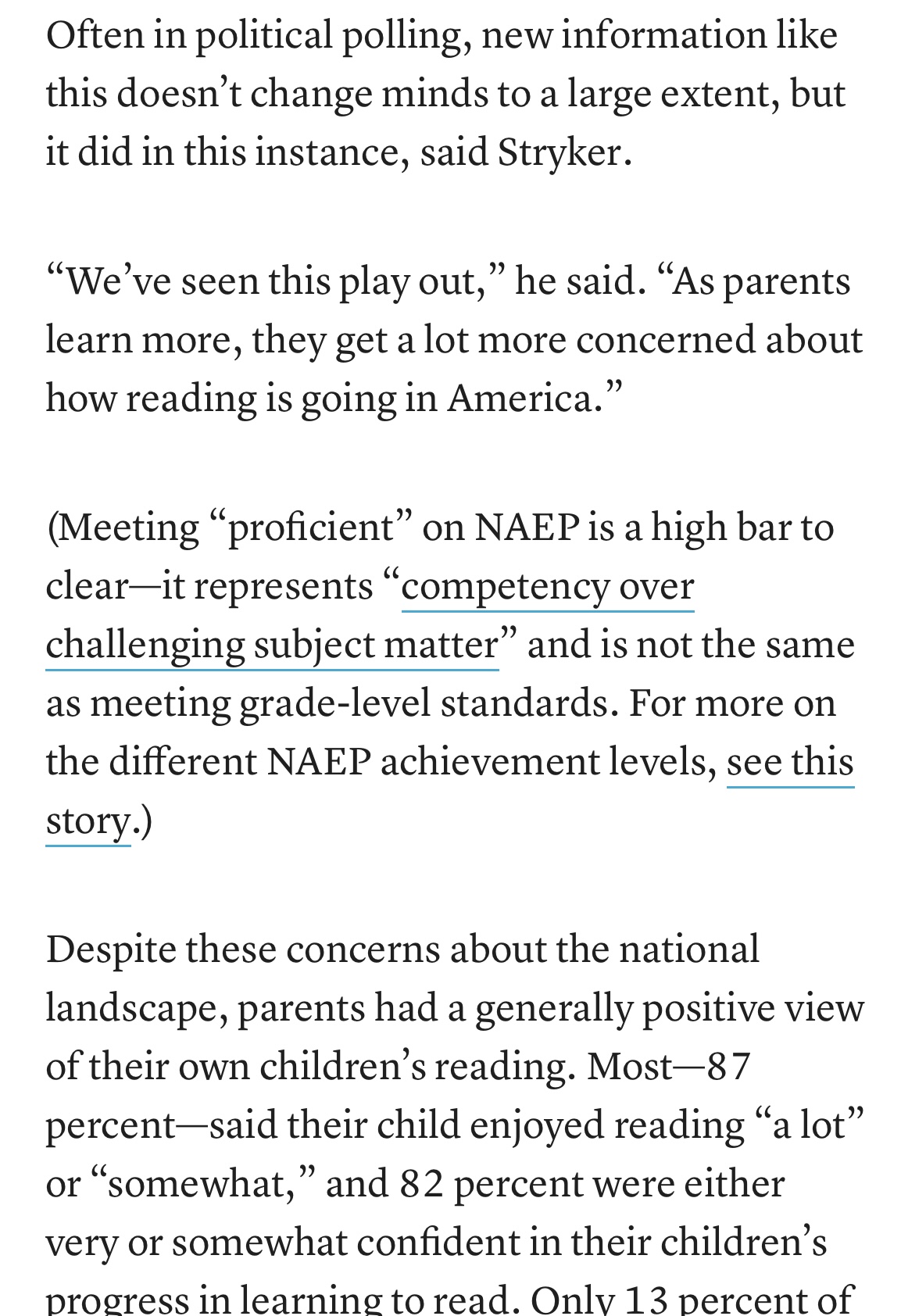
As I just recently posted, a survey of parents demonstrates the effectiveness of the SOR movement to turn false narratives into holy text.

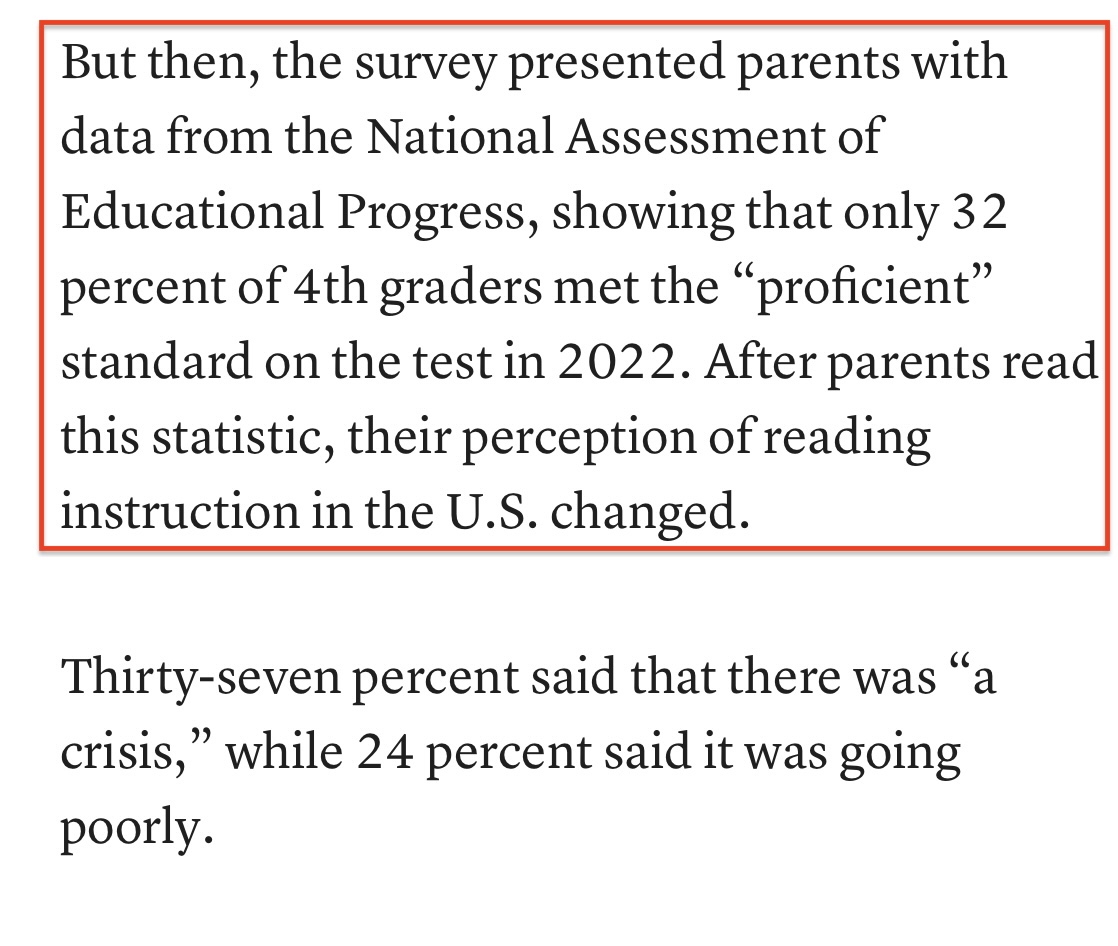
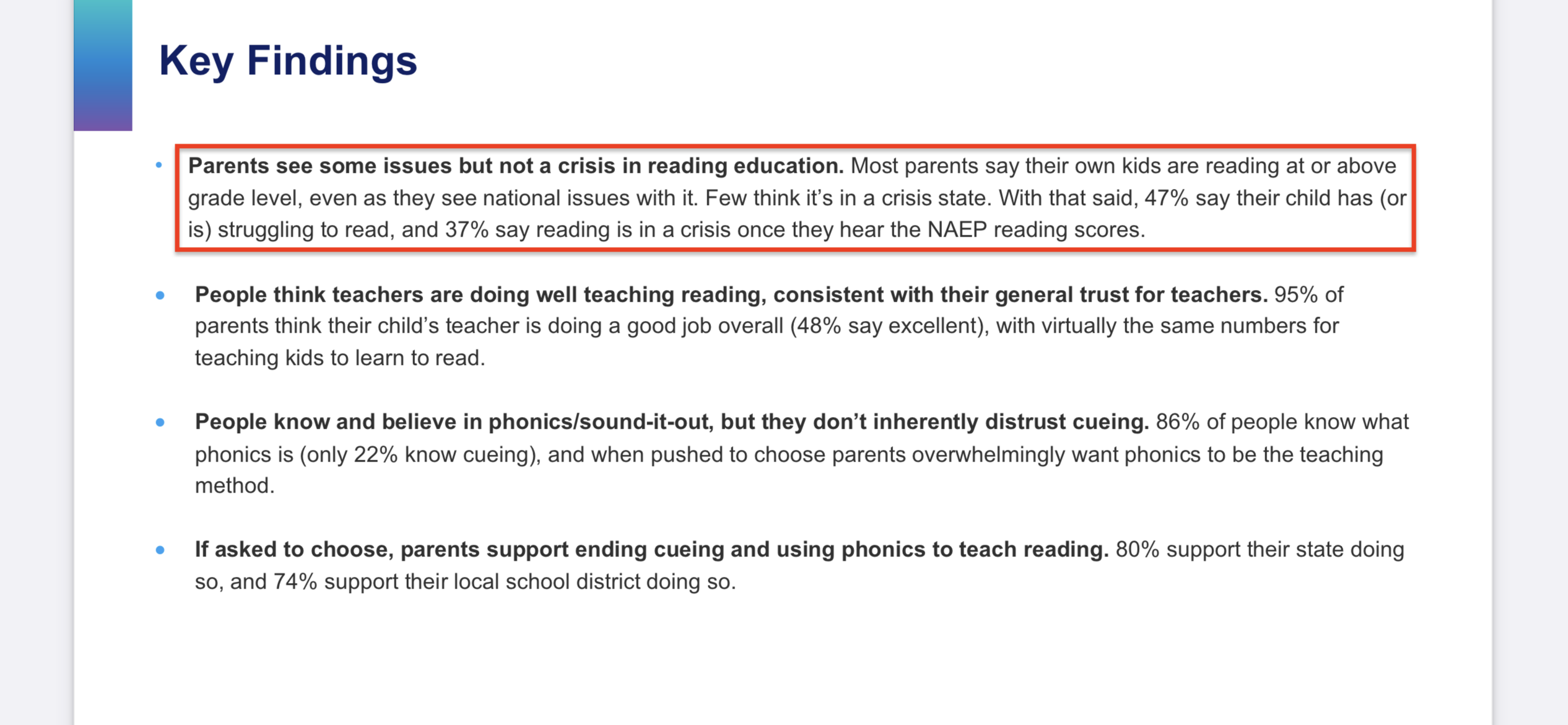
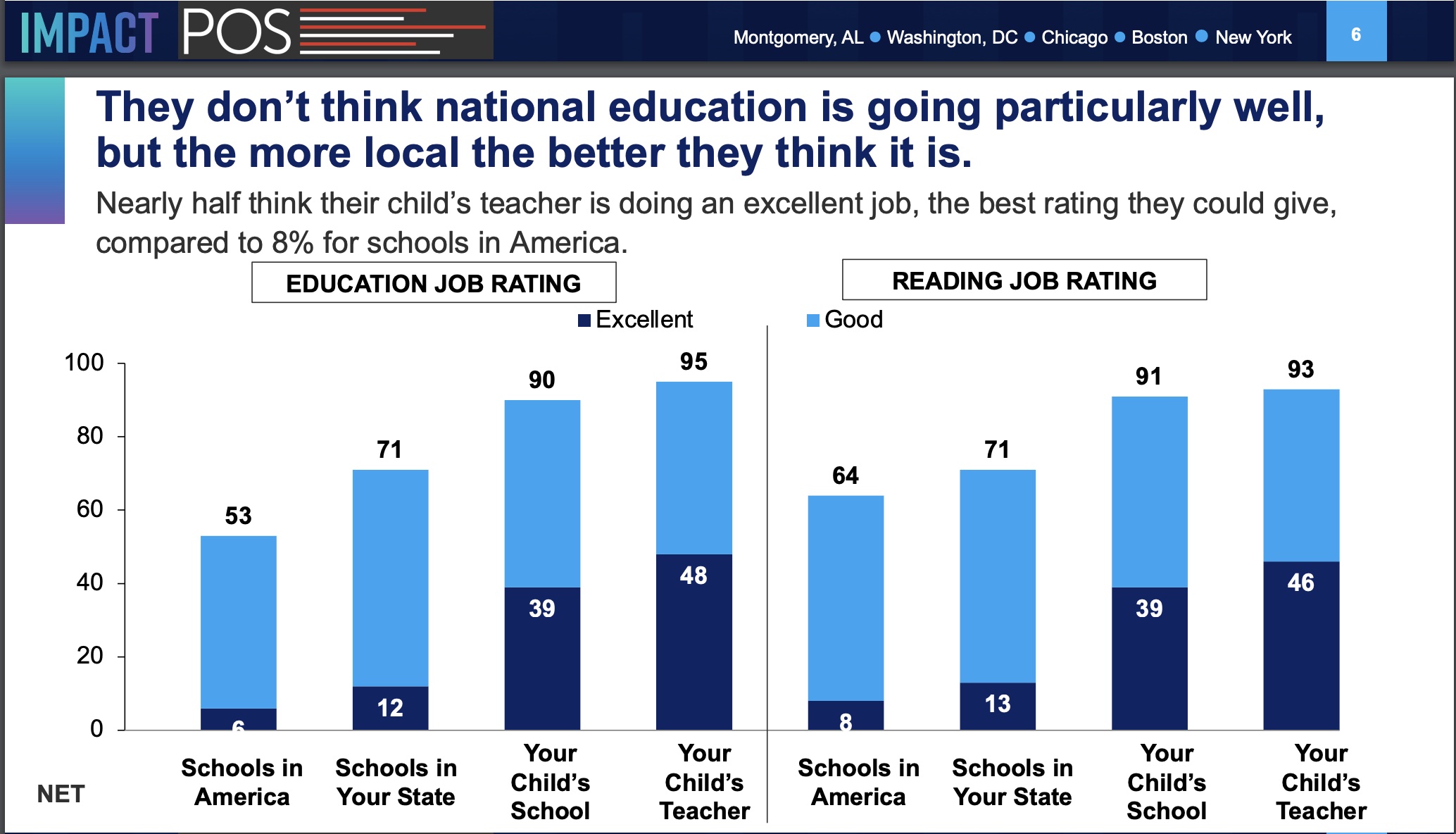
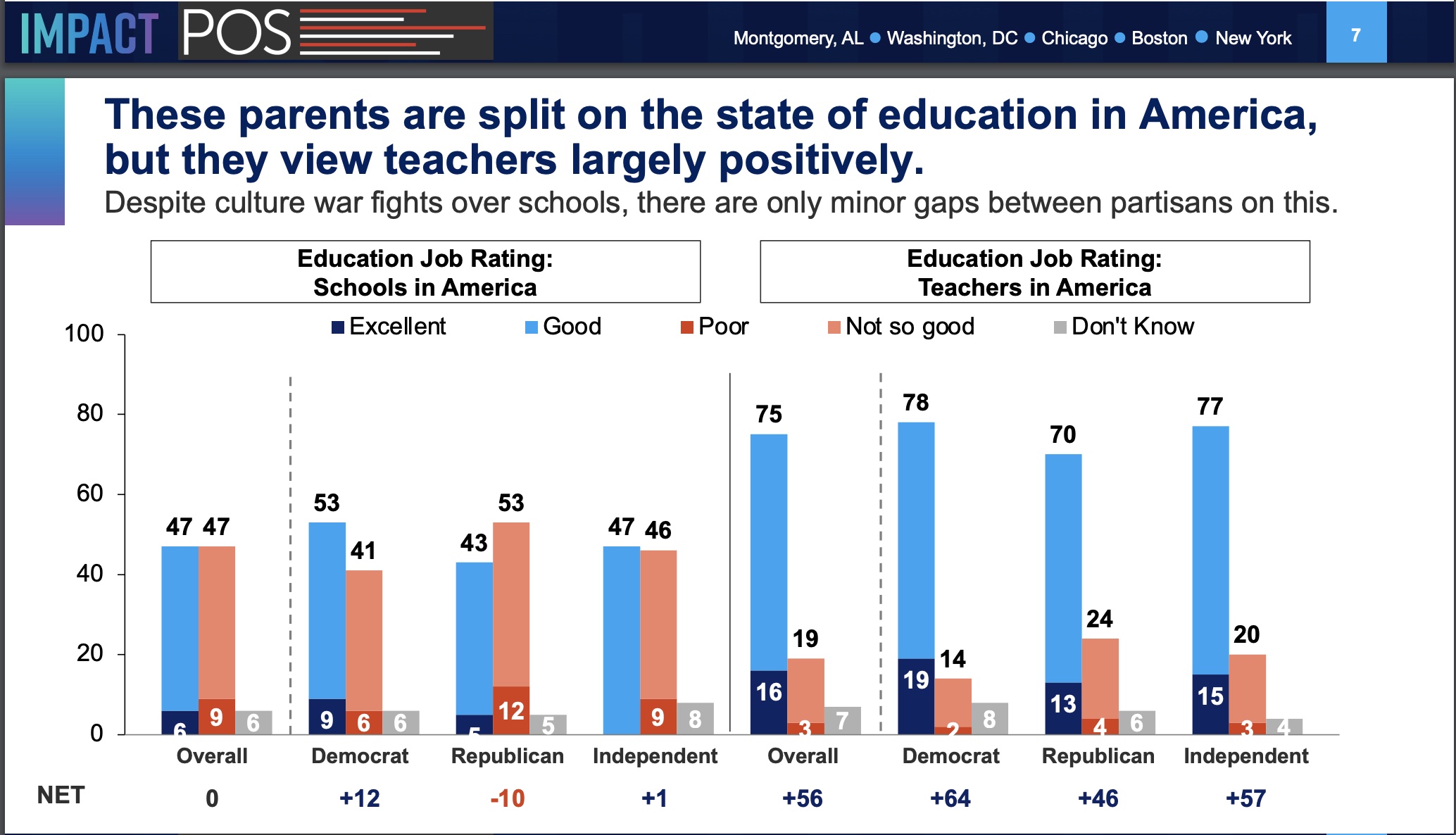
The survey shows both that parents held relatively positive views of their children’s reading achievement and their teachers. But once those parents were exposed to the false narrative of SOR, their opinions were more negative. The misrepresentation of NAEP data and cueing/guessing was presented to parents as facts, and the change in opinions confirmed that the SOR false information is incredibly effective and mostly embraced uncritically:

Reading Education Messaging: Findings and Recommendations from an Online Poll of K-5 Parents in America

The most shocking aspect of the developing SOR multiverse is that journalists, the public, and political leaders believe that 2/3 of students are not proficient readers and that same NAEP data show that 2/3 of students are reading at grade level or above—inverse “facts” simultaneously “true.”

Nearly as stunning is the Urban Legend around cueing and guessing that, again, simultaneously is believed by almost everyone while not existing in reality:

Narratives that speak into cultural beliefs are incredibly powerful, and bandwagons are difficult to slow down or reroute.

As a consequence truth and nuance are lost.

In a recent co-authored scholarly piece, colleagues and I confront the imbalance between the SOR movement/marketing and the full body of research on reading.

The responses to that article on social media and even among literacy scholars reflect the same problematic dynamic exposed in the survey of parents; nuance struggles to keep its head above water during a tidal wave.

I am currently at the annual NCTE convention and will present on a panel tomorrow about SOR; however, even at a professional conference, being critical of SOR is an outlier stance.

The SOR misinformation has won—at least for now.

In 5 or 10 years, the next reading crisis will somehow overwrite this one—simultaneously all of the century’s worth of reading crises existing and never having happened.

Just like now.

Now seems impossible, in fact, since “kids today” (no matter when “today” is) have never been proficient readers.

Yet, here we are, inexplicably harder to believe than Bigfoot.

NAEP, Media Fuel Manufactured Reading Crisis

Consider how people would respond to the two following statements for a survey:

  1. About 2/3 of US students read below “proficient” on national testing.
  2. About 2/3 of US students read at or above “grade level” on national testing.

We don’t need to imagine, however.

Coverage in Education Week of a new survey on parents’ perceptions of reading reveals incredibly damning findings—damning not about reading achievement or teaching but about NAEP and media:

The survey’s findings reflect that damning dynamic:

Yet, despite the misinformation about NAEP, these survey findings reflect decades of surveys showing parents generally have positive views of their children’s schools and teachers but believe public education nationally is failing:

This survey, though, exposes the source of that disconnect—media coverage of NAEP data, which seems to be designed more to manufacture a crisis than to assess student reading achievement.

The opening two hypothetical statements show where the problem lies because the first is an accurate statement about NAEP and the second is an accurate statement about reading at grade level.

As NAEP explains and others have addressed for years (see below), NAEP “proficiency” is well above grade level and “basic” represents something close to grade-level proficiency. However, the larger problem is the US has no standard criteria for “grade-level proficiency” and states set their own levels with NAEP using terminology that is at least confusing if not intentionally misleading.

Another problem, as I have argued, is that “grade level” is likely a worse metric than “age level” since many states now implement grade 3 retention based on reading tests, corrupting populations of students being assessed since data show that student scores on early reading are strongly correlated with birth month.

See the following to better understand NAEP and media misinformation about reading proficiency:

The US has a long and troubling history of media and political leaders being more invested in a manufactured education crisis than actually investing in better public education.

As a result, parents and students are trapped between their own genuine appreciation and need for effective, responsive reading instruction and a media-fueled political campaign to misinform the public because a constant state of reading crisis benefits a contracting media and generates political capital.

The reading crisis in the US is that the public is reading misinformation about reading and teachers, grounded in a national testing program designed to manufacture crisis.


NOTE

The survey also shows how misinformation about three cueing and phonics misleads parents and distorts their perception of reading instruction:

The framing of the survey misrepresents both cueing and guessing; see the following:

Guest Post: Letter to NYT, Susan Ohanian

re: Ohio Lawsuit Punches Back in Battle Over How to Teach Reading 

In highlighting the big money spent by the Reading Recovery Council  to influence state reading policy, the New York Times offers a slight variation on the same old meme of reading science vs reading catastrophe. 

As a longtime reading teacher, I await an article on the billions spent by leading publishers to promote something called the science of reading so they can continue selling their textbooks and billions of pages of   peripherals that accompany these texts. I mourn the hours children spend trudging through Big Business workbook pages traveling as “science.”

In “Ohio Lawsuit Punches Back in Battle Over How to Teach Reading,”  readers are offered the 23-year-old National Reading Report as evidence of the validity of science of reading.  The claims embedded in this report have been disputed by respected researchers since the day of publication. It’s time to scrap that old rolodex and expand the contact base. For starters, here’s a new report published in The Reading Teacher: “Stories Grounded in Decades of Research: What We Truly Know about the Teaching of Reading.” 

Table 1 offers “Highly Respected Researchers Whose Research Challenges the Science of Reading,”  Here are the names of 7 reading researchers New York Times reporters can contact the next time they decide to write about reading instruction in public schools.

Finally, I offer the evidence of a deaf child who entered public school in 3rd grade. Her residual hearing was helped by special equipment. she and I both wore. After some weeks of sobbing she couldn’t do it, this child triumphed. I attended her high school graduation, where she was on the honor roll. She contacted me 30 years later, telling me that she had graduated from college and enjoyed sharing Amelia Bedelia and knock-knock jokes with her children.

This is called teacher wait time.

Susan Ohanian

The Ignored Truth about Reading Proficiency in the US


Like dozens of stories in mainstream media, Marion Blank declared in Scientific American, “Biennial testing through NAEP [National Assessment of Educational Progress] consistently shows that two thirds of U.S. children are unable to read with proficiency.”

Reading proficiency crisis has been at the forefront of media coverage and state-level policy for over a decade now. However, the basic claim—2/3 of children not at grade-level proficiency—is misleading at best and false at worst.

The misunderstanding lies in NAEP achievement levels. NAEP warns, “It should be noted that the NAEP Proficient achievement level does not represent grade level proficiency as determined by other assessment standards.”

Tom Loveless calls this the “NAEP proficiency myth,” adding Basic represents grade-level proficiency, and thus, 2/3 of students in the US are reading at grade level or above.

Further, Blank begins the article touting achievement in Mississippi, focusing on impressive gains in NAEP reading. The media embracing of the Mississippi “miracle” further compounds the misinformation about both a reading crisis and one state’s ability to beat the odds.

To understand the US is not experiencing a reading crisis and MS is not a “miracle” template for reading reform, we must consider the recent call for Vermont to mimic MS.

On the 2022 NAEP reading test, VT has 62% of students at or above grade level proficiency (grade 4), compared to MS with 63%. Yes, this is an impressive similarity for MS with a state experiencing a significantly higher rate of poverty and minority students.

But that is not the whole story.

States such as MS and especially FL have very impressive grade 4 NAEP scores that plummet by grade 8: Compare VT (73% grade-level proficient and above) with MS (63%) and FL (69%), notably resulting in VT in the top 6 states in the US, MS in the bottom four, and FL ranking in the middle. Researchers have noted that FL students experience some the greatest drops in achievement from grade 4 to 8, in fact.

Another ignored fact is that MS, like FL, likely achieves the test score bump from extreme levels of grade retention—impacting from about 9,000 – 12,000 students per year across grades K through 3. The MS “miracle” is a test data “mirage.”

But the most important ignored truth about reading in the US can be found in the publicly funded schools run by the Department of Defense (DoDEA)—DoDEA schools NAEP outcomes include in 2022 (grade 4) 80% and (grade 8) 90% at or above grade-level proficient.

Now here is the most ignored truth about reading achievement. DoDEA schools are not distinct from traditional public schools because of reading instruction or reading programs, but as Mervosh reports:

How does the military do it? In large part by operating a school system that is insulated from many of the problems plaguing American education….

For starters, families have access to housing and health care through the military, and at least one parent has a job….

[T]eachers are also well paid, supported by a Pentagon budget that allocates $3 billion to its schools each year, far more than comparably sized school districts.

Who Runs the Best U.S. Schools? It May Be the Defense Department.

The most important and ignored truth about reading proficiency in the US is that reading is a marker for socioeconomic inequity in both our society and our schools. There is no crisis and there are no miracles. But as DoDEA schools demonstrate, if we have the political will, we can and should better serve all our children as developing readers and citizens.

Testing for Perpetual Education Crisis

“The administrations in charge,” writes Gilles Deleuze in Postscript on the Societies of Control, “never cease announcing supposedly necessary reforms: to reform schools, to reform industries, hospitals, the armed forces, prisons” (p. 4).

Deleuze’s generalization about “supposedly necessary reforms” serves as an important entry point into the perpetual education crisis in the US. Since A Nation at Risk, public education has experienced several cycles of crisis that fuel ever-new and ever-different sets of standards and high-stakes testing.

Even more disturbing is that for at least a century, “the administrations in charge” have shouted that US children cannot read—with the current reading crisis also including the gobsmacking additional crisis that teachers of reading do not know how to teach reading.

The gasoline that is routinely tossed on the perpetual fire of education crisis is test scores—state accountability tests, NAEP, SAT, ACT, etc.

While all that test data itself may or may not be valuable information for both how well students are learning and how to better serve those students through reform, ultimately all that testing has almost nothing to do with either of those goals; in fact, test data in the US are primarily fuel for that perpetual state of crisis.

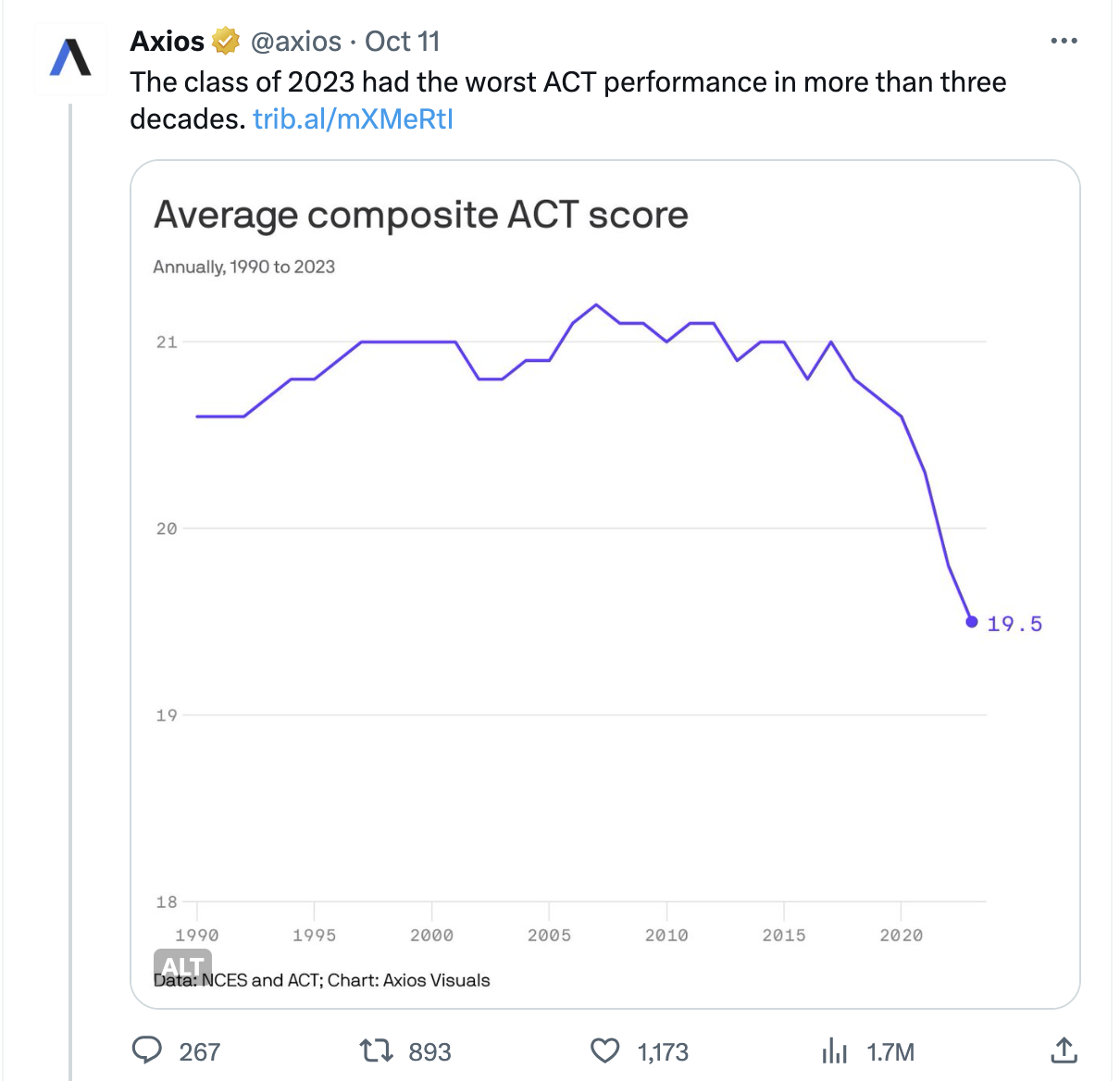
Here is the most recent example—2023 ACT scores:

I have noted that reactions and overreactions to NAEP in recent years follow a similar set of problems found in reactions/overreactions to the SAT for many decades; the lessons from those reactions include:

  • Lesson: Populations being tested impact data drawn from tests.
  • Lesson: Ranking by test data must account for population differences among students tested. 
  • Lesson: Conclusions drawn from test data must acknowledge purpose of test being used (see Gerald Bracey)

The social media and traditional media responses to 2023 ACT data expose a few more concerns about media, public, and political misunderstanding of test data as well as how “the administrations in charge” depend on manipulating test data to insure the perpetual education crisis.

Many people have confronted the distorting ways in which the ACT data are being displayed; certainly the mainstream graph from Axios above suggests “crisis”; however, by simply modifying the X/Y axes, that same data appear at least less dramatic and possibly not even significant if the issues I list above are carefully considered.

Many causal elements could be at work to explain the ACT decrease, including population shifts, social influences (such as the Covid impact), and the inherently problematic element of using test data for purposes not intended as well as making nuanced claims based on singular data points (averages).

For example, the ACT is exclusively designed to measure college preparedness, like the SAT, and not general educational quality of schools or general evaluations of student learning.

Students who take the ACT are a narrow subset of students skewed by region and academic selectivity (college-bound students versus general population of US students).

Also, while a careful analysis could answer these questions, the ACT score drop may or may not represent a significant event, depending on what that single point (average) represents (how many questions and how large is the change substantively).

Likely, however, there is never any credible reason to respond to college entrance data as a crisis of general educational quality because, as noted above, that simply is not what the tests are designed to measure.

The larger issue remains: Testing in the US rarely serves well evaluating learning and teacher, testing has not functioned in service of achieving effective education reform, but testing does fuel perpetual education crisis.

This crisis-of-the-day about the ACT parallels the central problem with NAEP, a test that seems designed to mislead and not inform since NAEP’s “Proficient” feeds a false narrative that a majority of students are not on grade level as readers.

The ACT crisis graph being pushed by mainstream media is less a marker of declining educational quality in the US and more further proof that “the administrations in charge” want and need testing data to justify “supposedly necessary reforms,” testing as gas for the perpetual education crisis fire.

Should Vermont Mimic Mississippi?: SOR Edition

There is a story education journalists love to tell; it is so innocent and compelling that even Florida wouldn’t bother to ban it.

Here is the story:

Despite how many have eagerly believed this fairy tale, it is nearly entirely caricature, misinformation, and lies. But it works so well that almost every education journalist in the US has recycled the story to fit their area or state, pulling from the original holy text.

For example, the most recent retelling comes from Vermont: Too Many Vermont Kids Struggle to Read. What Went Wrong—and Can Educators Reverse a Yearslong Slide in Literacy?

Predictably, this retelling includes the usual list of misinformation and lies:

  • The beginning of the article is a litany of misinformation about NRP, NAEP, and reading proficiency (see below about how this piece focuses on grade 4 but ignores grade 8).
  • Throughout (see above), the article relies on the caricature of balanced literacy and guessing/three-cueing.
  • NCTQ is cited as a credible source although the conservative think tank has never released a peer-reviewed report that meets even the minimum standards of valid research.
  • Orton-Gillingham is referenced as moving toward “‘a more scientific approach'” although O-G (multisensory instruction) is not supported by the most recent scientific studies.
  • The piece allows Moates to promote her own commercial product, LETRS, although, as with O-G, no scientific research exists showing that the program results in higher student reading proficiency.
  • And maybe most concerning, this piece again praises Mississippi as a model for reading reform in VT—although MS represents the problem with confusing higher test scores driven by grade retention with better reading instruction.

As I have noted, for at least 40 years, education reform has suffered under a crisis/miracle dichotomy that has failed students, teachers, and education.

The current crisis/miracle dichotomy is the manufactured reading proficiency crisis and the Mississippi “miracle.”

However, MS is based on the Florida model, which is now two-decades old.

Ironically, both FL and MS prove to be not models for reform but models for how political manipulation of education causes great harm to children (like the dark underbelly of fairy tales).

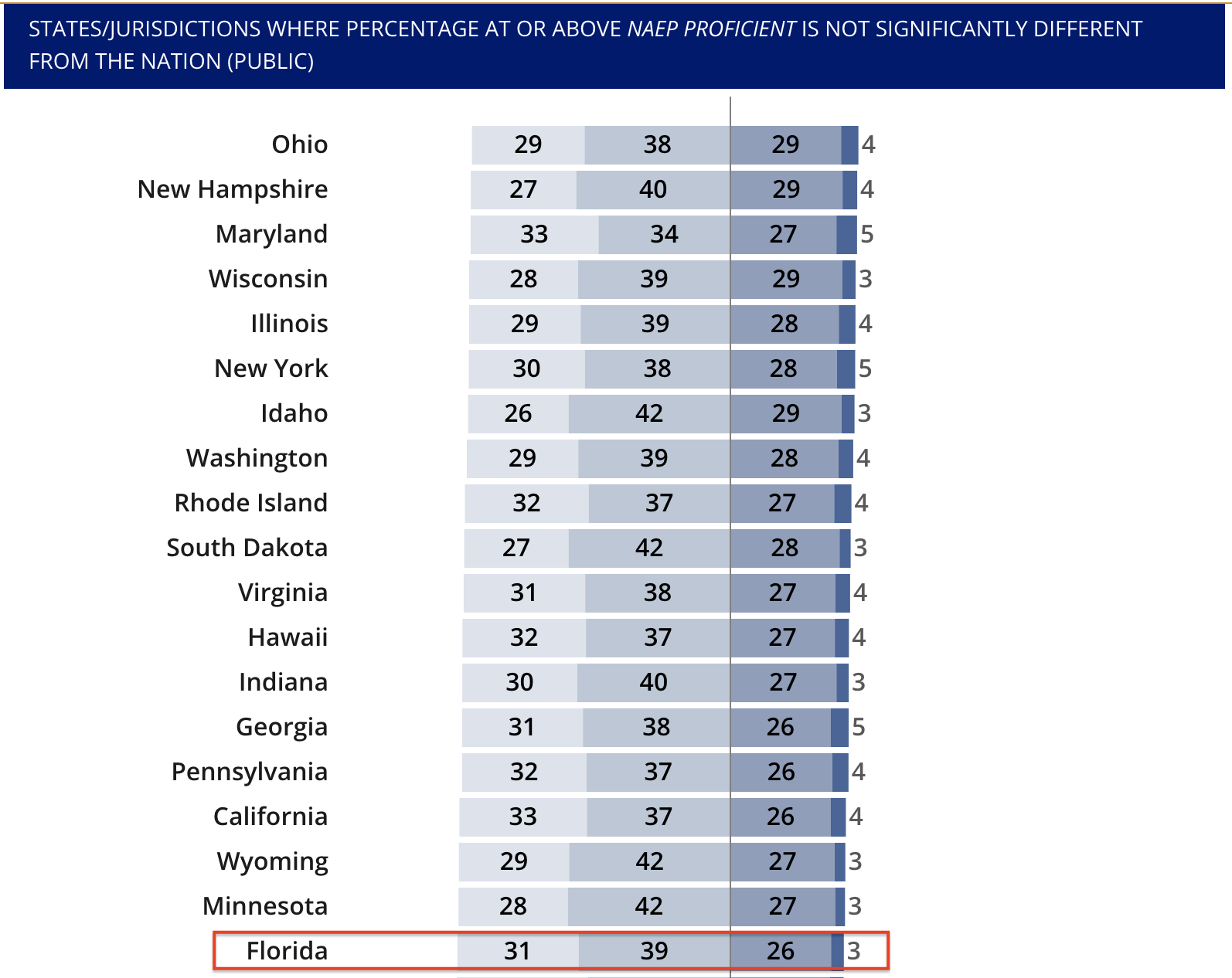
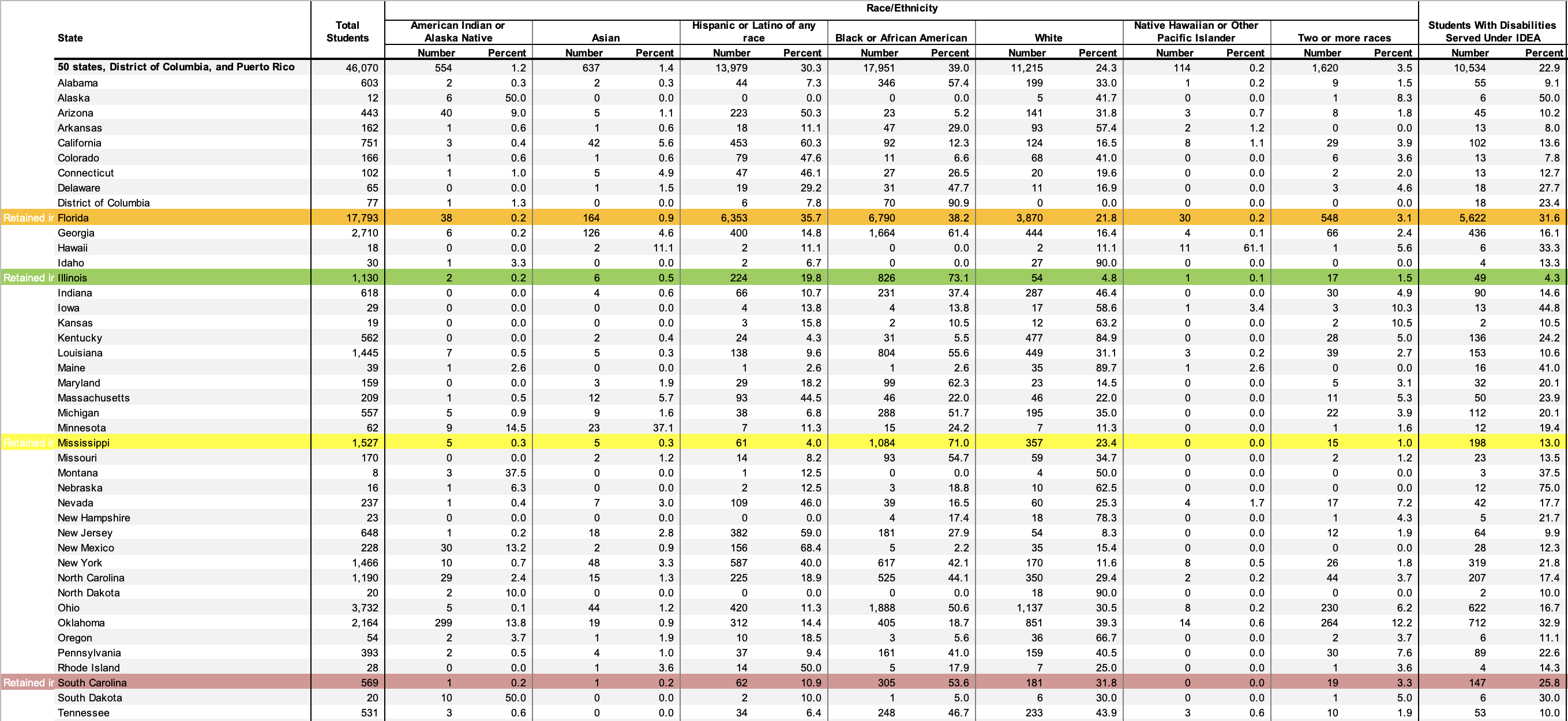
Yes, FL has found a process by which the state’s grade 4 reading scores on NAEP sit high in the national rankings; that “achievement” sacrifices almost 20,000 retained third graders a year (Black, MLL, and poor children disproportionately among those retained).

Here is the key problem not being fully addressed by media or reformers: FL also represents one of the states with the largest drop in achievement from grades 4 to 8, because the retention-driven grade 4 scores are mirages:

· Florida kids regress dramatically as they age in the system. Since 2003, Florida’s eighth grade rank as a state has never come close to its fourth grade rank on any NAEP test in any subject.

· The size of Florida’s regression is dramatic and growing, especially in math. Florida’s overall average NAEP state rank regression between fourth and eighth grade since 2003 is 17 spots (math) and 18 spots (reading). But since 2015, the averages are 27 spots (math) and 19 spots (reading).

Florida’s education system is vastly underperforming

MS has achieved its false “miracle” status by mimicking FL—retaining about 9,000-12,000 K through grade 3 students per year, again disproportionately minoritized students.

So what about VT? Well, despite the handwringing over VT’s grade 4 NAEP and reading proficiency, the state sits high in the national rankings of grade 8 reading on NAEP:

Florida is well behind VT in grade 8 reading:

And MS remains at the bottom of grade 8 reading:

Like the entire US, VT simply is not experiencing a reading crisis. And certainly not because of the witches brew of balanced literacy stealing children’s ability to receive effective reading instruction.

VT may be, in fact, a better model for our need to add patience and nuance to our evaluation of reading proficiency, how we teach reading, how we measure proficiency, and when students need to reach our benchmarks as developing readers.

And thus, VT should not mimic MS since that would be throwing out the baby with the cauldron water.

Recommended

OPINION: Historically underserved school districts in Mississippi were hit hard in the pandemic and need immediate help  

When Media Misinformation Becomes Conservative Education Legislation Over-Reach: Reading Proficiency Edition

What happens when years of media misinformation become a powerful talking point for extreme conservative advocacy groups and extreme conservative elected officials?

Consider this:

From the misleading and inaccurate work of Emily Hanford in 2018 to the more recent nonsense written by Nicholas Kristof in 2023, the lie that won’t die (2/3 of children are not reading at grade level) has ultimately—see above—driven a wave of conservative education reform that blurs curriculum and book banning legislation with “back-to-basics” reform touting the “science of reading.”

The key problem with the reading proficiency lie is that student reading proficiency is possibly the exact opposite of the lie because NAEP achievement levels are incredibly (purposefully?) confusing:

NAEP student achievement levels are performance standards that describe what students should know and be able to do. Results are reported as percentages of students performing at or above three NAEP achievement levels (NAEP Basic, NAEP Proficient, and NAEP Advanced). Students performing at or above the NAEP Proficient level on NAEP assessments demonstrate solid academic performance and competency over challenging subject matter. It should be noted that the NAEP Proficient achievement level does not represent grade level proficiency as determined by other assessment standards (e.g., state or district assessments). See short descriptions of NAEP achievement levels for each assessment subject.Scale Scores and NAEP Achievement Levels


While still a complicated statistic and claim, the reality is that if we use NAEP data as evidence, about 2/3 of students in the US read at or above grade level.

A better pair of claims, however, is that we do not have a universal definition of reading proficiency and that “grade level” is a far less valuable metric than “age level” for assessing reading proficiency.

This reading proficiency lie that won’t die is helping feed one of the worst waves of conservative assaults on schools even considering the 40-plus years of conservative education reform also based on the Nation at Risk lie.

Here is a reader for both reading proficiency and conservative education reform:

Reading Proficiency

ILEC RESPONSE: MAINSTREAM MEDIA COVERAGE OF READING PROFICIENCY, TEACHERS OF READING, NAEP SCORES, AND TEACHER PREPARATION

WHAT DO WE REALLY KNOW ABOUT READING PROFICIENCY IN THE US?

UNDERSTANDING AND REFORMING THE READING PROFICIENCY TRAP

THE PROFICIENCY TRAP AND THE NEVER-ENDING CRISIS CYCLES IN EDUCATION: A READER

EVEN MORE PROBLEMS WITH GRADE-LEVEL PROFICIENCY

THE POLITICS OF READING PROFICIENCY (AND CHARTER SCHOOLS)

BEWARE GRADE-LEVEL READING AND THE CULT OF PROFICIENCY

Conservative Education Reform

EDUCATION REFORM HAS BEEN BIPARTISAN AND CONSERVATIVE FOR MORE THAN 40 YEARS: WHAT WOULD PROGRESSIVE EDUCATION REFORM LOOK LIKE?

THE INDOCTRINATION PARADOX: THE CHRISTIAN CONSERVATIVE CRUSADE FOR PUBLIC SCHOOLS

SOR MOVEMENT MAINTAINS CONSERVATIVE ASSAULT ON TEACHERS AND PUBLIC SCHOOLS [UPDATED]

TEACHING IN A TIME OF CONSERVATIVE TYRANNY

CONSERVATIVES ARE WRONG ABOUT PARENTAL RIGHTS

DEAR PARENTS, YOUR CHILDREN’S K-12 EDUCATION IS ALREADY VERY CONSERVATIVE

Scripted Curriculum Fails Diversity, Students, and Teachers: SOR Corrupts Social Justice Goals (pt. 3)

[Header Photo by Marcella Marcella on Unsplash]

Grounded in the federal mandate for “scientifically based” instruction in No Child Left Behind (NCLB, 2001), anchored by the misrepresented National Reading Panel (NRP) report, the more recent “science of reading” (SOR) movement has successfully erased segments of the reading program market (Units of Study) and mandated as well as banned instructional practices in nearly every state of the US.

At the core of this SOR era of education reform is an orchestrated agenda to impose scripted curriculum onto reading instruction, often called “structured literacy”:

At its July 1st meeting, the IDA Board of Directors made a landmark decision designed to help market our approach to reading instruction.  The board chose a name that would encompass all approaches to reading instruction that conform to IDA’s Knowledge and Practice Standards. That name is “Structured Literacy.”…

If we want school districts to adopt our approach, we need a name that brings together our successes. We need one name that refers to the many programs that teach reading in the same way. A name is the first and essential step to building a brand….

The term “Structured Literacy” is not designed to replace Orton Gillingham, Multi-Sensory, or other terms in common use. It is an umbrella term designed to describe all of the programs that teach reading in essentially the same way. In our marketing, this term will help us simplify our message and connect our successes. “Structured Literacy” will help us sell what we do so well.

Structured Literacy: A New Term to Unify Us and Sell What We Do

Literacy scholars, however, have issued strong and research-based warnings about how structured literacy often devolves into scripted curriculum:

We recognize that some teachers using structured literacy approaches will find ways to respond to the interests, experiences, and literacy abilities of individual students; however, we are concerned about the indiscriminate and unwarranted implementation of the following practices:

  • Directive and/or scripted lessons that tell teachers what to say and do and the implementation of lesson sequences, often at a predetermined pace (Hanford, 2018)
  • Privileging of phonemic awareness and phonics as primary decoding skills (Hanford, 2018, 2019; IDA, 2019; Paige, 2020; Pierson, n.d.; Spear-Swerling, 2019)
  • Use of decodable texts that do not engage multiple dimensions of reading (Hanford, 2018; IDA, 2019; Paige, 2020; Spear-Swerling, 2019)
  • Specialized forms of reading instruction designed for particular groups of students as core literacy instruction for all students and teacher educators (Hanford, 2018; Hurford et al., 2016; IDA, 2019; Pierson, n.d.)
  • Mandating structured literacy programs despite the lack of clear empirical evidence to support these programs
  • Privileging the interest of publishers and private education providers over students.
Compton-Lilly, C.F., Mitra, A., Guay, M., & Spence, L.K. (2020). A confluence of complexity: Intersections among reading theory, neuroscience, and observations of young readers. Reading Research Quarterly, 55(S1), S185-S195. https://doi.org/10.1002/rrq.348

Compton-Lilly, et al.’s warnings are now being confirmed, notably in terms of bullet points 1 and 4 above as well as in terms of different reading programs now being mandated:

Overwhelming whiteness: a critical analysis of race in a scripted reading curriculum
Amanda Rigell, Arianna Banack, Amy Maples, Judson Laughter, Amy Broemmel, Nora Vines & Jennifer Jordan (2022) Overwhelming whiteness: a critical analysis of race in a scripted reading curriculum, Journal of Curriculum Studies, 54:6, 852-870, DOI: 10.1080/00220272.2022.2030803

Scripted curriculum not only de-professionalizes teachers, but also whitewashes the curriculum, confirming the significant overlap of conservative education reform agendas addressing bans and censorship along with the SOR movement.

As I have noted here and here, the SOR movement is a significant part of dismantling the social justice movement.

While the outsized attacks on some reading programs—those by Calkins along with those by Fountas and Pinnell—have been uncritically embraced by the media and politicians despite no evidence of a reading crisis or failure linked to those programs, there is little logic in claims that structured literacy programs are the solution to a manufactured crisis.

In fact, the move to structured literacy as scripted curriculum is demonstrably a shift in the wrong direction if we care at all about reading proficiency, our increasingly diverse population of K-12 students in the US, or our beleaguered teaching profession.


Recommended

What I learned from debating the Science of Reading more than 20 years ago is still true

Does the “Science of Reading” Fulfill Social Justice, Equity Goals in Education? (pt. 1)

America Dishonors MLK By Refusing to Act on Call for Direct Action (pt. 2)

Cherry Picking Isn’t Science

One of the foundational claims throughout the history of calling for education to be “scientific” is identifying instructional practices as either scientific (or evidence-based) or not.

A key concern with such claims is that they tend to overstate in a black-and-white way that practices are scientific or not, but also, a narrow view of “evidence” is certainly a problem (see Wormeli for example).

The “science of reading” (SOR) movement, for example, has tended to use “scientific” like a baseball bat, demanding that simplistic view of “science” and heralding some practices as evidence-based and others as “contrary practices” or “Ineffective and Currently Unsupported Instructional Strategies.”

Another flaw in the SOR movement’s demand for “scientific” instruction is cherry-picking research to promote and demonize selected practices.

Look at these two examples from pro-SOR documents:

Teacher Prep Review: Strengthening Elementary Reading Instruction
The Science of Reading: A Literature Review

Note here that the lists are different with some overlap, raising concerns about what science matters and what agenda any organization has (NCTQ releases reports that fail basic scientific validity to push a narrow agenda, for example).

The first list from NCTQ is overly dogmatic and an example of cherry-picking masquerading as scientific.

The second list has some promise since it allows for that some practices are not supported yet, a better characterization of science—although the lit review itself suffers from limited use of evidence.

One important element in the SOR movement and the legislation as well as practices that is driven by that movement is holding SOR claims to valid expectations of “scientific” that do not suffer from oversimplification.

In short, cherry picking is not science.