Cliches become cliches often because they do capture a truth, and “fish don’t know they are in water” may sound trite, but the saying captures well our five decades of education reform in the US.
Since A Nation at Risk under Ronald Reagan and then reinforced and expanded under George W. Bush (with Rod Paige and Margaret Spelling as Secretaries of Education), education reform in the US has been grounded in neoliberal ideology, the foundational beliefs of Republicans and conservatives.
“Neoliberalism” is a challenging term. First, it is hard to define, and second, the use of the word “liberal” has two contrasting meanings in the US—”liberal” as in “classic liberalism” is “conservative” or politically “right,” yet in common usage “liberal” is typically associate with “progressive” or politically “left.”
However, to simplify, in education reform, we can fairly interchange “neoliberal” with “conservative” and “Republican”—even though, as I want to discuss here, it is incredibly important to understand that neoliberal education reform is embraced and perpetuated by both Republicans and Democrats.
Look at the education reform landscape since the 1980s to understand.
A Nation at Risk established the neoliberal education reform playbook: manufacture an education crisis; declare that students, teachers, and public schools are failing; and mandate accountability policies to “fix” students, teachers, and schools (in-school reform only).
Insiders exposed that Reagan gave marching orders to the committee that created A Nation at Risk; Reagan wanted the US to embrace school choice (neoliberalism is a market ideology) and to “put prayer back in schools” (although voluntary prayer has always been allowed in public education, Reagan and Republicans depended on culture wars).
A key component of neoliberal education reform is the buy-in of the media. Until decades later, after numerous scholars discredited the report as a “manufactured crisis,” the media uncritically declared US education—teachers and students—failures.
And thus we set out on several cycles of the same accountability reform grounded in new standards, new tests, and new political mandates.
Governors scrambled to show they took education seriously, and George W. Bush in Texas turned his role as education reform governor into a launching pad for the White House.
Here is another key element.
Although Bush claimed a Texas “miracle,” again as with A Nation at Risk, after the political success and media as well as public buy-in, scholars showed that the “miracle” was a “mirage” (or better yet, a lie).
None the less, Bush took Paige into his administration and No Child Left Behind (NCLB) was modeled in the Texas “miracle”/”mirage”—and just as Democrats rushed to embraced Reagan’s lie, Democrats joyfully made NCLB one of the most prominent federal bi-partisan accomplishments in recent US history.
Few things show how pervasive neoliberal (Republican/conservative) education reform has become the water to the fish (education) than the Barack Obama/Arne Duncan education era.
Instead of ushering in a progressive or critical response to the Bush education policy, Obama/Duncan doubled down—fueling the draconian value-added method era of teacher evaluation, launching the deceptive and austere education career of Michelle Rhee, and supercharging the charter school movement (a “school-choice lite” movement that fulfills the market beliefs of neoliberalism).
At 40 years since A Nation at Risk, all we have to show for the constant reform in education is a series of claims of “crisis” and a smattering of “miracles”—both of which are always manufactured.
SOR has its roots firmly in NCLB and the National Reading Panel (SOR cites the NRP report as much or more than any other evidence)—the peak of neoliberal education reform.
SOR was also fueled throughout the 2000s by the Florida model, which depends heavily on grade retention and laser-focusing on grade 3 reading.
Around 2013, states began to revisit or reimagine reading legislation, but in 2018, the media supercharged the SOR movement, echoing the “manufactured crisis” approach of A Nation at Risk.
Notably, the “manufactured crisis” of the SOR movement is firmly grounded in NAEP testing; first, the media misrepresents NAEP data, and second, NAEP is purposefully designed (the test is a neoliberal tool) to create the veneer of failure by students, teachers, and schools.
NAEP allows media and political leaders to shout that 2/3 of students are not proficient in reading even though that claim isn’t what most people think.
Therefore, at its core, the SOR movement is another neoliberal education reform movement, a tool of Republican/conservative ideology and politics.
SOR has the student/teacher/school failure rhetoric, the “miracle” that is a “mirage,” the eager and uncritical compliance of the media, and the compelling use of standardized tests data (NAEP). But most importantly to understand how SOR is neoliberal education reform, the policies are repackaging Jeb Bush’s Florida model, emphasizing punitive reading policies such as grade retention.
However just like all the other neoliberal education reform since the 1980s, it will not work because it isn’t designed to work.
We are only 20 years since NCLB/NRP which mandated scientifically based reading instruction, yet there is a reading crisis?
Here is the dirty little secret about neoliberal education reform: It is a distraction for political gain.
Neoliberalism keeps the public’s gaze on individuals (students, teachers) and away from systemic forces; SOR wants people to believe that a couple reading programs are to blame for reading failures instead of poverty and inequity.
And the neoliberal attacks in SOR on people are yet another swipe at progressive and critical educators.
Like fish, many educators cannot see they are willing participants in neoliberal education reform; almost all Democrats cannot see they are willing participants in neoliberal education reform.
Fish don’t know they are in water, but with the SOR movement (and whatever crisis comes next), the better analogy may be lobsters in a slowing boiling pot.
Wagma Mommandi, a former public-school teacher, is a PhD candidate in education policy at the University of Colorado Boulder School of Education.
Kevin Welner is a professor and the director of the National Education Policy Center, which is housed at the CU Boulder School of Education.
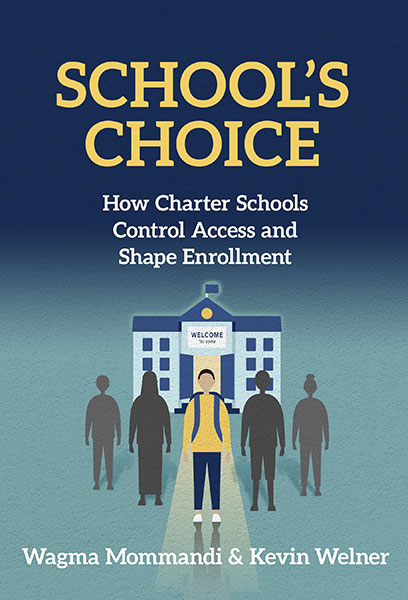
Access issues are pivotal to almost all charter school tensions and debates. How well are these schools performing? Are they segregating and stratifying? Are they public and democratic? Are they fairly funded? Can apparent successes be scaled up? Answers to all these core questions hinge on how access to charter schools is shaped. This book describes the incentives and pressures on charter schools to restrict access and examines how charters navigate those pressures, explaining access-restricting practices in relation to the ecosystem within which charter schools are created. It also explains how charters have sometimes responded by resisting the pressures and sometimes by surrendering to them. The text presents analyses of 13 different types of practices around access, each of which shapes the school’s enrollment. The authors conclude by offering recommendations for how states and authorizers can address access-related inequities that arise in the charter sector. School’s Choice provides timely information on critical academic and policy issues that will come into play as charter school policy continues to evolve.
Book Features:
Examines how charter schools control who gains and retains access.
Explores policies and practices that undermine equitable admission and encourage opportunity hoarding.
Offers a set of policy recommendations at the state and federal level to address access-related issues.
It has been a decade since I raised this question, Parental Choice?, after spending about a year examining all the research available as well as the public and political debate about school choice.
Now, Education Week seems to have finally recognized some of the conclusions I presented in that book: Why Don’t Parents Always Choose the Best Schools? I think it is important that this article does not ask “if” parents choose the best schools, but concedes that parental choice is a flawed part of the school choice as an avenue to educational reform argument.
In short, my research and analysis show that parental choice and school choice fail because they suffer from the same problem concerning all choice driven by America’s idealized perception of individual freedom and market economies. If school choice were a powerful and effective lever for positive educational reform (and it isn’t), market forces remain indirect ways to create the sort of equity of opportunity that a democracy could accomplish directly.
Choice, at best, is slow and erratic, depending on the quality and expertise of the consumers to eventually shape the outcomes desired all along. Pop music is exactly what consumers have created through supply and demand, but we are under no illusion that pop music success equals the highest quality of music possible. High-quality music may have a better chance of being produced by musicians fully publicly funded by NEA grants and left free of corrupting market dynamics.
The consumer choice/quality dynamic in school choice is the problem that Arianna Prothero is acknowledging and confronting in EdWeek.
The research and outcomes related to school choice have always been mixed at best, and the school choice debate has been marred by shifting talking points (different types of choice schemes and different outcomes promised). Since support from school choice is often ideological or driven by the inequity experienced in public education, however, the following patterns continue to characterize the debate:
Parents participating in school choice focus more often on cultural and ideological commitments rather than academic quality. School choice, then, is more likely to create stratified schools and not work as a lever for motivating higher academic quality across all schooling. School choice is not proof that a rising tide lifts all boats, but proof that given the opportunity, people will segregate themselves in a lot of different boats while disregarding the threat of drowning facing some of them.
School choice unintentionally feeds into the tyranny of parents at the exclusion of children’s autonomy and human rights. Secular public schools should be an opportunity for all children to experience a democracy of ideas and become the humans those children choose to be. Students shepherded into academic settings that perpetuate narrow ideals and ideas dictated by the parents are denied their choices and opportunities.
Marginalized and underserved populations (impoverished, Black communities, English language learners, etc.) do often welcome school choice as a possible avenue to greater equity of opportunity; that promise has also proven to be empty, but underserved populations’ support for school choice is also misread. School choice and charter schools have driven school re-segregation (clearly not a positive outcome for Black parents and students) and has not guaranteed that all students have the opportunities found in elite private schools (the choice of wealthy and mostly white parents). If public schools simply served all students well and fully, then the support for school choice found among marginalized groups would disappear.
Rarely do any advocates for school choice acknowledge that the qualities commonly found among expensive private schools—what the wealthy choose—are aspects of school reform that could be implemented in all public schools if there was the political will to do so. However, low student-teacher ratios, challenging course work (such as Advanced Placement and International Baccalaureate), and expansive fine arts programs somehow are not on the education reform agenda for all students.
The school choice debate ultimately fails because it doesn’t pull back far enough and acknowledge that public schools should be of a universally high quality that makes choice unnecessary. As a culture, we do not allow the market to determine which bridges we drive across are safe or not; all of us driving expect a minimum high quality of bridges on all public roads and highways. As I have concluded before:
People in poverty deserve essential Commons—such as a police force and judicial system, a military, a highway system, a healthcare system, and universal public education—that make choice unnecessary. In short, among the essentials of a free people, choice shouldn’t be needed by anyone.
No child should have to wait for good schools while the market sorts some out, no human should have to wait for quality medical care while the market sorts some out, no African American teen gunned down in the street should have to wait for the market to sort out justice—the Commons must be the promise of the essential equity and justice that both make freedom possible and free people embrace.
School choice advocates fail to consider the indirect and haphazard mechanisms of market forces. School choice not only re-segregates schools, but also creates a huge amount of wasteful churn—students moving among schools along with teachers and even the shifting of school building. The great charter overthrow experienced in New Orleans post-Katrina, for example, has replaced all the public schools with charter schools—with essentially the exact same educational problems remaining for the students, parents, and community.
School choice research has been negatively impacted by common problems with educational research (comparing similar populations, confronting problems of scaling up, etc.) as well as the corrupting influence of advocacy. Too much of what is presented in the media as “research” is actually advocacy masquerading as scholarship. Pro-school choice think tanks have been very aggressive and depended on a non-critical media and public, both of which are highly susceptible to press-release and both-sides journalism.
Ultimately, the school choice debate is a distraction from a sobering fact: the U.S. has failed public education by never completely committing to high-quality education for every child in the country regardless of their ZIP code.
There is no mystery to what constitutes a great school, high academic quality, or challenging education, but there is solid proof that almost no one in the U.S. has the political will to choose to guarantee that for every child so that no one has to hope an Invisible Hand might offer a few crumbs here and there.
A dog whistle is designed so that to unintended audiences (humans), the whistle is silent, but to the intended audience (dogs), the whistle is a sharp alert.
Now here comes the metaphorical portion of this post.
Over only a couple years of the Donald Trump era of Republican politics, we have become gradually accustomed—like a live lobster dropped in a pot of water soon boiled—to the gross and bluntly self-unaware language of his leadership of the Republican party—he of “grab them by the pussy,” no less.
In the U.S., we are pretty solid examples of Meursault’s dictum that people can get used to anything, but we also represent how short human memory is. I fear we have forgotten something most of us never even recognized: The good ol’ traditional political lie, often wrapped conveniently in dog whistle language.
It’s good work—if you are a white man with the sort of wealth and clout that you can negotiate into being among the rich-boys’ club we call the U.S. Senate.
DeMint’s political lie du jour is, hold your breath, an endorsement of school choice, the perennial go-to of conservatives:
Former U.S. Sen. Jim DeMint is urging state lawmakers to create education scholarship accounts to foster an expansion of school choice in South Carolina.
The proposal that DeMint outlined during a speech Monday night to the Greenville County Republican Party would allow parents of special needs and impoverished students to spend state-allocated education money to attend private schools. Foster children and military families also would be eligible to take part in the program.
“The only way we are going to save our culture and our society is if we can create an education system that the parents can customize,” DeMint said.
Wow, it really takes your breath away, doesn’t it, when someone of DeMint’s stature speaks for special needs children and children trapped in poverty?
And, he wants them to go to private school. Private. School.
As the dog whistle goes, however, if you aren’t a white nationalist/racist (and chances that you are and reading my blog are really pretty low), your eyes may have become all blurry with empathy tears by the time you got to “our culture and our society.”
If you did miss that, maybe track down a friend or family member who voted for Trump, or is a card-carrying Republican, and ask them who the “our” is all about, or maybe to define the whole “culture” thing.
I have a few ideas, as well, because I am really close to having lived 60 years in the very state DeMint represented—a state that clutches the Confederate flag and believes the Civil War wasn’t waged over slavery. You see, SC is a “Heritage Not Hate” state.
There’s some world-class Orwellian language for you, by the way, because, if you have the time and patience, I suspect it would be illustrative to ask anyone in SC who says “Heritage Not Hate” to explain what that heritage entails. Mind you, the explanation will defy reality, and history, but it will be an experience, and unlike a dog whistle, you will hear every word, but may doubt you are hearing the words you hear.
DeMint has provided for those who see and hear past the veneers the ugly relationship between school choice advocacy and the Republican party’s investment in white nationalism/racism.
First, the political lie of school choice:
In his speech Monday night, DeMint said education scholarship accounts can result in a “win-win” scenario for parents and public schools. He said parents can choose the best educational opportunities for their children while public schools can benefit from a reduction in class sizes.
“It creates a dynamic in every situation that we’ve studied where public schools get better,” DeMint said.
School choice, in fact, and including charter schools, has not improved anything, but has been strongly associated with re-segregating education and proving public funds for more affluent families to flee public schools.
Parents, you see, do not chose schools for academic reason mostly, but for ideological ones, such as making sure their children attend school with people who look like them and sit in classes that provide the sorts of indoctrination the parents desire.
School choice schemes never provide the sort of full support low-income parents need, such as transportation or time that is taken for granted by the affluent.
And what DeMint will not discuss is that the free market, the sacred Invisible Hand, has no incentive toward equity or quality. Market forces are guided by the lever of the customers and their capital.
Private schools are no better than public or charter schools—all of which are mostly reflections of the populations they serve.
So we are left with a really jumbled message to the white nationalists/racists who are anti-government: School choice will provide you public funds to isolate your white children with other white children to receive the indoctrination you want to preserve the sacred white race.
That is the dog whistle that is “‘our culture and our society.'”
To be conservative is to resist change and to advocate for keeping things as they are.
In South Carolina, with its long history of conservative politics, culture, and religion, that means keeping the complaints the same (public education is failing) and keeping the solutions the same (disregarding that these solutions neither match the problems nor have worked in any way over the last thirty-plus years).
Greenville County legislators vowing to make education reform a top priority on Tuesday publicized an education agenda from the conservative Palmetto Promise Institute.
The Help Our Pupils Excel plan would reformat the state’s education system by addressing “root problems in finance structure, accountability and equity of opportunity for our rural schools,” members of the Greenville County House Delegation said in a letter to House Speaker Jay Lucas.
Lee outlines the reform plan as the following:
Streamline and fix South Carolina’s education funding formula. The current formula is overly complex, according to the Palmetto Promise Institute, and “research shows that there is zero connection between how money is spent and actual student costs.”
Cut bureaucracy and consolidate small and shrinking school districts with less than 2,500 students. These districts “simply must be incentivized or compelled to consolidate,” the institute said.
Provide more education options for parents and students. The plan calls for expanding VirtualSC, the state’s online public learning program, and to create education scholarship accounts, which would give parents direct access to their child’s state student funding formula. Parents could spend the money on approved services their child needs, such as therapy or tutoring, according to the institute.
Support teachers. The H.O.P.E. plan calls for more pay flexibility for districts to reward and retain teachers “based on talent and effectiveness, rather than only years-in-service or degrees.”
Incent excellence in teaching & school leadership. (Headings taken from Fast facts PDF)
While the headline repeats the refrain of the think tank, “bold,” the truth is that this plan is warmed over conservative ideology that has failed public education again and again.
Most of the reforms are just elements of school choice, charter school advocacy, and school takeover schemes (achievement districts)—each of which has been thoroughly discredited by research (the one element that apparently must be avoided in order to be “bold”).
Below is a reader, then, discrediting this plan, yet again, as baseless conservative ideology that is poised to exploit and further fail public education in South Carolina—not offer our students and our communities the equity of opportunity all people deserve in a free society:
In short, this so-called “bold” reform plan is nothing new. It is the same old mantra of pet conservative political projects SC and the entire nation have suffered under since the early 1980s.
Yet, charter schools and private schools contribute significantly to segregation and inequity—both of which are key sources of problems in public schooling in SC.
Broadly, school takeovers (achievement districts, etc.) and school choice create a great deal of churn, but have failed badly the promises made by conservative politicians.
Regretfully, this bogus plan has proven my recent prediction accurate; especially in SC, conservative politicians are doggedly bound to pointing fingers at the same problems, ones they themselves have allowed to fester and even made worse by repackaging and offering again and again failed conservative ideology as solutions in the form of a Trojan Horse named, this time, “bold.”
Though some warnings about online “echo chambers” have been hyperbolic, tendencies toward selective exposure to politically congenial content are likely to extend to misinformation and to be exacerbated by social media platforms. We test this prediction using data on the factually dubious articles known as “fake news.” Using unique data combining survey responses with individual-level web traffic histories, we estimate that approximately 1 in 4 Americans visited a fake news website from October 7-November 14, 2016. Trump supporters visited the most fake news websites, which were overwhelmingly pro-Trump. However, fake news consumption was heavily concentrated among a small group — almost 6 in 10 visits to fake news websites came from the 10% of people with the most conservative online information diets. We also find that Facebook was a key vector of exposure to fake news and that fact-checks of fake news almost never reached its consumers.
I use standardized test scores from roughly 45 million students to describe the temporal structure of educational opportunity in over 11,000 school districts—almost every district in the US. For each school district, I construct two measures: the average academic performance of students in grade 3 and the within-cohort growth in test scores from grade 3 to 8. I argue that third grade average test scores can be thought of as measures of the average extent of educational opportunities available to students in a community prior to age 9. Growth rates in average scores from grade 3 to 8 can be thought of as reflecting educational opportunities available to children in a school district between the ages of 9 and 14.
I document considerable variation among school districts in both average third grade scores and test score growth rates. Importantly, the two measures are uncorrelated, indicating that the characteristics of communities that provide high levels of early childhood educational opportunity are not the same as those that provide high opportunities for growth from third to eighth grade. This suggests that the role of schools in shaping educational opportunity varies across school districts. Moreover, the variation among districts in the two temporal opportunity dimensions implies that strategies to improve educational opportunity may need to target different age groups in different places. One additional implication of the low correlation between growth rates and average third grade scores is that measures of average test scores are likely very poor measures of school effectiveness. The growth measure I construct does not isolate the contribution of schools to children’s academic skills, but is likely closer to a measure of school effectiveness than are measures of average test scores.
In its rush to pass a major rewrite of the tax code before year’s end, Congress appears likely to enact a “tax reform” that creates, or expands, a significant number of tax loopholes. One such loophole would reward some of the nation’s wealthiest individuals with a strategy for padding their own bank accounts by “donating” to support private K-12 schools. While a similar loophole exists under current law, its size and scope would be dramatically expanded by the legislation working its way through Congress.2 This report details how, as an indirect result of capping the deduction for state income taxes paid, the bill expected to emerge from the House-Senate Conference Committee would enlarge a loophole being abused by taxpayers who steer money into private K-12 school voucher funds. This loophole is available in 10 states: Alabama, Arizona, Georgia, Kansas, Montana, Oklahoma, Pennsylvania, Rhode Island, South Carolina, and Virginia.
It is the unwritten adjective that filled the infinite and simultaneously minuscule void between “all” and “men” when our founding fathers so eloquently declared their independence. The word “white” is not included in the Constitution, but it is understood by all to be the unmentioned modifier in “we the people.” It is our national equivalent to the aphonic letter “e.” We could always see it, but as a country we agreed to adhere to the first rule of American phonetics:
People have a habit of saying, “What is the theme of your story?” and they expect you to give them a statement: “The theme of my story is the economic pressure of the machine on the middle class”—or some such absurdity. And when they’ve got a statement like that, they go off happy and feel it is no longer necessary to read the story.
Some people have the notion that you read the story and then climb out of it into the meaning, but for the fiction writer himself the whole story is the meaning, because it is an experience, not an abstraction.
There is a disturbing but predictable formula when you combine the University of Arkansas (and dig a bit to the Walton money funding the Orwellian-named Department of Education Reform) and Knowledge Is Power Program (KIPP) charter chain that results in, at best, careless misinformation or, at worst, brazen deception.
Let’s start at the ironic end to a 2 August 2017 press release on the relationship between UofA and KIPP:
“KIPP helped me to not only be adaptable, but to stay motivated,” she said. “I think an excerpt from Robert Frost’s poem, ‘The Road Not Taken’ best describes my KIPP experience,” Walton said. ” ‘Two roads diverged in a wood, and I— / I took the one less traveled by, / And that has made all the difference.'”
The irony is that the sentiment ascribed here to Frost’s poem is a common misreading that parallels how KIPP and charter advocates impose their ideology onto what we know about KIPP/charter schools in the service of the brand and not the students (noting here how this press release allows the former KIPP student* to do all the heavy lifting).
Frost’s “The Road Not Taken,” in fact, is illustrative here, but not in the way intended.
Misreading and mis-teaching this iconic poem fail in one extremely important way: ignoring that the speaker in Frost’s poem repeatedly notes that the two roads are the same: “as just as fair,” “Had worn them really about the same,” and “And both that morning equally lay.”
The poem actually stresses that making choices is mostly unavoidable and certainly builds everyone’s fate, but the poem is also a satire about regretting choices, as Orr explains:
Frost had been inspired to write the poem by Thomas’s habit of regretting whatever path the pair took during their long walks in the countryside—an impulse that Frost equated with the romantic predisposition for “crying over what might have been.” Frost, Thompson writes, believed that his friend “would take the poem as a gentle joke and would protest, ‘Stop teasing me.’”
Therefore, Frost’s much mangled poem offers us two lessons missed by the UofA/KIPP agenda: (1) there is almost no difference between or among types of schools (charter v. public or private v. public), and (2) the claims made by KIPP and other charter advocates are far more complex than they seem on the surface (as is the poem).
Press release rhetoric falls apart, however, once the claims are carefully examined. Here are just a few examples of KIPP and charter exaggeration and deception:
KIPP is correct that schools that only count students who complete 12th grade will have inflated scores compared to KIPP that counts students who complete 8th grade. But what KIPP doesn’t mention is that the fairest way to make a comparison to the 9% number is to start counting at 5th grade. KIPP actually has a pretty big attrition between 5th and 8th grade so the true ‘gold standard’ is really not used by anyone. All the numbers are inflated. KIPPs might be inflated less than the others, but it still is so they can whine that the others are cheating worse than they are on this statistic, but they should admit that they are doing it too, though to a lesser degree.
This most recent press release from UofA/KIPP is yet another example of how charter advocacy and the entire education reform agenda are awash in misinformation, steering the rampant misreading of these reforms by politicians and the public.
I fear that like the satirized speaker in Frost’s poem, “I shall be telling this with a sigh/Somewhere ages and ages hence”: When you see “miracle” claims that are too good to be true, well, they are not true.
Shame on UofA and KIPP for continuing to traffic in such lies.
* NOTE: Certainly, two important points must be made about this student’s experience: (1) Everyone can fairly celebrate her success and pride in that success, while (2) an anecdote based on one person’s experience cannot prove or disprove any sort of generalizations. Thus, this student ascribing her success to KIPP in no way makes that true, even though she genuinely feels that way.
The school choice movement has its roots in mid-twentieth century, and was bolstered by some ugly truths about racism in the U.S. during the Civil Rights movement and public school integration.
While school choice advocacy has maintained some foundational catch phrases such as “innovation” and relied on appeals to uncritical faith in market forces over “the damned government,” school choice has also maintained two key patterns: (1) promises associated with school choice advocacy have mostly failed, and thus, (2) “choice” has morphed repeatedly into new versions to stay ahead of all the bad news about outcomes falling short of those promises.
The last decade, however, has revealed a school choice gold mine in the charter school movement that appears to blend the public’s support for public schools with the allure of parental choice.
However, on balance, charter school advocacy has proven to be mostly rhetoric and absent evidence in ways similar to the larger school choice movement.
Public and charter schools, for example, are currently plagued with rising segregation, and both embrace policies that can fairly be labeled racist and classist—leading the NAACP to maintain a strongly skeptical position about the credibility of charter schools.
And when charter schools appear to succeed where public schools do not, a careful analysis nearly always reveals that what is too good to be true is, in fact, not true.
School choice innovation, including charter school innovation, actually has little to do with education and more to do with keeping ahead of the evidence in order to maintain political and public support for finding yourself in a hole and continuing to dig.
Across the U.S., the National Association of Charter School Authorizers has been sounding the alarm about a trend it calls “authorizer shopping,” which it calls “a growing threat to overall charter school quality.”
“Authorizer shopping happens when a charter school chooses an initial authorizer or changes authorizers specifically to avoid accountability,” the group said in a 2016 report. “A low-performing school may shop for a new authorizer to avoid closure, or reopen under a new authorizer after closure.”
Also important to highlight is, as Bowers notes, how this new phase of charter expansion linked to less or no accountability is appealing to the least effective forms of charter schools:
Two of the first schools to express an interest in the new public charter school sponsor, the Charter Institute at Erskine College, are the S.C. Virtual Charter School and Cyber Academy of South Carolina. The two schools enrolled more than 4,000 students combined in kindergarten through 12th grade last school year.
The hard truths about educating children in a free society in order to create a more perfect union, to reach and sustain an equitable democracy, are that public education has mostly failed the children who need it most because the U.S. is plagued by political cowardice and that schemes labeled “education reform” are mostly even worse alternatives (including school choice and charter schools) to the mismanaged public system.
Near the end of his life, Martin Luther King Jr. called for addressing poverty directly and thus eradicate related social inequities and empower public institutions:
In addition to the absence of coordination and sufficiency, the programs of the past all have another common failing — they are indirect. Each seeks to solve poverty by first solving something else.
I am now convinced that the simplest approach will prove to be the most effective — the solution to poverty is to abolish it directly by a now widely discussed measure: the guaranteed income. …
We are likely to find that the problems of housing and education, instead of preceding the elimination of poverty, will themselves be affected if poverty is first abolished. The poor transformed into purchasers will do a great deal on their own to alter housing decay. Negroes, who have a double disability, will have a greater effect on discrimination when they have the additional weapon of cash to use in their struggle.
African-American women only earn 64 cents to every dollar earned by non-Hispanic white men, according to the NWLC analysis; the figure for women overall is 77 cents. That’s based on the average earnings of female and male full-time, year-round workers taken from Census data.
The pay gap for Black women varies based on age and industry. Older Black women have it the hardest—the pay gap is only 82 cents on the dollar for 15-year-old to 24-year-old Black women compared to white men, but the gap widens to 67 cents and 59 cents, respectively, for Black women ages 25-to-44 and 45-to-64.
As for industries, Black women working as physicians and surgeons—a high-wage and male-dominated occupation—make only 52 cents for every dollar paid to their white male counterparts. Black women fared slightly better in lower-paid occupations, making 86 cents on the dollar in male-dominated, mid-wage construction industries and 85 cents on the dollar working as low-wage, mostly female personal care aides. …
The fact that Black women are overrepresented in low-wage jobs doesn’t help, the analysis said. Black women make up 14 percent of low-wage workers and 6 percent of the overall workforce.
Education levels don’t make much of an impact on the high wage gap between Black women and non-Hispanic white men. While more education corresponds with higher wages for both Black women and white men, Black women still make between 61 and 66 cents on the dollar compared to their counterparts at every education level [emphasis added]. African-American women have to have at least a Bachelor’s degree to make as much as white men who didn’t finish college.
Education reform, then, especially under the guise of school choice/charter schools, is once again failing to address directly the root causes of why we believe public education needs reform in the first place.
The only real innovation among the charter school advocates is how many ways they can avoid the hard truths about reforming schools and the impotence of education to overcome social inequity and injustice.
It has become fashionable for pundits to argue that fake news has created a post-truth America; however, mainstream media, in fact, carry the brunt of the responsibility because too often journalists are trapped in press-release journalism and traditional expectations of objectivity.
Evidence of this can be found in how the media routinely cover education and education reform—even when good journalists with good intentions seek to be objective and fair by covering a topic.
Paul Hyde’s Advocates tout the benefits of school choice (25 January 2017) represents the ultimate failure of covering what advocates claim instead of confronting whether or not those claims are credible.
Regularly, the public is bombarded with school choice advocacy and proposals that school choice can somehow address the historical and persistent problems we rightfully recognize in South Carolina’s public schools. These arguments are compelling for a public in the U.S. that believes in choice and idealizesparental choice.
But here is the problem: The evidence rejects that market forces (through vouchers, tuition tax credits, charter schools, and even public school choice, which is in place in South Carolina’s Greenville county) are effective but indirect methods for education reform.
School choice is an ideological argument that exposes political cowardice (let the Invisible Hand do what political leaders refuse to do), and it ignores that public institutions should make choice unnecessary (think about why we do not privatize the judicial system, the police force, roads and highways).
First, the problems with our public schools are primarily strongly connected to large gaps in outcomes among identifiable groups of students by race, social class, special needs, and home languages.
All across South Carolina, for example, and notably along its Corridor of Shame, schools serving low-poverty populations have strong outcomes while schools burdened with high poverty and high percentages of students with special needs and English language learners have weak outcomes.
What we must acknowledge is first that struggling schools and students are not struggling because of a lack of choice, and then, all choice models for reform are indirect ways to make the changes that should be accomplished by public policy directly.
Here is the fact that political leaders are avoiding by abdicating their responsibilities to address inequity: Between 60-80% of measurable student outcomes are connected to students’ lives outside of school—home income, access to medical care, food and living security, and stable and well-paying jobs for the parents.
If public policy were to address these social inequities directly, student outcomes would improve with no in-school reform at all.
But our current schools also require direct reform, some of which could correct the negative consequences of choice—increasing segregation, creating unnecessary shuffling of student populations, diverting funds from public schools for charter and private schools that do not have better outcomes.
Too often, public school practices reflect and perpetuate the exact inequities in society that are overburdening our schools.
Instead of hoping that market forces create equity (and they will not), new direct policy should confront the following: vulnerable populations of students are assigned disproportionately new and un-/under-certified teachers, tracking and selective programs (Advanced Placement, International Baccalaureate) benefit advantaged students while vulnerable students are often barred, discipline practices and consequences perpetuate inequity, and too often school facilities and materials reflect the socioeconomic status of the community.
Ultimately, mainstream media failing to provide a critical response to school choice advocates allows yet more political cowardice.
School choice—from vouchers to charter schools to public school choice—over the past 20-30 years has never produced the miracles advocates promise. Despite public perception, charter schools and public schools do not have higher outcomes than public schools when adjusted for the characteristics of students served.
Types of schooling simply do not make a difference, but practices do—although no in-school practices have yet to overcome the influence of out-of-school influences beyond the scope of teachers and schools to control.
Allowing powerful people with vested interests to advocate for failed policy without any media, political, or public challenges is cheating our schools, our students, and our democracy.
The weight of evidence does not validate school choice advocacy, but more important than that, we know what needs to be reformed to insure better opportunities for all students.
We need politicians themselves to embrace choice, choosing direct action instead of continuing to hide behind the political cowardice of hoping parents-as-customers can force schools to accomplish the impossible.
educator, public scholar, poet&writer – academic freedom isn't free






 dr. p.l. (paul) thomas