Review: Santa Cruz Blur 2020 Carbon R Build

Among the many challenges of transitioning from college into the workforce is the toll that takes on your personal and recreational life. Throughout high school and college, I was always a recreational athlete, mostly pick-up and school-based or intramural basketball,

It was the mid-1980s, and I was in my second year teaching high school English as well as coaching two sports. I found myself exhausted, having lost weight (I was already rail-thin my whole life), and not doing any exercise for a couple years.

This is when I adopted recreational cycling, leading to a passion that has lasted over thirty years with many years including 9,000-10,000+ miles per year in the saddle.

Over the decades, I have owned about 45-50 bicycles and built up or maintained dozens and dozens more for myself and friends. I love cycling, but I also love bicycles, aesthetically and mechanically.

Primarily, I am a road cyclist, but I have had two significant commitments to mountain biking as well—most recently after several cycling friends and I were in a catastrophic car/bicycle accident on Christmas Eve of 2016.

Once my fractured pelvis healed, I turned to mountain biking. Over the past several years, then, I have owned several mainstream full suspension MTBs—Cannondale, Niner, Specialized—and one hardtail—Trek.

While I love the hardtail Trek (2019 Procaliber 9.6), as I near 60, my body simply couldn’t handle the wear and tear. The features of that hardtail I did enjoy included low weight, nimble handling, and responsive pedaling. [Incidentally, that year model of the Trek was incredibly consumer friendly; a great deal of bike for the money.]

During my first venture into mountain biking 20 or so years ago, I had a great experience with a Santa Cruz Super Light so I kept coming back to trying Santa Cruz again, which I did when I purchased the 2020 Blur with the Carbon R build from Competitive Cyclist (an online retailer with whom I have had great experiences for many years).
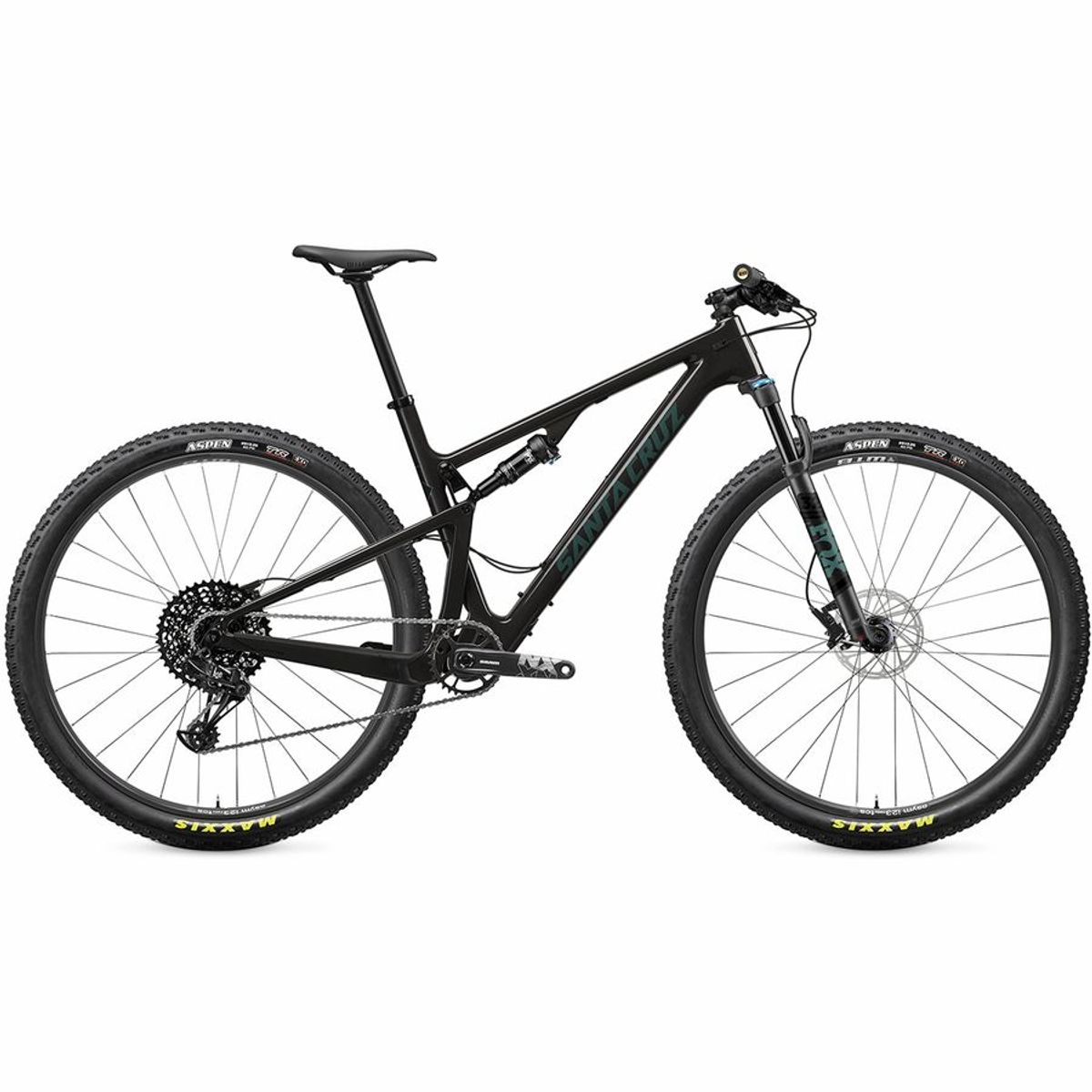
Santa Cruz Bicycles Carbon R Mountain Bike

I now have about 300 miles on the Blur and think I can give a solid review of the pros and cons for anyone considering a new MTB.

First, I have only a couple problems that I encountered in the beginning.

I received the MTB packed immaculately and securely by CC, requiring only minor assembly. As I noted above, I have been building and maintaining bicycles for three decades, but I was immediately concerned with the water bottle cage placement on this model.

In fact, the placement puts the cage between two cables and almost at the bottom of the seat tube. Long story short, the bottom bolt after removing it only once was not threading back in properly. I had to take the MTB to my local bike shop where the mechanic tapped the threading (for no charge) so I bought a new cage. [Note: CC offered to reimburse for the service, but I didn’t incur any.]

While I have been an exclusive user of SRAM products since the early 2000s, I have found the SRAM Level T brakes once again lacking (better than Guide, but nothing like even low-end Shimano brakes), and have had problems with the front disc squealing despite being cleaned by my LBS and me several times. [Note: CC sent a new front rotor no charge to address this.]

Both of these I consider minor issues, and I chose this build overwhelmingly because of the carbon frame (overall weight is in the 26-pound range, similar to the Trek hardtail), the Fox shocks, and the SRAM NX Eagle drivetrain; the mechanical performance of this MTB has been outstanding and nearly flawless despite riding in a variety of adverse conditions.

One issue I have struggled with when buying MTBs is proper fit; I have my road cycling fit dialed in to near perfection. I ride exclusively Ridley frame sets with traditional road geometries, and can count on the M (56 cm) frame fitting perfectly.

My MTB purchases have swung back and forth from M to L. The M Cannondale felt way too small and the M Niner felt way too large.

After consulting with Kyle Brown at CC, I chose a L for the Blur. First ride, I was immediately nervous because the L felt small. However, it didn’t take long to realize that I was riding the best fitting MTB I have ever owned.

And here is where I can attest that this Blur is among the best 2or 3 bicycles I have ever owned. Period. Road or MTB.

Along with finding the right fit in an MTB, matching the model (geometry, set up, etc.) of the MTB to the type of riding you do is incredibly important.

Many of the trails I ride have a good deal of roots (some are rocky also), a great deal of trees and tight trails, and significant switchbacks and grunts (several places have sustained climbs as well).

Before my hardtail destroyed my aging back, I was impressed with how the light and responsive frame greatly improved my riding, particularly my technique and ability to maintain momentum through switchbacks and over grunts. My experience with full-suspension has been a great deal of sluggishness over varied terrain and awkwardness in tight spots.

The Blur is light and incredibly nimble—as responsive and sharp as the hardtail while also providing the comfort of a full-suspension MTB.

Two examples have stood out to me. First, on my most often ridden local trails, Southside, one trail, High and Dry, has a rooty grunt section with a couple very tight and quick switchbacks all in about 30 feet.

When I started back on the MTB several years ago, this was a place I often put a foot down and felt like a really poor cyclist. Eventually, I learned to navigate that section, but I always struggle there even as I expect never to put a foot down again.

Lately, on the Blur, I have noticed the section is a whole new experience. I can do the section sitting and the biggest improvement is the handling, easily navigating the trees and switchbacks as I cross roots and a couple rock sections.

Each time I do High and Dry now, I am pleased to recognize that the MTB itself has made me a better rider.

The other example is riding on trails with extended climbs. I live within a hour or so of Dupont and Bent Creek, both in North Carolina and both with very long climbs and descents.

I bought the Trek hardtail in part to do these trails and the extensive gravel roads in each system. Certainly, there the hardtail excelled.

The Blur has modest shock travel (100 mm front and rear), and both are easily reachable to lock out. My most recent full-suspension before the hardtail had greater travel (140 mm front and 120 mm rear), making it an excellent descending frame.

Comparing the Blur to the hardtail for climbing and the greater suspension MTB for descending, I find that the Blur matches performances of each.

Most notable to me is that when climbing grunts, rollers, or long hills, the Blur’s suspension system (Santa Cruz’s VPP) is nearly “silent” in that it feels like a hardtail in terms of the MTB responding to your pedal strokes.

Finally, I am a fan of black bikes, and quality (but simple) graphics. This Blur is a beautiful bicycle in person (picture doesn’t do it justice). Santa Cruz does a great job with how bikes look and paint/graphics finish and quality.

From Santa Cruz to SRAM and Fox to Competitive Cyclist (and my LBS, Trek Spartanburg), I am a very happy customer and cyclist.

If you are looking for a light and nimble MTB for technical and challenging trails with climbs and dense trees, you will love the Blur.
Words Matter: Pandemic Edition

As the U.S. stumbles toward addressing COVID-19 concurrent with economic concerns connected to the pandemic as well as unrelated international events, such as oil futures, Henry David Thoreau’s “Civil Disobedience,” with its focus on slavery and 1840s America, may seem even less relevant than when many of us were assigned the essay in high school.

But Thoreau’s first few paragraphs capture well the problems with public discourse, notably on social media, about the role of government during a time of national emergency spurred by a pandemic.

Immediately, Thoreau lays out the libertarian grounding of his argument:

I heartily accept the motto,—“That government is best which governs least;” and I should like to see it acted up to more rapidly and systematically. Carried out, it finally amounts to this, which also I believe,—“That government is best which governs not at all;” and when men are prepared for it, that will be the kind of government which they will have.

It is important to recognize here the essential idealism in libertarian thought (and to admit this idealism is little different than the idealism of Marxism/communism that libertarians and other conservatives point to in order to discredit the Left).

In the U.S.—and emphatic on social media—there remains a powerful urge to shout “Damn government!” at every turn. The American narrative includes a blanket demonizing of government (always the Bad Guy) and an uncritical and idealized view of the free market (always the Good Guy).

This is lazy and cartoonish, but an enduring way to navigate the world in this country.

Yet, just a couple paragraphs later, Thoreau makes a key clarification that drives the rest of his essay:

But, to speak practically and as a citizen, unlike those who call themselves no-government men, I ask for, not at once no government, but at once a better government. Let every man make known what kind of government would command his respect, and that will be one step toward obtaining it.

While I have little patience for “no-government men [sic],” Thoreau’s practical call here is compelling across larger political and economic ideologies. I suspect that most of us recognize that humans have yet to reach the level of enlightenment that would allow no government and that since the free market unchecked proves time and again to be at least amoral if not guaranteed to be immoral (tending toward Social Darwinism), we can admit the necessity of government.

The history of the U.S. has also shown that neither local control nor federal control in the workings of government is uniquely effective; for government to be that “better government” a free people likely need tension between local and federal control as well as tension between government and the free market.

As Thoreau demonstrates, we would all be better served with some nuance in how we discuss our expectations not only for better government but also better market dynamics.

In this time of COVID-19, two sets of choices about wording seem particularly important: preferring “publicly funded” to “free” and clarifying criticisms of “this administration” instead of “government.”

Here is one example of how word choices misrepresent the sort of ideological and political choices a free people should make to attain “better government” directly and then a better quality of life for all people: South Korea’s Drive-Through Testing For Coronavirus Is Fast — And Free.

Many experts believe South Korea has responded well to COVID-19, and that response is the work of government. But there is nothing free about the response.

What this situation in South Korea highlights is that publicly funded government can (and should) work well in the service of the people who are providing the public funds.

In democratic countries that draw tax revenue from labor and commerce, the choice for those people is how that public funding is allocated, in whose interest that public money is dedicated.

For the U.S., we as a people generate a tremendous amount of public funding, but political leadership tends toward cavalier spending on the military and the economy (banks, the stock market) while mostly balking at serving the public directly (health care for all, basic income). This is a choice, an ideological one that is countered by the South Korean example above.

One of the lessons of the 2016 election is that voting has consequences; the COVID-19 national emergency exposed Trump’s dismantling public agencies as well as how political leadership is willing to allocate public money.

But the pandemic has also exposed the consequences of not having health care for all, not protecting hourly workers who must work to be paid (even when sick), of not having robust infrastructures that can survive when stressed.

These lessons are about administrations since they are about how government works as a consequence of these administrations.

For 8 years, I criticized almost daily the education policy and discourse during the Obama administration, practically speaking little different and even often worse than the George W. Bush administration.

That criticism was never about “government schools,” but I was often acknowledging that political and public policy has mostly failed public education—not that public education is itself an inevitable failure.

I would resist a Thoreau version about public education writ large: that when people are ready we will have no public education. But I am in the camp of this version: I ask for, not at once no public education, but at once a better better public education.

Scholars and academics are often seen as “merely academic,” pointy-headed intellectuals who serve no practical purpose. Often, this may be a valid criticism.

But we do have one practical and valuable skill—taking care with the words we use to make nuanced and complex examinations of the world around us.

Especially in the early stages of a pandemic, and then once we reach the other side and begin to reflect on how to build not just a better government but a better world, we must be more precise with our words.

Say “publicly funded” and not “free” to describe the workings of government.

Say “this administration” and not “government” when the criticism is focused on policy changes directly controlled by a specific administration.

We must resist being simplistic, but this is a simple truth: Words matter.

Who Does Your Instructional Labor Serve?

One recurring theme to many K-12 and higher education institutions moving to remote instruction has been “uh-oh” moments concerning challenges not immediately anticipated. One example is that when my university’s professors have been reaching out to students, they have discovered many of their students left for spring break without their textbooks and notes.

Since the university has discouraged any students returning to campus, professors are now faced with revising courses for remote instruction realizing students may not have the necessary materials or the technology needed.

I want here to pull back from the specifics of teachers and students suddenly shifting mid-course into on-line/remote education in order to pose an essential question for teachers at all levels: Who does your instructional labor serve?

When I first started teaching high school English in 1984, my teaching position for the first 18 years of my career, I was laser-focused on being an effective teacher of writing. Much of those first five or six years were mired in my constantly changing what I was doing because I failed to see in student work (their writing) the growth or positive outcomes that justified my labor as a teacher and their labor as learners.

I was very fortunate, I think, to begin my career with that focus on teaching writing because that sort of instruction is necessarily very labor intensive. Responding to essays takes a great deal of time, and writing as well as rewriting essays is also time intensive for students.

Since I hate wasting time, and wasting other people’s time, I have worked for almost forty years to be extremely efficient—lowering labor while increasing positive outcomes.

Because of those patterns to my work as a teacher, when I was asked to switch to remote teaching of my two courses, I made the shift very easily by being very low-tech and simply revising my daily schedules slightly. Much of my instruction leans toward individualized teaching any way, and my courses are heavily text and writing intensive (and much of the reading students need to do is already provided online).

There remain some problems for my courses, but the only real loss we will experience is that my class sessions are mostly discussion based around how students respond in class. I don’t have lectures prepared, and I am not deeply committed to a fixed set of content that we must cover.

My classes are interactive and extemporaneous, demanding a great deal from me but these are topics I have studied and taught for decades.

Here, I want to emphasize that it is my attitude about teaching, learning, and content that makes this shift less stressful for me; I take a Thoreau attitude about my classes in that it is my obligation not to do everything, but to do something well.

Students who complete four years of college will have 16-17 years of formal education. This accumulated series of experiences likely will afford them a wealth of learning that cannot be narrowed to any single course, teacher, or class session.

While many teachers are making the transition from traditional classes to on-line/remote emergency teaching and learning, I suggest that we all reconsider our teaching labor and the teaching/learning efficiency of that labor.

For example, on a Facebook group about this shift, a teacher noted that they had a stack of essays they had hand-graded and needed to return, but would not see students again.

A key part of this problem, to me, is the teacher framed the need to justify grades with the responses on the essays.

I am a non-grader who does not put grades on any assignments but must record a grade for my classes (per university requirements). My stance has long been that my teaching labor must have some direct learning outcomes; therefore, when I spend time responding to student work, I expect students to do something with those responses—typically revise the assignment.

I, therefore, highly discourage marking student work to justify grades since that teaching labor is not serving the student or learning but bracing for an assumed concern not expressed by the students.

As someone noted, teachers can and should always offer to provide justifications for grades to students who request that (I do this through face-to-face conferences, but would adapt to email or video-conferencing under these unique circumstances).

Here, I would stress that a dialogue around grade justification is a more effective and efficient form of teaching labor than meticulously marking assignments, many if not most of which will never be seriously read or considered by students. (This traditional form of teacher labor is mere martyrdom.)

While this one example represents well navigating the relationship between teaching labor and learning outcomes, I think the entire—and urgent—reframing of classes mid-course is a great time to carry some of these revisions into our classes when (and if) we return to some sort of normal face-to-face teaching and learning.

I am a much better teacher than during my first five or six years, but I remain diligent about who my teaching labor serves and about respecting the learning labor of my students.

Setting aside traditional structures such as lectures and grading have allowed me to focus on my teaching, my students, and their learning in ways that better serve all of us. I think students respect that I am critically aware of what we are doing and why in terms of their learning and not simply serving some bureaucratic or traditional expectation.

As we teachers rush to serve our students as best as we can in the coming weeks and months, I hope we will include several sticky notes on the changes we make in desperate times that can become our new—and better—normal on the other side of COVID-19 in 2020.

Anxiety in the Time of COVID-19: Toilet Paper Edition

A few days ago, I noticed the back-up stack of toilet paper was low. I paused, thinking about the urgency to go buy more toilet paper. I have never been one to let anything run out, and I tend to buy double of things I use often anyway.

But these are not ordinary times, and in one of the oddest twists of irrational panicking, many people across the U.S. have begun hoarding toilet paper in response to the possible COVID-19 pandemic.

A toilet paper panic seems to have happened first in Japan, also fearing COVID-19, but in that case, the toilet paper mania was spurred by fake news that Japan depended on toilet paper from China.

As a life-long resident of the Upstate of South Carolina, I am well-versed in irrational grocery store panicking; if the weather forecast even hints at cold rain, much less snow, ice, and sleet, the bread and milk shelves are almost instantly barren. I am still not certain why the Southern brain is wired to hoard bread and milk in case we have frozen precipitation (which almost never disrupts travel for more than a day or two any way).

No one seems to understand the toilet paper panic over COVID-19 in the U.S. either, but this is quite a real thing.

So I have been more than once lately temporarily paralyzed over taking normal and even rational measures that balance my normal life with preparing for self- or imposed quarantine—or even, dare I say it?, the zombie apocalypse.

There is a motif running through the film Zombieland in which a main character, Columbus (Jesse Eisenberg), meticulously explains to the audience that people who are anxious were those most well equipped for the zombie apocalypse. In an odd and ugly twist of fate, life-long practice with expecting impending doom prepares one well to survive that doom once impended.

Anxiety is mostly irrational hyper-focusing on the what ifs that virtually never happen. Like hypochondria.

However, tediously working through every worst-case scenario and being hyper-aware of everything (I mean every thing) can be extremely helpful when the worst-case comes to pass.

So I noticed a few more rolls of toilet paper in the bathroom cabinet, deciding not to further stress the system by going to the store. I have more recently bought just a few frozen dinners on the off-chance of quarantine, or COVID-19 mutating into a zombie superbug.

But the larger issue for me has been watching as my anxiety world has expanded into virtually everyone’s life. COVID-19 is something new, unknown, and unlike flu (itself very dangerous but something expected and thus known), it puts us all in an uncomfortable position between over-reacting and under-reacting.

Anxiety, the pervasive and mostly irrational kind, is about not knowing and having little or no power.

For women, there is the pervasive anxiety over physical vulnerability when walking through a dark and secluded parking lot. Being assaulted may be incredibly rare, but the possibility is there.

But clinical anxiety is far less rational or reasonable. I became sick several days ago just as my spring break began. I loathe being sick, but I also immediately thought “What if I have COVID-19?”

That was my clinical anxiety since there are almost no rational reasons for that question except some sort of proximity: I exist in a time when COVID-19 is spreading.

We anxious function in worst-case thinking. That is exhausting, mostly unproductive, and nearly always futile.

COVID-19 has thrust almost everyone into that world where not knowing and a lack of control overshadow functioning in rational and reasonable ways.

This is made even more complicated by the paradox of empirical evidence. If everyone is proactive and the COVID-19 pandemic is averted, then some will see the lack of a pandemic as evidence the proactive measures weren’t needed.

That is the perpetual life of the anxious; dozens of worst-case scenarios fretted over daily until the horrible thing hasn’t happened, or is replaced by a newer worst-case scenario.

Or some simply recycle—every minor illness or pain becomes the worst possible disease, until it isn’t.

I am also constantly policing myself to be reasonable, to give myself a break. The COVID-19 panicking makes me another level of anxious, about wanting to help and soothe those hoarding toilet paper as well as hand sanitizer and soap.

But just as it is very Southern (and ridiculous) to hoard bread and milk in winter weather, it is self-defeating to hoard those things that everyone needs to stem the possibility of COVID-19 becoming an unmanageable pandemic.

Everyone needs soap and cleaning items. Health care providers need the masks and rubber gloves.

Hoarding by a few puts all of us at greater risk.

Just as I think I am my worst self when I am in the throes of anxiety, I am watching COVID-19 spur the very worst of being an American—the got-mine urge of too many of us.

I also am seeing beyond me the very real and negative consequences of being irrational even as I understand the powerful tug of those irrational responses.

There are many of us in the clutches of anxiety and OCD who look at the alarm clock or stove with the nearly irresistible urge to turn them off perpetually. We lock the car door with the remote 19 times, and then once more, and then fret about walking back to the car to check again 15 minutes later.

The possibilities, not knowing, and not having control. These are real monsters and they aren’t lurking under the bed.

I am not certain of the claims made by Columbus, that we anxious are somehow better equipped for apocalypse.

But I am well aware of how the COVID-19 question has sparked a large-scale reaction that I recognize, have a great deal of empathy for.

I have absolutely no idea how dangerous this health event is. I do know I worry about my safety and the safety of loved ones and friends—although those worries are pervasive with or without COVID-19.

As I watch the range from over-reacting to under-reacting, I do know that I do not wish my internal world on anyone.

If you are exhausted by this new COVID-19 anxiety, by not knowing, by not really having any control, you now know my world, one I have yet to find any vacation from.

Sorry.

The Politics of Capitalism in Trumplandia

In the idealism of youth, I came to believe deeply in the power of education to transform not only individuals (as it had done for me) but also society. More than a decade before I discovered my intellectual home, critical pedagogy, I was compelled by John Dewey’s philosophy of education, democracy, and their relationship.

This idealism was tinted with a naive lack of awareness about my own privilege and the corrosive power of systemic inequities driving racism, sexism, classism, and many other social biases. I was raised in a home, community, and region of the country steeped in rugged individualism and bootstrap narratives among working-class (and racist) whites.

Over the course of my first decade-plus of teaching, I certainly could see that I was shaping individual lives, but I grew increasingly skeptical of the revolutionary power of education to transform society.

By the spring of 2005, then, after I had secured my doctorate and moved from K-12 to higher education, I sat in a hotel room in New Orleans watching George Carlin talk about being a non-voter. I recognized that day my skepticism had turned into full-blown cynicism, and I then joined the ranks of non-voters who argued there was little discernible difference between the two major political parties in the U.S.—and that the U.S. had no real organized Left with political power.

I had spent nearly all of my adult life as an impotent voter since I lived in South Carolina, a monolithically Republican state where many Republican candidates run unopposed. Very few people I voted for were ever elected, and almost all of those “for” were in fact more votes “against” Republicans and conservatives.

Soon after I became a non-voter, the U.S. elected Barack Obama. I conceded that Obama’s election had very important symbolic power since he stood as the country’s first Black president, but I spent a great deal of scholarship and public writing criticizing the failures of the Obama administration that were indistinguishable from the George W. Bush era.

The election of Trump, however, and the sudden and awful deaths of both my parents brought into full relief that voting has the most dire consequence, even when the two political parties are nearly identical.

In hindsight, I began to recognize that while Obama’s policies were often inadequate (the Affordable Care Act) and even regressive or harmful (most the of the education agenda), the Obama years did create the atmosphere in which the country became demonstrably more progressive—expanding marriage to gay Americans and allowing the decriminalization/legalizing of marijuana, for example.

But the most profound evidence I witnessed for recognizing the consequences of the democratic process was my parents, lifelong Republicans who voted repeatedly against their own self-interests as working-class and aging (chronically ill) people.

I am not sure if they were avid supporters of Trump, but I am certain they would easily be counted among those more than tolerating Trump, mostly to stick it to the liberals.

I also know that their political commitments brought them early and truly awful deaths in an uncaring system they refused to challenge.

While I am not and have never been a Democrat, I have been more partisan politically active during this primary season, advocating for voting for women as well as calling for anyone with moral grounding to abandon Trump and his Republican base. In the wake of the South Carolina Primary and Super Tuesday, however, I find myself creeping back to the cynicism I recognized in 2005.

I have watched as large groups of people have continued, like my parents, to vote against their self-interests and even against their stated policy commitments. For example, the exit polls from Super Tuesday show the following:


Yet, Joe Biden, distinctly not supporting Medicare for All or anything like universal health care, garnered similar support percentages to the contradictory level of support for abandoning private insurance (which Biden endorses).

Much of these contradictions lie in the South, which I have long described as self-defeating. And even as Biden’s record on race and racism are deeply scarred by his rhetoric and his support for harmful, racist policies (such as mass incarceration and the war on drugs), voters who are Black have significantly supported Biden and reveled on social media that Sanders got burned on Super Tuesday.

My critical pedagogy calls for me to resist fatalism, but the hope expressed in Paulo Freire and others is often very hard to hold onto. As an academic, then, I am left with trying to understand and not simply, once again, to abandon our democratic process.

What are our choices? Here is my analysis as best as I can offer now:

  • Elizabeth Warren is a Capitalism Idealist (Active). Her position is that we must repair the damage we have done to capitalism. This idealistic view of capitalism holds that when it works properly, capitalism works for all people in a free society, and her belief in capitalism requires an academic (and legal) approach to repair and maintain the best capitalism has to offer (a rising tide lifts all boats).
  • Joe Biden is a Capitalism Idealist (laissez-faire). His stance is that capitalism will correct itself if leaders are decent people (“decent” as code for idealized paternalism). He and his supporters are arguing not really for policy, but for replacing Trump (not a decent leader) with Biden (because he is, they claim, decent). This position concedes that capitalism needs some sort of moral rudder, but Biden’s “nothing will change” claim reflects his laissez-faire approach to leadership in a capitalist society.
  • Mike Bloomberg is a Capitalism Individualist (authoritarian like Trump). Billionaires by virtue of their enormous wealth are uniquely qualified to manage capitalism (like a rodeo cowboy who can ride a bull the longest). This perspective also concedes a “bull in the china shop” possibility for capitalism when it isn’t well managed by those with expertise in strong-handed management.
  • Bernie Sanders is a Social Democrat (but not a socialist). His skepticism of capitalism holds that it is inherently amoral/flawed. Citizens in a democracy must protect themselves against capitalism, and protect capitalism from itself, with robust public institutions. This is a public before private stance.
  • Barack Obama is a Capitalism Pragmatist. In many ways, his approach to capitalism and leadership is a blend of Warren and Biden’s idealism, but Obama is uniquely likable. Capitalism and government can, it seems, be judiciously guided by charism and personality—as long as the biggest boats enjoying the rising tide are not rocked too much (see Biden).

Smarter people than me in terms of political science have noted that a great deal of voting is driven by fear, both fear cultivated by politicians (see Trump) and existential fear experienced by voters who are more comfortable with the known bad than the unknown that may be better (this includes the worst aspects of racist voters embracing the known of their racial hierarchies).

Sanders and his policies are not as likable as Obama nor as known as Biden’s. Warren has proven in the wake of Hillary Clinton that women have a tremendous hurdle to jump in presidential politics; Kamala Harris and Cory Booker highlighted that race and gender are enormous hurdles as well.

Among these candidates we can see the corrosive impact of fear grounded both in ideology (the unknown and misunderstood specter of “socialism”) and bigotry (sexism and racism).

But there is more as well, I think, in terms of the cult of personality in politics. Too often we become trapped in supporting and voting for candidates while not focusing on policy.

I am weary of participating in the partisan politics of personalities, but I am trying to resolve myself to remain committed to the politics of policy, advocating and using my privilege in the service of the following policies:

  • Universal single-payer health care
  • Student loan forgiveness and universal publicly funded K-16 education
  • Protecting and expanding women’s reproductive rights
  • Marijuana legalization/decriminalization (reparations to those incarcerated and released)
  • Ending mass incarceration
  • Reversing Trumpism 
  • Expanding workers’ rights

I am certain that re-electing Trump works against these commitments, but I am hard pressed to imagine how electing Biden serves them much better.

Misreading Academia, and Why Education?

While I was teaching high school English in rural South Carolina, I became close friends with a colleague; I was English Department chair and also taught Advanced Placement, and he was the chair of history and also taught A.P.

But the strongest bond we shared was our similar life experiences of having been born, raised, and educated in the Deep South. We came to be ideologically quite different (radical, progressive) than how we were raised (traditional, conservative) in redneck and racist homes. And we both quickly attributed this transformation to our educations, although in slightly different ways.

My colleague often noted that when he and his father fought as they grew older and farther apart intellectually (as I did with my father), his father would often end those fights by declaring that the biggest mistake he ever made was sending my colleague to college.

While I did in fact attribute my liberation from all sorts of negative -isms to wonderful and thoughtful professors and classes in my undergraduate education, my colleague actually graduated college mostly unfulfilled, but motivated to self-educate by reading widely and deeply. Yes, college helped his transition, but he did a great deal of his own intellectual soul-searching after he graduated.

Both of us also eventually sought doctoral degrees later in life and then moved on to higher education. As a result of our backgrounds and experiences in K-12 and higher education, I think, I have noticed two important conversations on social media that at first may not to seem related, but they highlight how often the media and the public misread higher education and the larger question of why we have formal education.

One debate is about political alliances in higher education:

Embedded in this question (an interesting and valid one in many ways) is a couple assumption: (1) the monolithic progressive (liberal) professorate, and (2) a hidden class division within academia that avoids the institutional hierarchy of academia (tenure and promotion structures).

Here is an often ignored fun fact about higher education: Professors and contingent faculty are not monolithically progressive, liberal, and/or leftists.

In fact, some disciplines highly influential beyond the academy are the most moderate and conservative—economics, psychology, political science.

But professors are disproportionately among a privileged class due to their academic status in the academy (although how we arrived here does create some tensions, speaking as a working-class academic). That intellectual privilege skews academia toward a very moderate progressive-leaning middle.

Those of us who embrace and practice a genuine leftist or radical approach to academics and life are outliers, often marginalized in ways that publicly marginalized groups are not overtly treated in academia. For example, higher education is quick to give lip service to inclusion for LGBTQ+ individuals and communities but not to openly Marxist professors (and for the record, stating inclusion doesn’t magically create inclusion even in higher education).

The key distinction between academia and the so-called real world, then, is about the norms of discourse in each setting. Yes, higher education is more aggressively complex and progressive in how many topics are discussed and examined. To people outside academia, this discourse norm seems left of mainstream society (I imagine that is a fair assessment) and likely seems more permissive and less traditional.

It is at this tension where misreading academia can be more directly examined. That tension is captured well in this exchange on social media:

Jason Myers is making a case for a utilitarian, or essentially conservative, view of formal education—to prepare anyone for the world as it exists (in the U.S., that is to create workers). Erin Bartram, however, is speaking for a much broader purpose of education, essentially progressive, one that contributed heavily to my colleague’s and my transformation—to foster critical consciousness and autonomous citizens.

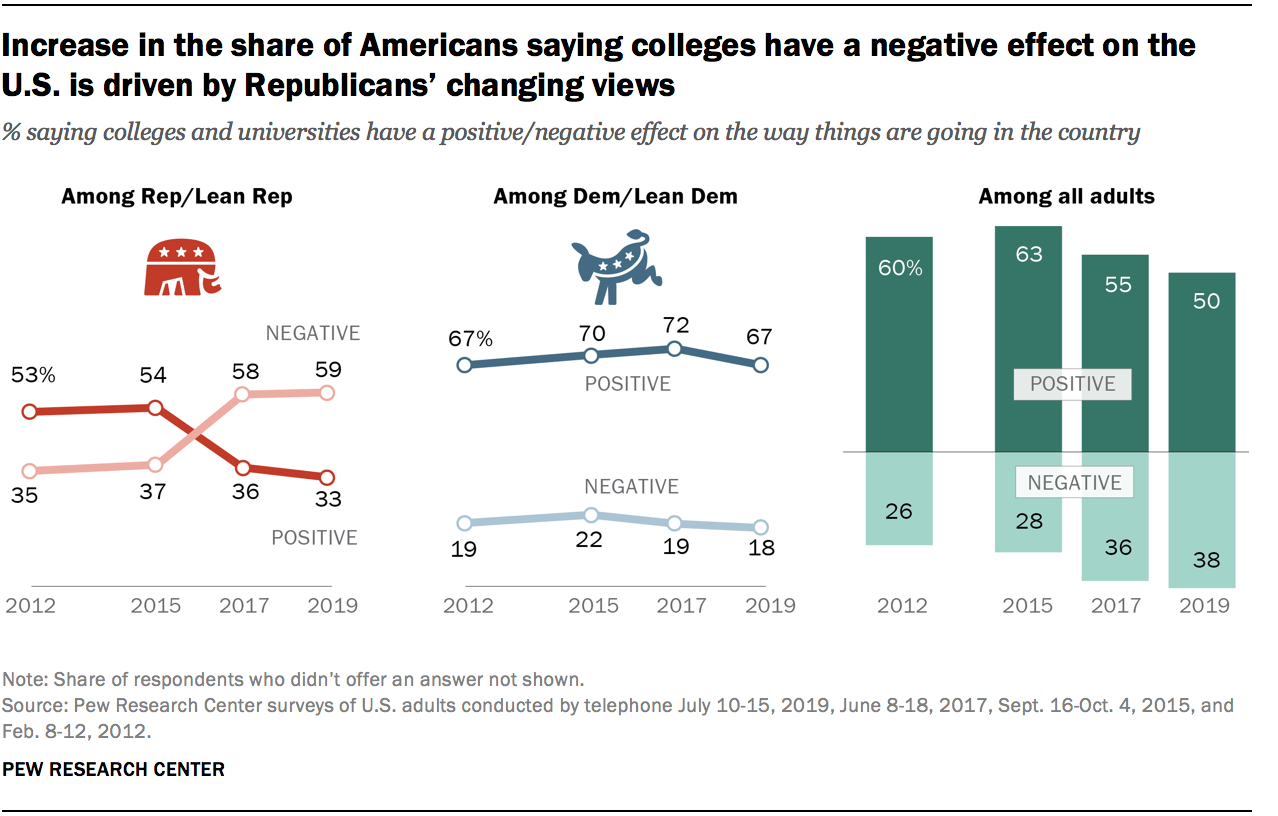
The tension in these Tweets is reflected in the difference between Democrats and Republicans on college:

Increase in the share of Americans saying colleges have a negative effect on the U.S. is driven by Republicans' changing views

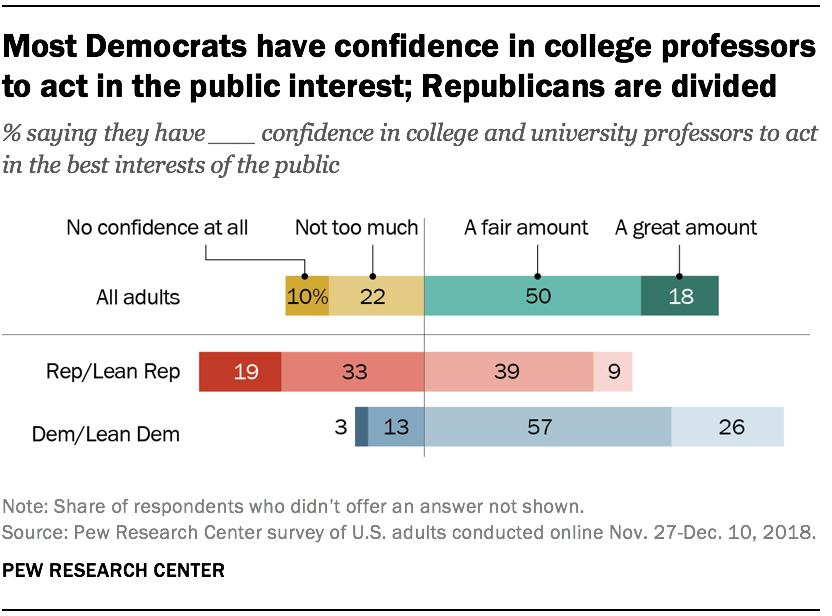
There is a similar partisan contrast in terms of perceptions about professors as well:

Most Democrats have confidence in college professors to act in the public interest; Republicans are divided

Misreading academia as uniformly progressive or leftist is grounded in how anyone views the purpose of formal education. Many in the U.S. are ideologically conservative and traditional so anything that seems to challenge that tradition or call for change is viewed skeptically if not cynically.

The current fear-mongering around single-payer health care is an excellent example of how a relatively moderate idea (universal health care) is framed as radical or “socialism” by a conservative culture (media and the public see the status quo as predictable and safe; therefore, change is to be feared).

As a Southerner raised in a conservative home and community, I can attest that formal education has the potential to be transformative—it worked for me—but as someone who is a leftist, I can also attest to the fact that academia is no progressive playground of fair-minded and ideological leftists.

Structures of higher education and the disciplines are too often inequitable and conservative, protective of the status quo even when that reality reflects and perpetuates the worse aspects of society.

Is there more space for equity and inclusion, diversity of radical thought, in higher education? Yes, and when formal education is about interrogating the world, then we are experiencing a more progressive environment. But that is not the norm of higher education because all institutions are prone to self-preservation.

The possibility of education in the pursuit of interrogating the world will always feed the tension between formal education and the so-called real world, leading some to misread higher education for its outlier qualities.

But the greatest tension of all may be at the root of the skepticism among conservatives about higher education (and all formal schooling); education is a debate about who decides what knowledge matters.

For children and young adults, universal public education and public higher education may provide some of the few safe spaces for a young person to discover a rich knowledge base that allows them to rise above indoctrination, bigotry, and uninformed lives.

This is, I admit, as ideal I aspire to as a teacher/professor, something I work hard to nudge my school toward. And simply by hoping a formal education can be a doorway into the life any person wants and deserves, I am that liberal professor people who misread higher education warn you about.

Standards in K-12 Education: A Reader

Recently, Gerald Coles confronted the newest round of the Reading War that once again centers phonics instruction. One of Coles’s points is how keeping the education reform gaze on an instructional practice (phonics) allows reform to ignore the more substantial and causal elements surrounding teaching and learning—socio-economic, racial, and gender inequities.

The now four-decades long venture into accountability grounded in standards and high-stakes testing has revealed one paradoxical and often ignored fact: The problems with teaching and learning have almost nothing to do with the presence or quality of high-stakes standards.

Currently, we are seeing a wave of acknowledgements that Common Core now has fallen into that pattern of failure.

The research base on standards has been consistent in showing that the accountability process fails; see below:

Student Evaluations of Teaching: Research and Commentary [Updated]

One of the prevalent contradictions in higher education is the high-stakes use of student evaluations of teaching (SET) despite the overwhelming evidence that SETs are flawed measures of teacher/teaching quality and are often harmful for faculty already marginalized in society and academia.

Here is a collection of research and commentary highlighting those flaws and calling for ending this traditional practice:

educator, public scholar, poet&writer – academic freedom isn't free