Category Archives: Education

Recommendations Spring/Summer 2024

[Header Photo by Ethan Robertson on Unsplash]

I have had a notably good run lately with entertainment (books, films, series, music, etc.) and pop culture. And nothing makes that more enjoyable than sharing with others.

This covers a good deal of re-reading and re-watching by me, but also some wonderful new works and thinkers/creators that I am really excited about.

Here, then, is a very eclectic list of recommendations for your spring and summer of 2024.

Haruki Murakami

Kafka on the Shore [Just finished re-reading. A wonderful and powerful work by Murkami, many think his best.]

1Q84 [Currently in the midst of re-reading, and my initial venture into Murakami. Brilliant and quite long, which I enjoy.]

Haruki Murakami Manga Stories 1: Super-Frog Saves Tokyo, Where I’m Likely to Find It, Birthday Girl, The Seventh Man [On deck to read.]

Haruki Murakami Manga Stories 2: The Second Bakery Attack; Samsa in Love; Thailand [On deck to read.]

Arthur C. Clarke

Rendezvous with Rama [Just re-read and a gem from my adolescence. Incredibly readable and just wonderful sci-fi.]

Childhood’s End [Another love from my adolescence, and on deck for re-reading.]

Poor Things

Poor Things (2023) [A very graphic and incisive film. Lots of sex and nudity just FYI.]

Poor Things, Alasdair Gray [Really surprised with how wonderful and laugh out loud funny this is. Highly recommend, but an interesting typeset approach with some images.]

Music

Wonderful cover by The National of “Heaven” by Talking Heads

Vampire Weekend [New obsession.]

The Decemberists [New album out soon and “All I Want Is You” is wonderful.]

Series

Outer Range [Currently re-watching because S2 is out. Sci-fi western. Some glorious fun (and a bit of David Lynch vibes) and wonderful acting/writing.]

Fallout [My partner is the gamer and I have no background in this. But the series grew on me so I will be re-watching.]

Ian Cushing

Cushing does excellent scholarship on deficit perspectives of language and the “word gap.” And open-access.

Tiered vocabulary and raciolinguistic discourses of deficit: from academic scholarship to education policy, Ian Cushing

Social in/justice and the deficit foundations of oracy, Ian Cushing

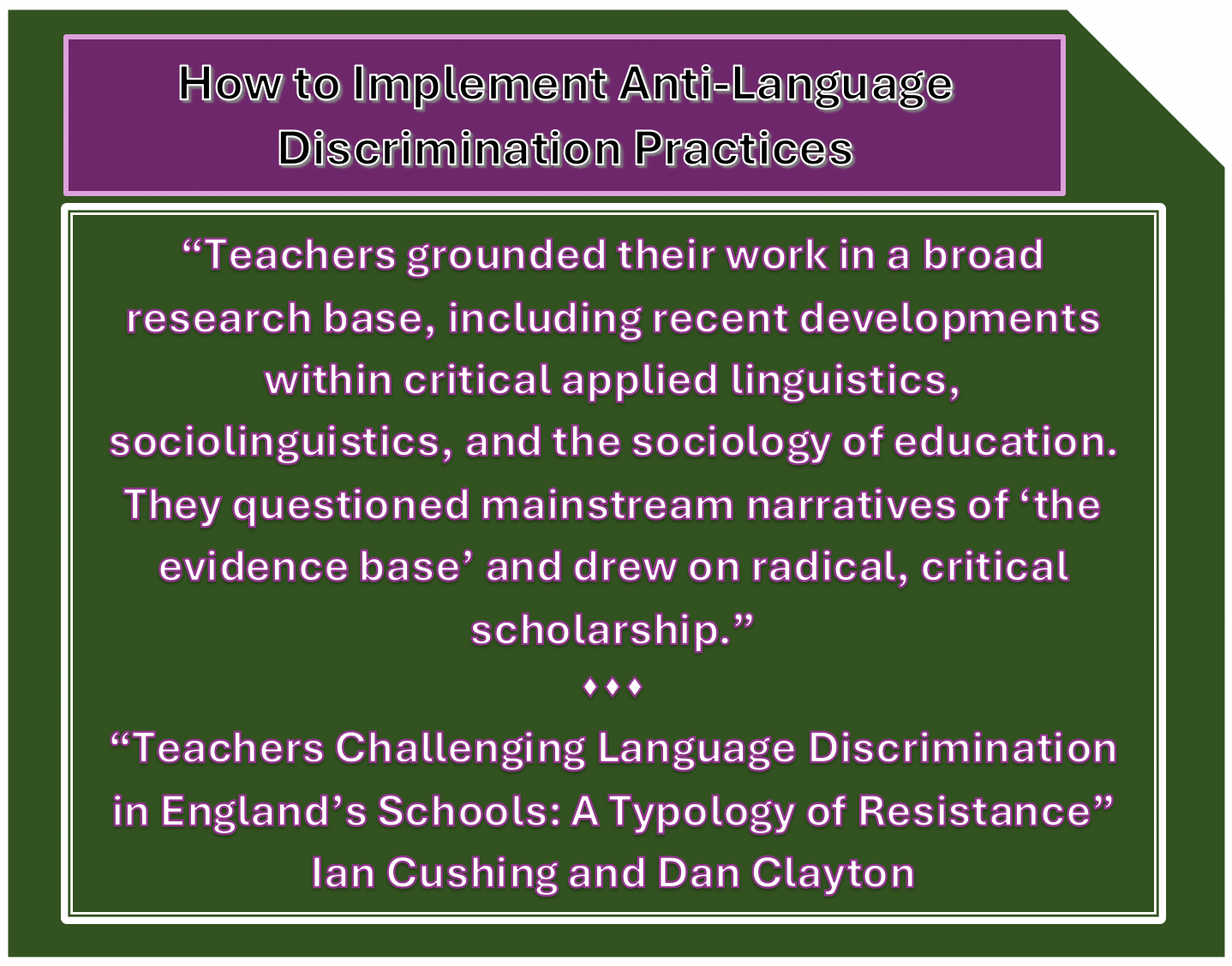
Teachers Challenging Language Discrimination in England’s Schools: A Typology of Resistance, Ian Cushing & Dan Clayton

James Baldwin

“The American institutions are all bankrupt,” explains James Baldwin in “Notes on the House of Bondage.” And he weighs in on voting when “how it happens that in a nation so boastfully autonomous as the United States we are reduced to the present Presidential candidates?”

George Saunders and Lane Smith

The Very Persistent Gappers of Frip, Saunders and Smith [A wonderful work and I cannot recommend it enough. I love Smith’s art, and blogged about this here.]

It’s a Book, Smith [One of my favorite picture books, funny and sharp.]

Lego

Haven’t been much into these types of builds but both are really good ones and nice displays.

Rocket & Baby Groot (76282)

Green Goblin Construction Figure (76284)

Daredevil and Black Widow

Daredevil Omnibus v.3 [I am currently drafting a book on Black Widiow, and this is a wonderful collection of the Daredevil/Black Widow era from my adolescence when I became a comic book collector.]

Lou LaBrant

The US in 2024 has become Russia via 1950s

Diversifying the matter (1951)

To Be Read

Kim Jiyoung, Born 1982: A Novel, Cho Nam-Joo

Frankenstein in Baghdad: A Novel, Ahmed Saadawi

Just What Is “Good Writing”? [Swift Update]

[Header Photo by hannah grace on Unsplash]

I haven’t seen the memo, but it appears that there is a mandate whenever anyone discusses Taylor Swift they must include at least that she is a good songwriter, although usually the claim is that she is a great songwriter, possibly the greatest songwriter ever (although Rolling Stone would beg to differ).

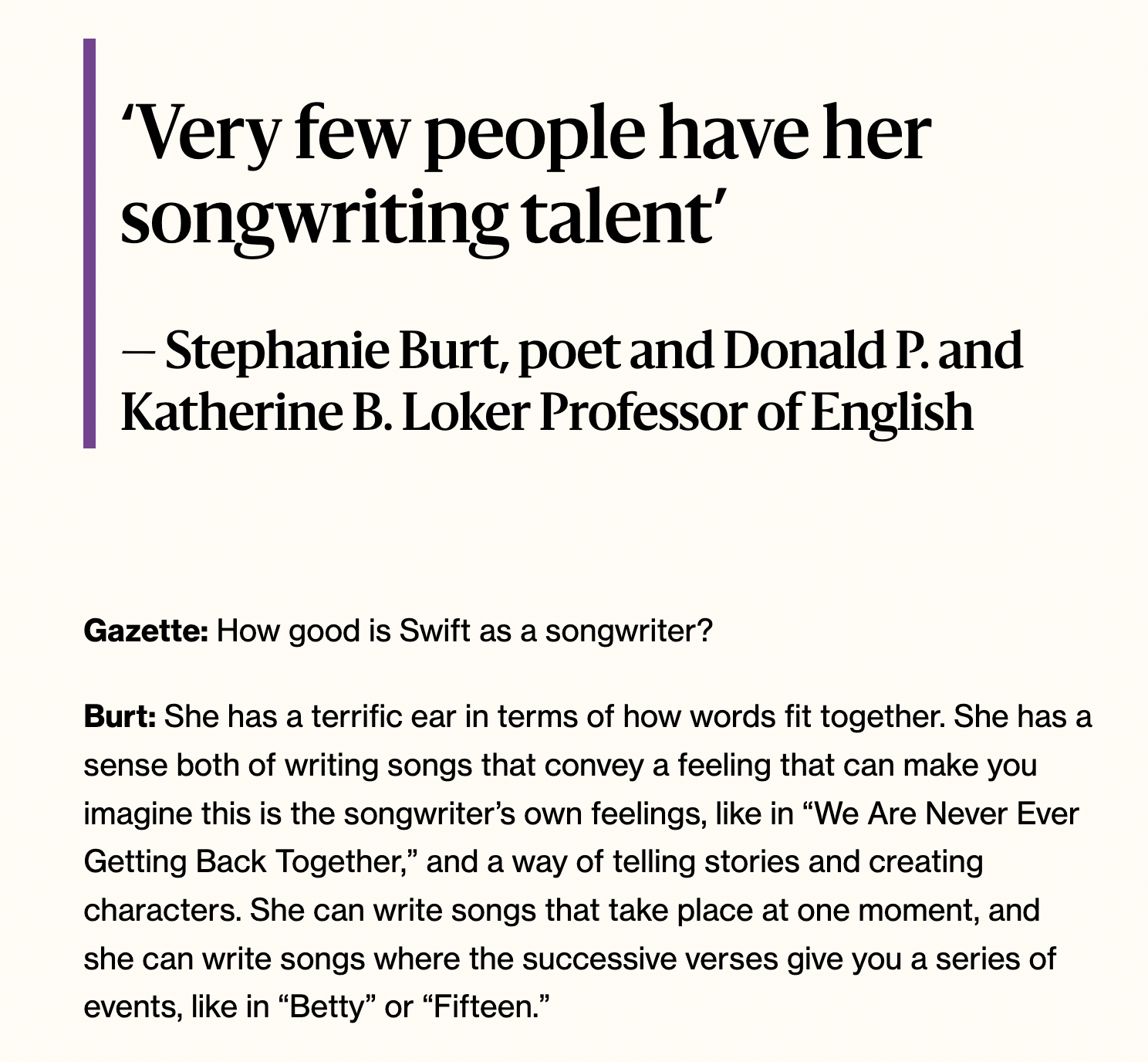
This interview with poet Stephanie Burt typifies the sort of effusive praise Swift elicits for her writing even outside pop culture among so-called serious writers:

Burt continues and makes a key point about Swift being accessible as well:

She has a lot of different gifts as a songwriter, both at the macro level, how the song tells a story or presents an attitude, and at the micro level, how the vowels and consonants fit together, and she’s able to exercise that range, along with quite a lot of melodic gifts, and in a way that does not make her seem highbrow or alienate potential audience members.

So let’s consider a simple question that seems to have already been definitely answered—Are Swift’s lyrics “good writing”?—but only as a context for answering, Just what is “good writing”?

And the short answer is, Yes, and probably not.

Because it all depends on what we mean by “good writing.”

I have been myself a “serious” writer (writing almost daily) since college, about 44 years. For 40 years, I have also been a writing teacher.

I also love popular music, and consider pop art valid art—a craft and genre all its own that shouldn’t be discounted simply for being popular.

My adult life is richer because of my love for The National (and other popular bands) and my renewed life as a comic book collector.

I am drawn myself to pop culture with “good writing”—song lyrics and narratives of comic book writers and artists (yes, I consider comic book artists “writers” as well).

What I want to emphasize, then, is that this isn’t intended to be a snob post that takes a passive aggressive swipe at pop culture icons.

That said, I think we can make fair assessments such as distinguishing song lyrics from poetry; in that, they are not the same but share some of the same characteristics that help us understand what good writing is.

It seems pedantic (like using the word “pedantic”) and even petty to announce that Swift, in fact, isn’t a good songwriter since her success as an artist is elite if not unique.

But for writers and teachers of writing and literature, often “good writing” focuses on the how of expression as well as the what.

I have noticed the general public will say something is well written if the film or book or series is engaging and interesting—regardless of the actual craft of the writing. There is definitely something to accessibility for the general audience—Burt’s writing “in a way that does not make [Swift] seem highbrow or alienate potential audience members.”

Here, then, I want to focus on good writing as craft—the writer’s choices about diction (word choice), sentence formation, and most importantly, the writer’s purposefulness and control.

Swift’s lyrics clearly resonate with a large percentage of listeners, and Swift is consciously composing those lyrics with attention to technique (metaphor and other types of figurative language).

In that respect, her lyrics are good writing in terms of purposefulness.

For example consider Swift’s “Love Story” as a craft lesson on using the Romeo and Juliet narrative. But, for this discussion, I want to offer that your consideration of Swift as a good writer should be posed beside another song also incorporating the same mythology: “Romeo and Juliet” by Dire Straits (lyrics by Mark Knopfler).

I don’t mean this as a negative criticism, but Swift’s use of craft often reads as a music performer purposefully inserting craft into her lyrics—which I would distinguish from writers who incorporate craft elements in the service of the writing and expression. [1]

The opening of the two songs are distinct with Swift framing the Romeo and Juliet reference as a overlay of an actual relationship; her opening, for me, is too direct and a bit clunky:

We were both young when I first saw you
I close my eyes and the flashback starts

Knopfler re-imagines Romeo and Juliet, the narrative creating what John Gardner always emphasized that writing should be a “vivid and continuous dream”—the goal being that the writing is so engaging that the reader forgets they are reading (think also of a viewer forgetting they are watching a film).

Yes, Swift is using figurative language and even allusion (“scarlet letter”); this is clearly writing with craft and purpose.

Not to again be pedantic, but this is about degree of what counts as “good writing” and an argument that there is a range of sophistication in writing.

For example, the use of “like” in a simile is considered more direct (and clunky) than a metaphor. Emily Dickinson’s “Hope” is the thing with feathers remains at the level of metaphor simply by avoiding simile “‘Hope’ is like a bird.”

So that range of sophistication can be seen in the following:

  • Bryan can’t pay attention. His brain is like a squirrel.
  • Karin is squirrely a lot of the time.
  • We’ve always called him “Squirrely Matt.”

Or think about the word “boomerang.” Even in day-to-day speech we tend not to say “That moved like a boomerang” because we have adopted the simile into a metaphorical verb, “That boomeranged.”

It is here that I acknowledge that Swift’s lyrics seem to be pale or under-developed examples of good writing because I am distracted when listening to the lyrics often by a lack of control in terms of word choice and tone.

This will seem like a negative criticism, but part of the accessibility of Swift as a good writer is that her use of craft is still in an adolescent stage (which doesn’t mean “worse” or “bad”).

A poet I found who was accessible for my high school students was James Dickey; not his use of both direct comparisons (similes) in “The Hospital Window” and then the never directly mention comparison (lifeguard like Jesus/savior) in “The Lifeguard”.

This is not intended to be about Swift as much as a plea that we make claims of “good writer” and “good writing” a bit more carefully in terms of acknowledging the craft and, again, the purposefulness and control.

What is the writer doing and how is that craft in the service of expression? And then, ultimately, is that expression itself something novel or unique and, probably more importantly, is the expression a thing we should embrace, endorse, or consider seriously?

Craft in the service of bad ideas, I think, isn’t worthy of considering as “good writing,” for example (in fact, powerful writing and expression that leads humans astray is a horrible thing with too many examples dotting history).

I have to end in teacher mode by offering a smattering of poems that allow you to put my thoughts here into practice; these are glorious examples of “good writing” (I think) because of the craft, the purposefulness and the control (specifically, look closely at the word choice in Plath’s “Daddy” in the service of expression):

Those, I believe rise to the level of “good writing” while remaining mostly accessible. If you want to dip your toe in “good writing” that may be a bit less accessible, you should spend some time on Emily Dickinson (and likely not the poems you have been assigned before:


[1] After the release of Swift’s 2025 The Life of a Showgirl, this analysis of that album adresses some of my concerns about the lyrics—No Good Art Comes From Greed.

See Also

Listening to Langston Hughes about “Make America Great Again”

NEPC: Critical Policy Research. What It Is. And What It Is Not.

[Reposted by permission from NEPC]

It’s a term that often gets misused, misinterpreted, and—in the process—maligned.

By the general public, it’s poorly understood.

It’s critical policy research. And it’s the topic of the June 2024 issue of the peer-reviewed journal, Educational Evaluation and Policy Analysis. A free webinar on the issue will be held from 2:00-3:30 pm Eastern on May 23rd.

Under the name “critical race theory,” this approach to understanding the world was not only denigrated but legally banned by politicians in multiple states, many of whom had a limited understanding of even its definition.

So here’s what critical policy analysis is—and isn’t—according to the introduction to the special issue, written by guest editors Erica O. Turner of the University of Wisconsin-Madison, Dominique J. Baker of the University of Delaware, and NEPC Fellow Huriya Jabbar of the University of Southern California:

1. Approach to existing policies

Traditional policy research: Typically takes policy at face value, presuming it was created for the reasons stated (e.g., “to increase attendance”) or for technical reasons (e.g., “the former policy needs to be updated because it was created before the introduction of artificial intelligence”).

Critical policy research: Starts by examining why policies develop, how they are framed, who benefits, and who does not. In doing so, critical researchers explore the extent to which there may be connections between a policy that on the surface appears to apply to one narrow area (e.g., educational testing) and broader societal issues such as culture, economics, or gender. Critical researchers attend closely to rhetoric, which can provide clues to the values underlying the policy. For example, the use of the phrase “achievement gap” implies students themselves are responsible for the historically lower test scores found among some groups, whereas the phrase “opportunity gap” highlights the idea that some students have more and better chances to learn and prepare than others for exams.

2.  Policy implementation

Traditional policy analysis: Often equates policy with the rhetoric with which it is surrounded, viewing implementation as dichotomous (either it’s implemented or it’s not implemented).

Critical policy research: Examines the extent to which those charged with implementing policy have the ability to do so and how factors such as environment, power, and ideology play into that equation.

3.  Change

Traditional policy research: May assume that certain societal trends (e.g., changes in technology) are inevitable and immutable.

Critical policy analysis: Examines and questions underlying assumptions about social trends, asking for who benefits from them and who does not. Public policy is viewed as a tool with the potential to shift—rather than simply mirror—phenomena that are sometimes described as natural, common sense, or unchangeable.

Even as critical approaches have been villainized by politicians, they are a robust and growing area of academic research on education. The co-editors of the Educational Evaluation and Policy Analysis special issue noted that the call generated nearly 400 submissions—“a clear signal of the excitement and interest in conducting critical education policy research and the real need for more outlets that publish critical policy research in education.”

The Poverty Trap: “Myths that Deform Us”

[Header Photo by James Lee on Unsplash]

I am the son of aspirational working-class parents who grew up themselves in the aspirational 1950s.

My sister and I are posed in front of the barn next to our rented house in Enoree, SC, a mill town slowly withering away.
A portrait of an All-American family filled with hope of the American Dream.

My maternal grandparents for most of my life lived in little more than a shack with a wood-burning stove for heat and an outhouse. By comparison, my paternal grandparents were working-class themselves as my father’s father ran a gas station in our hometown.

By the time I was 38, I had achieved a doctorate, and then a few years later, I moved from teaching high school in my hometown to being a professor at a selective university where most students are from a social class I have almost no context for understanding.

In almost all ways, I am an extreme outlier among other people having been born into poverty or working-class homes.

My achievements are not the only ways in which I am an outlier since my journey through many years of formal education also allowed me to set aside the “myths that deform us” [1]—specifically the belief in rugged individualism and bootstrapping that are the basis of the American Dream.

While I am vividly aware that my education (and my parents’ sacrifices for that education) saved my life intellectually and materially, that education also allowed me to recognize that my personal story and my status as an extreme outlier do not prove that everyone from a similar background should or can rise above those beginnings.

That’s the paradox of the poverty trap and the role of formal education in the US.

So when I made the following post on Twitter (X), I was not surprised by the many ideological responses that resist the wealth of evidence behind the comment:

I was very careful to choose “perform academically” (and not “learn”) because I am addressing the norm of formal schooling in the US over the past 40 years: Schools, teachers, and students are primarily and substantially labeled, sorted, and judged based on test scores of students (what I mean by “perform academically”).

Let’s start there with research from 2024 (that replicated decades of similar studies):

Because many commercially prepared standardized tests of mathematics require large amounts of reading, student background knowledge casts a large shadow over the results because of its influence on reading comprehension skills derived in part from human and social capital. Background knowledge influences students’ ability to comprehend test questions and use their existing knowledge to successfully answer questions or generate answers.

…Almost 63% of the variance in test performance was explained by social capital family income variables that influence the development of background knowledge. Background knowledge is a known predictor of standardized test results. Family income variables are immutable by schools. Only public policies, outside the control of school personnel, can influence family income.

In general students who live in poverty perform significantly lower on standardized testing that students from more affluent backgrounds.

Further, unlike my own personal story, despite access to public education, more people remain in the social class of their birth than not; in short, social mobility in the US has been decreasing for decades.

Despite the cultural beliefs to the contrary, education in the US is not the great equalizer.

In fact, advanced education is often merely a marker for the affluence of people who would have remained affluent with or without the education.

The double paradox here is that if we in the US would set aside those “myths that deform us,” formal education could, in fact, become the great equalizer—but not on its own.

First, the “no excuses” approach education now embraces (students and teachers must not use poverty as an excuse) is both dehumanizing and cruel since it demands that children somehow set aside the negative consequences of lives they did not choose and cannot change (and lives that their families cannot in general change either).

“No excuses” approaches are deficit ideologies that center the failures in the children and not the systemic forces that are reflected in those students’ academic performances (test data). The result is seeing education as a way to “fix” children instead of addressing social inequity.

Evidence shows that living in poverty reduces cognitive function the same as being sleep deprived, and thus, demanding that children in poverty simply perform the same academically in our schools while refusing to address the poverty and inequity of their lives (and too often of their schooling) is both dehumanizing and unrealistic.

Here is an analogy of what I mean.

When people discovered the dangers to children of lead-based paint, the current approach in education (fix the child and not the systemic poverty) would have meant that we simply taught children not to eat lead paint

However, that isn’t what we did. We of course did teach children not to eat lead paint, but we also removed lead from paint.

Today’s educational ideology is only focusing on our students (don’t eat the paint), but we refuse to address the larger systemic burdens (in effect, saying there is nothing we can do about lead in paint).

Absolutely no one is arguing that since poverty and inequity are the overwhelming causal factors in student achievement that we should throw up our hands and do nothing.

However, most people are saying we cannot do anything about poverty so let’s just fix the children (for example, the discredited work of John Hattie and Ruby Payne represents how that ideology is embraced by mainstream education).

Continuing to insist that simply finding the right curriculum and instruction, focusing only on in-school education reform, or identifying the “miracle” schools (so-called “high-flying” schools with high poverty and high achievement) [2] to scale up is not only misguided but also a disservice to children and our society.

Wanting something to be true doesn’t make it so.

Yes, in the US we want to believe our democracy is a meritocracy, we want to believe in the rugged individual, we want to trust in bootstrapping.

And we want to believe that a rising tide lifts all boats; however, we also want to pretend that some people have no boats—and some insist that is their own fault (even children).

Demanding that every child born into poverty must be exceptional is among the cruelest demands a culture can make. That cruelty is magnified by a wealthy society that throws up its collective hands and declares there simply is nothing we can do about poverty, even for children.

I am convinced by the evidence that a different ideology must guide us, one embraced by Martin Luther King Jr.: “We are likely to find that the problems of housing and education, instead of preceding the elimination of poverty, will themselves be affected if poverty is first abolished.”

And as I showed with how we addressed the dangers of lead paint, we must work to eradicate poverty and simultaneously choose equitable and humane ways to offer children from inequitable backgrounds the greatest opportunities to learn possible—while not blaming them for the lives they did not choose or create.


[1] “[A]s we put into practice an education that critically provokes the learner’s consciousness, we are necessarily working against myths that deform us. As we confront such myths, we also face the dominant power because those myths are nothing but the expression of this power, of its ideology.” (Freire, 2005, p. 75)

Freire, P. (2005). Teachers as cultural workers: Letters to those who dare to teach (D. Macedo, D. Koike, & A. Oliveira, Trans.). Boulder, CO: Westview Press.

[2] Thomas, P.L. (2016). Miracle schools or political scam? In W.J. Mathis & T.M. Trujillo, Learning from the Federal Market-Based Reforms: Lessons for ESSA. Charlotte, NC: IAP.

Reading Reform We Refuse to Choose

[Header Photo by Nick Fewings on Unsplash]

Since the early 1980s, the US has been in a constant cycle of accountability-based reform in education. By 2001 and the implementation of No Child Left Behind (NCLB) and the central role of the National Reading Panel (NRP), that education reform cycle intensified by adding a much more robust federal accountability, but as well, the focus on reading was magnified (although education reform and testing have over the past 80 or so years primarily targeted reading and math).

I recently posted that the “science of reading” (SOR) era of reading/education reform is rearranging the chairs on the deck of the Titanic. In that analogy, the Titanic is the current reform paradigm, and with reading reform, one example of rearranging the chairs is the move by states to ban some reading programs and then mandate other (or different) reading programs.

Having engaged now for about six years in the public debates about reading, reading reform, and the SOR movement (the media story and the legislation that has resulted from that), I recognize that resisting SOR and SOR-based reform is mostly pointless since virtually every state has implemented some aspect of SOR, and despite the SOR story being misinformation, the vast majority of media, the public, and political leaders uncritically buy what is being sold.

Briefly here, I want to offer a series of evidence-based conditions that form the basis of the reading reform I think the US has refused to choose (primarily for ideological reasons grounded in rugged individualism and bootstrapping mythology).

First, consider these evidence-based conditions:

  • Since the 1940s, the public and political beliefs about student reading proficiency have been primarily described as a reading “crisis.” Despite an enormous amount of variety across the US for 80-plus years, at no point has anyone declared reading proficiency or student reading as a success or even adequate.
  • Over the past 40-plus years of accountability-based education reform, not a single set of reforms has been declared successful, and the entire public education system in the US has, like reading, been perpetually characterized as being in “crisis” (spurred by A Nation at Risk report from the early 1980s).
  • The national focus on public education in crisis has been NAEP testing, which has (for reading specifically) basically flat for thirty years, and the public and political discourse about student achievement has been significantly distorted by misunderstanding and misrepresentations about what NAEP achievement levels and data mean:
  • Research continues to confirm that high-stakes standardized testing is causally driven by out-of-school (OOS) factors at a rate of at least 60%, and teaching impact on those test scores are as small as 1-14%.
  • The current SOR movement has grounded claims in the use of the term “science” but depended primarily on anecdotes and citations that are not in fact scientific, such as the 90-95% rule that suggests student reading proficiency should be at 90-95% as opposed to the NAEP pattern of about 60+% (NAEP “basic” and above; see chart above).
  • Media and political claims of education and reading “miracles” are not grounded in credible evidence, but do distract from evidence of exceptional student achievement (again, notably in reading on NAEP)—the Department of Defense schools:

These related series of evidence inform the following conclusions for me:

  • US public education and student reading are not in crisis, but are trapped in decades of being incredibly inequitable (marginalized and minoritized students are disproportionately under-served or mis-served).
  • Decades of intense education reform have not improved that inequitable status quo, but education and reading do, in fact, need to be reformed.
  • A new reform paradigm for education and reading must include both a new set of social reforms as well as a different approach to in-school reform, both of which must be equity and not accountability based.

What does that last point look like, focusing on reading?

I want to address OOS reform first—not as an argument that we do nothing in terms of in-school reform (which I detail next) but because until we address OOS reform, in-school reform will continue to appear to fail.

For most people in the US, this is counter-intuitive, but the following social contexts must be reformed because social policy is education policy:

  • Universal healthcare, food and home security, and stable work for parents are all essential reforms that would impact reading proficiency measurements in the US.
  • Student access to books/texts in their homes and their communities (public libraries) is an evidence-based and highly correlated mechanism for increasing student reading proficiency.

Let me emphasize here that the US has committed directly and indirectly to a “no excuses” ideology that demands students and teachers set aside the impact of OOS factors and simply do the work of learning and teaching. This is not only a self-defeating ideology but also a dehumanizing ideology.

The people who are most likely to advocate “no excuses” for other people do not live by that dictum themselves.

Acknowledging poverty and inequity is not using that as an excuse to do nothing but a call to address the lives of students and teachers so that learning and teaching can be reformed in robust and important ways.

Now, the sort of reading reform we refuse to choose must include the following:

  • Stop the reading program merry-go-round. Reading programs have not failed and reading programs will not save reading proficiency. We must shift from demanding that teachers implement reading programs with fidelity and toward making it possible for teachers to teach students to read with fidelity to every students’ strengths and needs.
  • Set aside the trivial debates over reading ideologies and instructional practices. Similar to the bullet above, there is no evidence that any ideology or practice is singularly or pervasively failing students or would better serve students. This aspect of reading reform has always been about the adults and not the students.
  • Focus on learning and teaching conditions in terms of equity. What would better insure teachers the conditions necessary to serve individual student needs? Access to courses, teacher assignments, class sizes/student-teacher ratios—these are learning and teaching conditions that are currently inequitable and must be reformed. (Again, learning and teaching conditions are indirectly improved by addressing OOS factors.)
  • Reform standardized testing of reading at the national and state levels. NAEP needs to be reformed to address misleading achievement levels, and the nation needs a uniform set of standards for age-level reading proficiency. Shifting from grade-level to age-level removes the incentive for harmful practices such as grade retention, and a standard age-level proficiency allows for more accurate assessments of success or weaknesses across the US. State-level reading assessment must use those uniform achievement levels and should be reformed to provide instructional support for teachers and not simply label and sort students.
  • Address student access to books/texts in their classrooms and libraries.

I have been advocating for this different approach for many years and remain skeptical that the US will make this shift.

My experience is that many people force my work into the paradigm I am rejecting (I don’t endorse or promote reading programs, reading ideology, or instructional practices) because there is a powerful ideological reason we have remained mired in the same reform cycle for decades.

Education/reading reform as industry is American as apple pie.

We seem fatally addicted to “crisis” and “miracle” rhetoric as well as making claims about education and reading that are grounded in beliefs, not evidence (see my opening evidence-based conditions).

As a consequence, the media and political leaders perpetuate a false story about the Mississippi “miracle” while almost entirely ignoring the valid success of DoDEA schools—the former appears to prove the bootstrapping myth, the latter concedes the power of systemic forces on individual behavior. And ironically, the empirical evidence only supports the latter.

The sort of reform I am advocating isn’t appealing to the market or political power structures; the sort of reform I am advocating isn’t very sexy; the sort of reform I am advocating resists American mythology.

Regretfully, the issue is not whether or not we make sincere efforts to reform reading in the US. The issue is that we are reforming with ideological blinders on, adults rearranging chairs on the deck of the Titanic to prove they are right and students be damned.

The “Science of” Era of Education Reform: Rearranging Chairs on the Deck of the Titanic (Again)

[Header Photo by K. Mitch Hodge on Unsplash]

The rhetoric of education reform over the past six or so years has embraced a now pervasive labeling, the “science of”—grounded in the “science of reading” (SOR) movement.

Some of the defining features of the “science of” movement include significant doses of arrogance and idealism.

A turning point for me in terms of engaging in the heated SOR discourse on social media was when a prominent literacy scholar with roots in the National Reading Panel (NRP) pointedly referred to scholarship challenging the SOR story and movement as “stupid.”

That turning point included not engaging with that aspect of the debate at all while continuing to make the case I was certain is well supported by the evidence—the SOR movement is yet another example of rearranging the chairs on the deck of the Titanic.

And as the scholarly responses to the media and political SOR movement increased, that assessment has become more and more valid.

In short, the SOR era of education reform targeting reading is nothing new and the consequences of simply rearranging the chairs are harming students and teachers.

However, just recently a major organization that has promoted SOR has doubled down, oddly calling scholarly presentations on SOR at the national AERA conference nothing more than “myths.”

AERA is a rigorous organization and conference, thus, such as assertion seems at best careless and at worst incredibly negligent.

One aspect of the “myth” post that is worth examining more carefully is the claim that we all must either stay on the SOR bandwagon or revert to a so-called failed status quo.

This is yet another lazy false binary that concedes to remaining on the Titanic—the four-decades long accountability reform movement.

Let’s start by clarifying exactly what the criticism of the SOR movement and SOR-based legislation and policy is addressing:

  • As John Warner asserts: “When you see the construction the ‘science of…’ as applied to education you are looking at a marketing term, not a reflection of something real when it comes what most of us think of when it comes to scientific inquiry and the standards of proof for claims.”
  • “‘Is there a sudden reading crisis right now?’ [ Shayne] Piasta said. ‘I see it more (as) this has been chronic. And I think COVID just put more of a spotlight on it.'” (Debunking myths about co-opted reading science)
  • According to Reinking, Hruby, and Risko, “there is no indisputable evidence of a national crisis in reading, and even if there were a crisis, there is no evidence that the amount of phonics in classrooms is necessarily the cause or the solution.”

To be brief, the SOR movement is grounded in a manufactured crisis orchestrated by the media and then amplified by the education marketplace and political leaders who are deeply invested in education reform as industry.

While the SOR movement and mainstream education reform are permanently invested in “crisis” rhetoric and endless cycles of in-school only reform initiatives (rearranging the chairs), there are alternatives to the current SOR reform agenda and the inadequate status quo (which, ironically, is little different than the SOR reform itself).

First, rhetorically, we must stop using the word “crisis” since, as Piasta noted, the state of reading proficiency among US students is chronic—essentially for thirty years or more about 2/3 of students seem to be performing roughly at grade level or above with the remaining 1/3 over-represented by minoritized, marginalized, and vulnerable populations of students.

Second, we must acknowledge and then address that well over 60% of measurable student achievement (including reading proficiency) is causally related to out-of-school factors. Thus, social reform is education reform, and addressing healthcare, home and food security, and children’s access to books in their homes and communities would likely improve measurements of student reading proficiency.

Third, as Reinking, Hruby, and Risko show, there simply is little evidence that reading programs, reading instruction, or teacher quality are uniformly failing students in terms of reading. Over those thirty years of flat reading scores across the entire US, reading programs and instructional practices as well as the teacher workforce have never been uniform.

Fourth, as Warner notes, education reform in the US is almost always a market initiative. In reading, the constant cycling through different reading programs and the hyper-focusing on fidelity to those programs (notably, not fidelity to the needs of students) have never produced the results promised (and never will).

And finally, along with refusing to address out-of-school factors, the inability to move beyond rearranging chairs distracts from the sort of in-school reform we have never attempted—addressing teaching and learning conditions.

Likely the very worst aspect of the SOR movement is that SOR reform has made teaching and learning conditions worse; for example, these are some of the realities of legislation that defy the idealism and willful ignorance in continuing to endorse SOR reform:

  • Grade retention. Grade retention creates a mirage of increased grade 3 and 4 reading scores that disappear by grade 8 [1], but that mirage benefits political leaders at the expense of students (grade retention remains strongly correlated with student low self-esteem and dropping out of school).
  • Scripted curriculum. Along with “science of” as marketing rhetoric, “structured literacy” is a central term in SOR reform, created by the IDA to “help us sell what we do so well.” The problem with structured literacy programs is that they are often scripted curriculum that increases the accountability focus on fidelity to teaching the program and not students. Structured literacy mandates have de-professionalized teaching by replacing teacher autonomy with market authority.
  • “Whitewashing” the curriculum. The structured literacy programs that are phonics-forward have also decreased the diversity of texts presented to students and significantly reduced the amount of authentic and extended texts that students read. As noted above, the chronic failure of reading in the US has impacted disproportionately diverse populations of students who are now being feed a white bread curriculum devoid of nutrients.

Education reform broadly and the current SOR movement (along with the growing “science of” cousins) are fatally committed to idealistic and aspirational rhetoric and claims that ironically are not supported by either the science or the evidence in our day-to-day classrooms.

If we are serious about addressing the chronic state of reading proficiency in the US, we must not stay on the failing SOR bandwagon, but we cannot simply throw up our hands and stay the course—continuing to rearrange the chairs on the deck of the Titanic.

To do the right thing, we must do something different, and doubling down on idealism while pretending the ship isn’t sinking is not something different.


[1] Mississippi and Florida demonstrate the test score increases in grades 3 and 4 but falling by grade 8. Further, if SOR worked, why are both states continuing to retain about the same number of students over the last decade?


Poem: car wrecks

[Header Photo by Josh Sonnenberg on Unsplash]

-1-

we got old
the way we were told

we got old
but did not grow bold

we got old
and all that we sold

-2-

in the middle of drinking a few more than you should have

-3-

our memories are too short
our memories are forever

my dog follows me
room to room
like every memory

her eyes knowing
staring directly at me
like every memory

our memories are too short
our memories are forever

-4-

i didn’t hear
“are you paying attention?”
because i wasn’t paying attention

until i was paying attention
to not paying attention
and realized i wasn’t paying attention

-5-

i have been following myself around
forever it seems

trying to find me walking there in my feet
following and searching

until finally i realized i was right there
all along

—P.L. Thomas

ILEC Response: Reading Science: Staying the Course Amidst the Noise (Albert Shanker Institute)

International Literacy Educators Coalition

ILEC Vision: To promote literacy learning practices that enable all children and youth to realize their full potential as literate, thinking human beings.

Download a PDF of the response.


ILEC Response: Reading Science: Staying the Course Amidst the Noise (Albert Shanker Institute)

Repeating claims in a report on reading reform, Esther Quintero presents 4 “myths” about the “science of reading” (SOR) at the Albert Shanker Institute blog grounded as follows:

At the annual conference of the American Educational Research Association (AERA), …I witnessed the spread of serious misinformation about reading research and related reforms. In this post, I aim to address four particularly troubling ideas I encountered. For each, I will not only provide factual corrections but also contextual clarifications, highlighting any bits of truth or valid criticisms that may exist within these misconceptions.

The post, however, misrepresents valid concerns about SOR messaging and the growing reality of negative consequences for SOR-based legislation and mandates[1]. Further, many of the bullet points under “facts” do not refute but support valid criticisms framed as “myths.” The post focuses on idealized possibilities of SOR to the exclusion of the current implementation of SOR-based programs and instruction.

Positive Aspects of the Post:

  1. Under Myth #1, Quintero acknowledges the problems with misrepresenting National Assessment of Educational Progress (NAEP) data[2] on reading and minimizing the impact of poverty and inequity on student achievement[3].
  2. Quintero concedes: “Reading science (indeed, any science!) is not settled; science is dynamic and evolving.”

ILEC Concerns:

  1. Myth #1(“The reading crisis is manufactured”) is self-contradictory in that the “fact” bullets repeat the valid concerns raised among SOR critics about misrepresenting NAEP data and ignoring out-of-school factors in education reform. Once again, the SOR reading “crisis” is in fact manufactured[4].
  2. Myths #2 (individualized instruction) and #3 (SOR restricts teacher agency) misrepresent the trend across the US of banning some reading programs and mandating other programs that tend to be structured literacy and too often scripted curriculum. Scripted curriculum does in practice impose on-size-fits-all instruction and de-professionalizes teachers[5].
  3. Myth #4 (“The Science of Reading harms English learners”) fails to acknowledge concerns raised among Multilingual learner (MLL) scholars and teachers about SOR’s one-size-fits-all mandates[6] and “whitewashing”[7] the texts offered students from diverse backgrounds[8].
  4. Quintero poses a false binary between SOR reform or reverting to an inadequate status quo, ignoring credible alternatives to reading reform grounded in equity/diversity and teacher agency.

[1] Fact-checking the Science of Reading, Rob Tierney and P David Pearson

[2] Big Lies of Education: Reading Proficiency and NAEP

[3] Big Lies of Education: Poverty Is an Excuse

[4] Reinking et al. (2023); Aydarova (2023).

[5] Chaffin et al. (2023).

[6] Noguerón-Liu (2020); Ortiz et al. (2021); Mora (2023).

[7] Rigell et al. (2022).

[8] Aukerman & Schuldt (2021).


See Also

International Literacy Educators Coalition (ILEC) Responses

May the Force Be With You: Reading for Pleasure Instead of Reading as Task

[Header Photo by Brian McGowan on Unsplash]

May 4 has become a special day in pop culture, especially for fans and nerds who love Star Wars. May 4, 2024, proved to be a doubly special day since it fell on Free Comic Book Day.

That morning, I had two of my grandchildren—my granddaughter, 9, and my grandson, 7. With some trepidation that they would be far less excited than I was, I offered to take them to Free Comic Book Day at my local comic book shop, The Tangled Web.

The store was filled with adult faces I knew from visiting the shop at least weekly, but I was pleased to see many children there also as we weaved through the pay line to reach the back room tables stacked with free comic books.

The sign read “Three Books Only,” and the store owner greeted us, adding that the comics for children were on the first table.

My grandson said he saw the book he wanted, Pokemon, as we shuffled forward in line.

When we reached the end, where the owner was sitting, my granddaughter was holding three books when she saw one at the end she wanted so we told her she could swap out one she was holding.

The owner heard us and told her to keep all four.

We looked around a bit—my grandson wanted to see the high-priced Pokemon cards behind the case—and then as we walked to the car, my granddaughter took my hand and said the owner was nice for letting her have an extra book.

Immediately in the car, my grandson began flipping through his Pokemon book, saying some times he just likes to look at the pictures. I told him that over my comic book life sine the 1970s, I almost always do a first “read” of the books just looking at the artwork.

Back at the apartment, my granddaughter took one book in to read, a teaser copy of Monster High (IDW). My partner was setting up for her and the children to play Smash Bros. on the TV while my granddaughter consumed her new comic book.

Soon, she moved over to the couch, sitting down heavily and sighing. The story ended in a cliff hanger, and she was sad there wasn’t more.

My granddaughter was hooked. The magic of free comic book day.

No tests. No assignments. No chastising children not to look at pictures while making meaning.

Just a few encouraging adults, access to books, and the freedom to read for pleasure.

We had to drop the children off with their father just after midday to head to my partner’s book club. I tend to be a passive observer, although I did read their first book.

The book club consists of mostly friends in a gamer group, and the anchor for the monthly gathering is a series of wines for tasting.

The discussions are relatively haphazard, often wandering off into very interesting tangents punctuated with attending to children and dogs or grabbing snacks provided by everyone.

This Saturday the food was supposed to be Star Wars themed because of May 4.

As time passed and some needed to leave, the group chose the next book—this month had been nonfiction and the next category is works in translation (something I was particularly excited about)—by sharing blurbs about several suggested books (including three from my partner).

As they worked through the summaries, I ordered the first two options—Frankenstein in Baghdad: A Novel and Kim Jiyoung, Born 1982: A Novel. But the group chose the novel most enthusiatiscally recommended by my partner, Kafka on the Shore by Haruki Murakami.

My partner taught that novel for several years, and I have a co-edited volume on Murakami, just submitted an invited chapter on Murakami’s Men Without Women based on this blog post, and am currently re-reading 1Q84.

To say the least, my partner and I are as excited as my grandchildren were in the wake of Free Comic Book Day.

The next day, however, I read Dan Kois writing about the “Decline by 9”:

[A] child’s attitude towards reading enjoyment and importance is a predictor of reading frequency, which is why it also is striking to note the drop between ages eight and nine in the percentage of kids who think reading books for fun is extremely or very important (from 65% to 57%). Similarly, the number of kids who say they love reading drops significantly from 40% among eight-year-olds to 28% among nine-year-olds.

Kois acknowledges some of the standard reasons cited for children not reading—often over many decades blaming technology such as smartphones today—but then makes this point:

But others also pointed to the way reading is being taught to young children in an educational environment that gets more and more test-focused all the time. “I do not blame teachers for this,” said O’Sullivan, but the transformation of the reading curriculum means “there’s not a lot of time for discovery and enjoyment in reading.” She noted a change I, too, had noticed: Reading in the classroom has moved away from encouraging students to dive into a whole book and moved toward students reading excerpts and responding to them. “Even in elementary school, you read, you take a quiz, you get the points. You do a reading log, and you have to read so many minutes a day. It’s really taking a lot of the joy out of reading.”

The specific reference is to the “science of reading” (SOR) movement that has targeted reading programs by banning some and mandating those that are often scripted curriculum and phonics-heavy.

As Kois’s article acknowledges, the SOR movement is sacrificing important aspects of reading, including pleasure, rich texts, and diversity [1].

Yes, possibly even more intensely than at any point over the past 40 years of high-stakes accountability in education, the SOR movement has sacrificed reading for pleasure to reading as task.

But this is a matter of intensity because formal schooling has always been one of the places where pleasure reading goes to die.

I taught high school English for 18 years throughout the 1980s and 1990s, witnessing first-hand that most of my very bright students had become non-readers even though you could visit any K-1 classroom and see a room full of children eager to read.

My high school students all had one thing in common—formal schooling.

This May the Fourth was a truly wonderful day for reading that I was gifted to witness. On a Saturday and nowhere near a school.

I watched children and adults choose to be readers, eager and excited.

And again, no tests. No assignments. No chastising anyone about how to make meaning or what mattered about what they were reading.

This May the Fourth was about The Force, not some Jedi skill set, but reading for pleasure and not reading as a task.


Note

[1] Does the “Science of Reading” Fulfill Social Justice, Equity Goals in Education? (pt. 1)

America Dishonors MLK By Refusing to Act on Call for Direct Action (pt. 2)

Scripted Curriculum Fails Diversity, Students, and Teachers: SOR Corrupts Social Justice Goals (pt. 3)

Recommended

The power of touch is vital for both reading and writing, Naomi S. Baron (The Conversation)

The Guardian view on English lessons: make classrooms more creative again

Not Lost in a Book, Dan Kois