Category Archives: education reform

Claiming the Education Reform Narrative

If the education reform movement is transitioning into a next phase and if my call for teaching with our doors open as an act of resistance can gain traction beyond the school house, educators must also begin to lead when our leaders fail, in part by claiming the education reform narrative away from political, media, and non-expert reform advocates.

Here, then, I want to outline the how’s and why’s of raising our professional voices as educators in order to succeed in a public arena:

  • Too often, educators have been on the defensive, historically and during the recent three decades of accountability, in the education reform debate. That has left those without expertise always determining the ground and content of the debate, framing educators as professionals as always rejecting reform and having little to offer as an alternative. Step one, then, is we must begin to initiate the narratives about what educational problems exist and then what policies better address those needs. This must include avoiding both the people and policies dominating mainstream reform. Instead of rejecting over and over the edu-reform leader of the moment, we must speak with authority on our own terms—not as a response to the person or the policy.
  • If Edu-reformer X is wrong and lacking credibility, we must not rush to pat Edu-reformer X on the back if/when he/she expresses a position we have offered credibly often. Our evidence-based professional stances are credible on their own; we do not need those without credibility but with misplaced authority in order to be right. For example, as an alternative to refuting edu-reformers, at the school level, since standardized test scores are problematic across public education, we must not celebrate if our school has high test scores, but instead, find more valid ways to celebrate our schools that also honor all public schools.
  • We must stop trying to out-do the edu-reformers: stop offering better accountability, stop offering better testing, stop offering better standards. The accountability approach to education reform and education is a failure, period. Just as educational leaders have failed by fighting for a place at the accountability table, educators have also too often made this mistake. We must make the case for professional and shared responsibility for the good of each student as well as all students.
  • We cannot fall prey to government bashing. “Publicly funded,” not “free,” is the heart of a democracy, the essential foundation for economic commitments to work well and for a people to achieve justice. When our government has failed, in fact, it has failed to act as government. It is ours to show that public education rests beside other essentials, such as the fire department or roads/highways, that the public tends to embrace positively.
  • Stories matter more than research, and words matter. While as professionals we must assert our evidence-based reasons schools struggle and policies to address those problems, we must take care to craft narratives that accurately reflect that research base; here are real people doing real things, and not “research shows.” But just as we must stop playing at the accountability table set for us, we must set aside the words and phrases at the heart of the failed reform agenda: accountability, grit, no excuses, rigor, achievement gap.
  • More broadly, we must not participate in the decades’ long and corrosive crisis/Utopian discourse framing of current reform: the contradictory education is in perpetual crisis and education is the one true way. They are both false, and they are both counter-narratives to the stories we must tell.
  • One of the most powerful and complicated parts of the flawed reform agenda is the claim about teacher quality, and here, educators have a huge challenge. We must begin to assert that teachers and teacher quality matter, but that value is not easily measured. As I noted above, this will require that we find avenues and techniques to celebrate our schools, our teachers, and our students in credible and complex ways—stories with teachers and children, and not numbers. And thus, we must shape a community narrative; teacher quality is not about one teacher, but about a community of educators and a community of learners, often over many years. Why not take a class of 8th graders at the end of their journey at a middle school and highlight all three years and all the teachers involved—experiences both academic and extracurricular? Teaching and learning are complex, and often messy; thus, we must make this story vivid and compelling.

Yes, some edu-reformers must be confronted, rarely and when egregious, and some policies must be directly and powerfully refuted (as I have with corporal punishment and grade retention), but we now need to shift the balance of our public voices.

The case, however, is now clear that political leaders, the media, and most edu-reformers have weak credibility and support failed policies.

“The challenge is in the moment,” James Baldwin implored, “the time is always now.”

It is time to claim our profession, and part of that includes claiming the education reform narrative, one that is informed, honest, and productive.
Open Letter to Teachers Unions, Professional Organizations, and Teacher Education

After speaking and guiding a workshop recently, I was struck by some distinct impressions I witnessed among several hundred educators.

First, although teachers and educational leaders coming to a conference are a skewed subset of teachers, I was impressed with their passion for teaching but more so for their students.

However, I must add that these teachers repeatedly expressed a lack of agency as professionals; a common refrain was “I [we] can’t,” and the reasons were administration and mandates such as Common Core (or other standards) and high-stakes testing. That sense of fatalism was most often framed against these teachers clearly knowing what they would do (and better) if they felt empowered, professionally empowered, to teach from their expertise as that intersects with their students’ needs.

This experience came just two weeks after my trip to the National Council of Teachers of English (NCTE) annual convention, this year in Washington DC—where I presented on the value of books and libraries as well as delivering the Moment of History as the Council Historian. Again, I spent several days with a skewed subset of teachers, but there I would also characterize much of the talk as “I [we] can’t”—because of administration, because of Common Core.

I must admit that during my 13 years as a teacher educator, once our students enter the field of education, I listen as my highly motivated and bright young teachers begin to speak in “I [we] can’t,” often apologizing for essentially never being able to implement in their classes the many research-based practices and robust philosophies we explored when they were in methods courses.

Let me now highlight here that the first experience above was with all unionized teachers; the second example, with active members of a professional organization; and the third, with traditionally certified teachers from a selective university and a highly praised and accredited program.

Earlier this year, Helen Klein reported:

American teachers feel stressed out and insignificant, and it may be impacting students’ educations.

Gallup’s State Of America’s Schools Report, released Wednesday, says nearly 70 percent of K – 12 teachers surveyed in a 2012 poll do not feel engaged in their work. The study said they are likely to spread their negative attitudes to co-workers and devote minimal discretionary effort to their jobs.

…When compared to 12 other occupational groups, teachers were least likely to report feeling like their “opinions seem to count” at work.

And thus, I have a very serious question:

If being unionized, a member of a professional organization, or certified results in teachers feeling the same powerlessness, the same lack of professionalism as most other teachers, how do teachers unions, professional organizations, and teacher education justify themselves?

I think this question is valid, and I think we now stand at a watershed moment for teachers unions, professional organizations, and teacher education. And I offer this hard and blunt question because, ultimately, I believe in the promise of teachers unions, professional organizations, and teacher education as a discipline.

My first impression about this question is that far too often unions, professional organizations, and teacher education have failed teachers and education by racing to grab a seat at the table—eager to contribute to how to implement standards, testing, and bureaucracy. All three arenas of educational leadership have failed educator professionalism by rushing to participate within the partisan political accountability movement over the past thirty years.

Leadership from unions, professional organizations, and teacher education has been overwhelming as fatalistic as the teachers I described above; diligently compromising, eagerly complying, breathlessly trying to excel at accountability and bureaucracy—in effect, leading by following.

If we return to what we know about how teachers feel, Klein noted the ultimate danger of a lack of teacher professionalism:

“The problem is that when teachers are not fully engaged in their work, their students pay the price every day,” says the report. “Disengaged teachers are less likely to bring the energy, insights, and resilience that effective teaching requires to the classroom. They are less likely to build the kind of positive, caring relationships with their students that form the emotional core of the learning process.”

And thus, compliant, fatalistic educational leadership feeds compliant, fatalistic teachers—failing the most important aspect of universal public education, students.

Instead of challenging the assumption that public education needs accountability based on standards and high-stakes testing, unions, professional organizations, and teacher educators have mostly focused on helping teachers navigate each new round of standards and tests—even praising each new round despite no evidence that standards and testing work (or are in any way address the real roots of educational inequity).

Too often, that same pattern has occurred with value-added methods for teacher evaluation and calls for reforming teacher education. [1] The responses have been about implementing policies slowly so they can be done correctly—not substantive rejecting of deeply flawed policy and the dismantling of teaching as a profession.

I do not discount that a powerful consequence of high-stakes accountability is that educators and educational leaders are on the defensive, often frantic because a failure to comply with flawed policy can result in serious consequences—risking funding, lost jobs, ruined careers even.

However, the exact reasons that teachers unions, professional organizations, and teacher education should matter are the antidotes to remaining trapped in a state of frantic reaction: Collective and professional noncooperation with any policies not supported by the knowledge-base of the field of education and the established norms of professionalism.

So this is my point: Teachers unions, professional organizations, and teacher education have a duty to their own existence and to teachers as well as the field of education; that duty includes no longer fighting for a place at the education reform table, no longer putting organizational leadership and bureaucracy before the integrity of education as a discipline and a profession.

As English educator and former NCTE president Lou LaBrant announced in 1947: “This is not the time for the teacher of any language to follow the line of least resistance, to teach without the fullest possible knowledge of the implications of his medium.”

As James Baldwin declared in Nobody Knows My Name: “The challenge is in the moment, the time is always now.”

This is about time. It is time to set aside the failed pursuit of accountability, the corrosive insistence on rigor, and the dehumanizing commitment to standardization.

It is time that teaching reclaim its rightful place as a profession, setting the table for how teachers teach, how students learn.

It is time leaders in teachers unions, professional organizations, and teacher education lead by leading.

[1] We do have examples of resistance, although too rare; see this response to NCTQ by NCTE.

Creating Crime, Criminals to Justify Deadly Force

“The road to hell is paved with good intentions”—and this I learned while teaching high school (more than) once when I supported a new school policy designed to encourage our students to come to class each day prepared, specifically having done their homework.

Let me offer some context before explaining further.

I taught in the rural high school I had attended, and this was a rules-based public school, reminding many people of the strictest private schools.

Students took each year a handbook test, which they had to pass before they could begin their classes. We had a demerit system and, eventually, in-school suspension—including automatic demerits for being late to class, chewing gum, and having to use the restroom during class.

I found the climate of the school and the rules themselves to be unnecessarily harsh, counter-educational; therefore, I had posted on my wall instead of the required classroom rules, this:

“Any fool can make a rule, and any fool will mind it.” – Henry David Thoreau

But we also were a relatively collaborative school in that the principal came to the department chairs and sought support and consensus for changes or major decisions. One of those changes was creating and implementing homework center.

If students failed to have homework completed for any class, teachers turned those students in (we had elaborate 3-carbon-copy forms for the task), requiring that students serve homework center for 30 minutes after school and present the required homework.

Of course, the intent of homework center was to encourage students to complete their homework.

However, not long after the practice was implemented, we discovered several key things: (i) the number of students assigned to homework center swelled quickly, (ii) students began to embrace showing up for class without homework, openly declaring they would use homework center to complete the assignment, and (iii) students attending homework center tended to be the same students over and over (similar to what we observed with in-school suspension), but not the same students typically in the discipline process.

I also learned a larger lesson: Once we instituted homework center, no matter how much evidence we had that it did not work—that it actually created new problems—no one in authority was willing to end it.

School rules and laws create the boundaries of what constitutes infractions or crime and who is a delinquent or a criminal.

Schooling as preparation for life, in its ugliest form, is how we determine what rules/laws count and who suffers the burdens of both.

As I have noted before, the Reagan administration provided fertile ground for education reform and mass incarceration, increasing racial and class inequity in schools and society.

And just as Berliner and Biddle recognized the manufactured crisis of education reform, we are now faced with the social realities in which crime and criminals are being created in order to justify deadly force.

While we witness a cycle of black young males being shot and killed while unarmed (or holding something mostly harmless but appearing harmful), across the U.S. marijuana is being legalized so that mostly white people can now build businesses around the once-illegal recreational drug that has been the cause of thousands upon thousands of people being labeled as criminals—disproportionately young black males who did not use or sell at higher rates than affluent whites, but suffered the greater weight of arrest, prosecution, and sentencing.

This is no abstraction: One day marijuana possession makes you a criminal; the next day, an entrepreneur.

Too often in the U.S. crimes and policing those crimes are the mechanisms for determining who we demonize (police claimed Tamir Rice looked 20, when the boy was 12; Darren Wilson claimed Michael Brown “look[ed] like a demon”) in order to justify the most extreme responses to created criminals.

Often we are left with no hard proof for what happened when a police officer charged with protecting the public shoots and kills a person later shown to be unarmed, innocent.

We are left then with seeking ways in which those realities are less tragic, and we must consider at least this: What if deadly force was automatically reviewed with complete transparency? And what if police officers in the U.S. were trained differently, as they appear to be in other countries where deadly shootings are rare or nearly non-existent?

Blacks and people in poverty are disproportionately innocent victims in the criminal justice system designed and implemented by the privileged.

That system creates crimes, creates criminals, and creates the powerless who then behave in ways that work in the service of those in power to point to those powerless taking any power they can as justification for the system, an often dead-end and deadly system for those powerless.

The U.S. was born out of lawlessness—and countless crimes against the humanity of native and enslaved peoples. Instead of humility, we have adopted idealism and arrogance, failed in the exact way Thoreau criticized: Too often foolish people with power making foolish laws, creating crimes and criminals.

In “We Can Change the Country,” James Baldwin confronts the most damning creation before us:

It is the American Republic—repeat, the American Republic—which created something they call a “nigger.” They created it out of necessities of their own. The nature of the crisis is that I am not a “nigger”—I never was. I am a man….

Now there are several concrete and dangerous things we must do to prevent the murder—and please remember there are several million ways to murder—of future children (by which I mean both black and white children). And one of them, and perhaps the most important, is to take a very hard look at our economic and our political institutions….

We have to begin a massive campaign of civil disobedience. I mean nationwide. And this is no stage joke. Some laws should not be obeyed. (The Cross of Redemption, pp. 60, 61)

Baldwin recognized that who controls laws creates crime and criminals, and he also recognized “a gesture can blow up a town”—although those left mostly unscathed are the ones making the rules leading to those gestures.

Testing the Education Market, Cashing In, and Failing Social Justice Again

On Black Friday 2014—when the U.S. officially begins the Christmas holiday season, revealing that we mostly worship consumerism (all else is mere decoration)—we are poised to be distracted once again from those things that really matter. Shopping feeding frenzies will allow Ferguson and Tamir Rice to fade away for the privileged—while those most directly impacted by racism and classism, poverty and austerity remain trapped in those realities.

History is proof that these failures have lingered, and that they fade. Listen to James Baldwin. Listen to Martin Luther King Jr.

But in the narrower education reform debate, we have also allowed ourselves to be distracted, mostly by the Common Core debate itself. As I have stated more times that I care to note, that Common Core advocates have sustained the debate is both a waste of our precious time and proof that Common Core has won.

As well, we are misguided whenever we argue that Common Core uniquely is the problem—instead of recognizing that Common Core is but a current form of a continual failure in education, accountability built on standards and high-stakes testing.

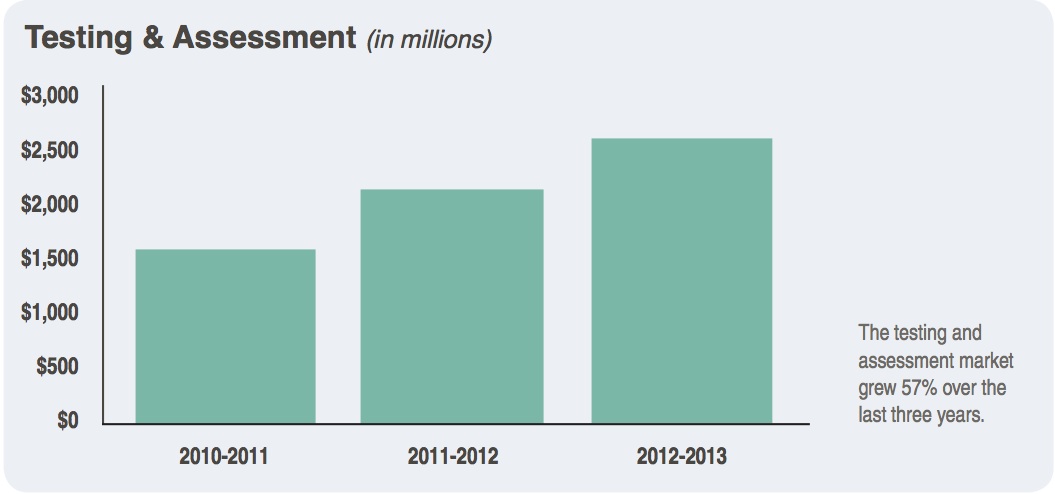
With the release of Behind the Data: Testing and Assessment—A PreK-12 U.S. Education Technology Market Report*, we have yet another opportunity to confront that Common Core is the problem, not the solution, because it is the source of a powerful drain on public resources in education that are not now invested in conditions related to racial and class inequity in our public schools.

Richards and Stebbins (2014) explain:

The PreK-12 testing and assessment market segment has experienced remarkable growth over the last several years. This growth has occurred in difficult economic times during an overall PreK-12 budget and spending decline….

Participants almost universally identified four key factors affecting the recent growth of the digital testing and assessment market segment:

1) The Common Core State Standards are Changing Curricula

2) The Rollout of Common Core Assessments are Galvanizing Activity….

(Executive Summary, pp. 1, 2)

testing and assessment 57 percent
(Richards & Stebbins 2014).

So as I have argued before, Common Core advocacy is market-driven, benefiting those invested in its adoption. But we must also acknowledge that that market success is at the expense of the very students who most need our public schools.

And there is the problem—not the end of cursive, not how we teach math, not whether the standards are age-appropriate.

Common Core is a continuation of failing social justice, draining public resources from needed actions that confront directly the inexcusable inequities of our schools, inequities often reflecting the tragic inequities of our society:

As the absence or presence of rigorous or national standards says nothing about equity, educational quality, or the provision of adequate educational services, there is no reason to expect CCSS or any other standards initiative to be an effective educational reform by itself. (Mathis, 2012, 2 of 5)

Who will be held accountable for the cost of feeding the education market while starving our marginalized children’s hope?

Reference

Richards, J., & Stebbins, L. (2014). Behind the Data: Testing and Assessment—A PreK-12 U.S. Education Technology Market Report. Washington, D.C.: Software & Information Industry Association.

* Thanks to Schools Matter for posting, and thus, drawing my attention to the study.

Teaching with Our Doors Open: Professional Transparency as Acts of Resistance

“It is very nearly impossible, after all, to become an educated person in a country so distrustful of the independent mind.”
James Baldwin, “They Can’t Turn Back”

During my 18 years as a public high school English teacher, I had a standing commitment shared with my students: I taught with my door open.

This may not sound that radical, but I want to offer two points of context: (i) I taught with a colleague who always kept the door locked (and advocated that all other teachers do that also to create a barrier for drop-in visits by administrators), and (ii) I taught in ways not supported by my school as well as allowing student behavior explicitly punishable by school rules (eating and drinking in class, for example).

This context of my years as an English teacher came back to me during my session at the 2014 National Council of Teachers of English. At the end of the session, including Sean Connors (University of Arkansas) and Nita Schmidt (University of Iowa), the audience discussion turned to a tradition in teaching that likely is doing us great harm: teaching with our doors shut as an act of resistance (since we use the shut doors to implement practices counter to mandates).

Let me offer two moments from the history of teaching English before making a call for teaching with our doors open as acts of resistance.

Around 1931-1932, English educator (and 1954 NCTE president) Lou LaBrant taught while working on her doctorate at Northwestern University. In her unpublished memoir housed with her papers at the Museum of Education (University of South Carolina), LaBrant recalled a powerful—and disturbing—situation she encountered with her roommate, a Spanish teacher at her school.

Since the school had a prescriptive curriculum (including required books, etc.) and a standard assessment system based on that curriculum, LaBrant and her roommate fabricated an entire year’s lesson plans to conform to the mandates, but then implemented what LaBrant called progressive practices throughout the year (LaBrant did not require the books provided, allowing choice in reading and writing instead, for example).

In one respect, LaBrant and her roommate represent the all-too-common “shut your door and teach the way you believe.” But the disturbing aspect is that LaBrant’s students scored exceptionally high at the end of the year on the mandated assessment, prompting the administration to highlight how well LaBrant implement the requirements—and thus attributing the students’ success to the prescribed curriculum LaBrant did not implement.

Now let’s jump forward about 40 years to what Stephen Krashen calls Whole Language and the Great Plummet of 1987-92.

Krashen and Regie Routman have both detailed how problematic “shut your door and teach” can be when we consider literacy policy.

While many blamed whole language as a policy commitment in California for the literacy test score drop in the late 1980s and early 1990s, Krashen explains:

Did teachers change their ways in California? Nobody really knows. There have been no empirical studies comparing methodology in language arts teaching before and after the 1987 committee met. (p. 749)

Routman is more direct:

So while the California framework…recommended the teaching of skills in context (as opposed to isolation), in actuality, the teacher training to empower all teachers to do this successfully was insufficient. In addition, the framework was widely misinterpreted. (p. 19)

At best, then, we can say about whole language implementation in California: (i) we have no firm data on if it was practiced, (ii) few teachers were adequately trained to implement whole language, and (iii) evidence suggests whole language was misunderstood often. Ultimately, California failed whole language, but whole language did not fail California—in part, because so many teachers shut their doors and teach.

This highlights a central tension around teacher agency and professionalism within a culture that demands teachers to be not political, not activists: Implementing mandates is not the work of professionals, notably when teachers and the research base for a field are excluded from how the policies are created within a partisan political arena (that teachers are deterred from entering as professionals).

My solution, then, is that teachers must begin to embrace and embody their professional selves by teaching with the doors open, especially when our practices reject flawed policy and mandates. Additionally, we must make transparent more credible artifacts of students learning, and not simply rely on the high-stakes testing data also used to de-professionalize teachers.

Teaching with our doors open creates agency where the system has denied it; teaching with our doors open offers direct alternatives to the practices we reject, to practices not supported by the evidence of our field; and teaching with our doors open models for our students how professionals behave.

While there is understandable refuge in teaching with our doors closed—historical and current forces that have worked to deny teachers their voices, their professionalism—it will only be through teaching with our doors open that we can both serve our students well and create a lever to reclaim our profession.

See Also

A Call for Non-Cooperation: So that Teachers Are Not Foreigners in Their Own Profession

Nastiness, Failed Logic of Racism Denial

While we can never make statistically valid claims about who and what is posted in online comments, I believe those comments represent common beliefs more than we’d like to admit.

Possibly the nastiest and most troubling comments occur when I publish something about race and racism, as in this piece in The State (Columbia, SC) about racial inequity in school discipline and mass incarceration.

Let’s consider some of the failed logic:

  • “I don’t believe your statistics and here are some statistics that prove my point”—this comment reveals the power of seeking support for a belief someone will never release. What is also interesting is that this approach almost always shifts entirely the discussion, not actually refuting the original statistical evidence: to reject racism in mass incarceration, for example, single-mother birth rates are cited.
  • Racism denial almost always plays the poverty card, but in the racial inequity of mass incarceration, that point falls flat. Impoverished white males outnumber black males 2 to 1; thus, incarceration is not more significantly a function of poverty than race, since black males outnumber white males 6 to 1 in prison.
  • Racism denial also has a favorite statistic: black on black crime rates. However, white on white crime rates are about the same as black on black crime rates, both over 80%. In fact, crime in the U.S. is typically within race and by someone the victim knows (often family). If within-race crime rates explained mass incarceration, then blacks and whites would be about equally represented in prisons.
  • And finally, I have been told by email that I don’t know anything about being a police officer since I have never been a police officer—these denials are by white former officers who, of course, know nothing about being black (using their logic). Much of what I offer about the racism of school discipline and the judicial system is based on the research and lived experienced of blacks, to me a much more credible source of understanding the inequity.

The raw data on school discipline and mass incarceration are undeniable in terms of racial inequity. As I noted, that requires a careful and nuanced consideration of the many reasons that inequity exists. In the case of mass incarceration, Michelle Alexander has offered a detailed examination that uncovers significant racism in who is arrested, how (and if) people are charged, and what sentences are handed down.

Decades of research also shows racial inequity in school discipline and then high and disturbing correlations between school discipline and incarceration rates.

Denial of racism in school discipline and incarceration, from the nasty to the illogical, is embracing school and judicial realities that mis-serve black children and black young adults—and then mis-serves us all.

Asking why these inequities exist so that they can be eradicated is a call for justice, not a plea for anarchy.

Education Accountability as Disaster Bureaucracy

The puzzle isn’t hard to put together because the pieces are in clear sight and fit together easily, but political, media, and public interest in facing the final picture is at least weak, if not completely absent.

Gerald Bracey (2003) and more directly Gerald Holton (2003) exposed that the stated original intent under the Ronald Reagan administration was to create enough negative perceptions of public education through A Nation at Risk to leverage Reagan’s political goals:

We met with President Reagan at the White House, who at first was jovial, charming, and full of funny stories, but then turned serious when he gave us our marching orders. He told us that our report should focus on five fundamental points that would bring excellence to education: Bring God back into the classroom. Encourage tuition tax credits for families using private schools. Support vouchers. Leave the primary responsibility for education to parents. And please abolish that abomination, the Department of Education. (Holton, n.p., electronic)

The accountability formula spawned after A Nation at Risk swept the popular media included standards, high-stakes testing, and increased reports of pubic school failure.

While the federal report created fertile ground for state-based school accountability, that proved not to be enough for political leaders, who within 15-20 years began orchestrating national versions of education accountability. The result was No Child Left Behind and then Common Core standards and the connected high-stakes tests—both neatly wrapped in bi-partisan veneer.

About thirty years after Reagan gave the commission that created A Nation at Risk the clear message about the need for the public to see public education as a failure, David Coleman, a lead architect of Common Core, exposed in 2011 what really matters about the national standards movement; after joking about having no qualifications for writing national education standards, Coleman explained:

[T]hese standards are worthy of nothing if the assessments built on them are not worthy of teaching to, period. This is quite a demanding charge, I might add to you, because it has within it the kind of statement – you know, “Oh, the standards were just fine, but the real work begins now in defining the assessment,” which if you were involved in the standards is a slightly exhausting statement to make.

But let’s be rather clear: we’re at the start of something here, and its promise – our top priorities in our organization, and I’ll tell you a little bit more about our organization, is to do our darnedest to ensure that the assessment is worthy of your time, is worthy of imitation….

There is no amount of hand-waving, there’s no amount of saying, “They teach to the standards, not the test; we don’t do that here.” Whatever. The truth is – and if I misrepresent you, you are welcome to take the mic back. But the truth is teachers do. Tests exert an enormous effect on instructional practice, direct and indirect, and it‟s hence our obligation to make tests that are worthy of that kind of attention.

The pieces to the puzzle: Education accountability began as a political move to discredit public schools, and next the Common Core standards movement embraced that above everything, tests matter most.

And now we have the final piece; Gerwertz reports:

In a move likely to cause political and academic stress in many states, a consortium that is designing assessments for the Common Core State Standards released data Monday projecting that more than half of students will fall short of the marks that connote grade-level skills on its tests of English/language arts and mathematics.

Like Naomi Klein’s disaster capitalism—the consequences of which are being exposed in New Orleans, notably through replacing the public schools with charter schools—the Common Core movement is not about improving public education, but a form of disaster bureaucracy, the use of education policy to insure the perception of educational failure among the public so that political gain can continue to be built on that manufactured crisis.

Yes, disaster bureaucracy is an ugly picture, but it is evident now the accountability movement is exactly that.

Common Core is not some unique and flawed thing, however, but the logical extension of the Reagan imperative to use education accountability to erode public support for public schools so that unpopular political agendas (school choice, for example) become more viable.

The remaining moral imperative facing us is to turn away from political claims of school and teacher failure, away from their repeatedly ineffective and destructive reforms, and toward the actual sources of what schools, teachers, and students struggle under as we continue to reform universal public education: social and educational inequities that have created two Americas and two school systems that have little to do with merit.

Accountability built on standards and high-stakes testing (not Common Core uniquely) is the problem because it is a designed as disaster bureaucracy, not as education reform.

References

Bracey, G. W. (2003). April foolishness: The 20th anniversary of A Nation at Risk. Phi Delta Kappan, 84(8), 616-621.

Holton, G. (2003, April 25). An insider’s view of “A nation at risk” and why it still matters. The Chronicle of Higher Education, 49(33), B13-15. Retrieved March 26, 2010, from OmniFile Full Text Mega database.

SC Parents Warned: “no state provision…to opt-out of state-or district-wide testing”

South Carolina is a hard-core right-wing state, often leaning Libertarian and almost always contradictory.

SC politicians push school choice while running against a woman’s right to choose. Now we learn that school choice advocacy in SC does not include parents’ right to choose whether or not their children participate in relentless testing.

According to a memo from the SC Department of Education and to district superintendents:

It has come to the attention of the South Carolina Department of Education (SCDE) that opt-out request forms are circulating around the state giving some parents the belief that they can opt their children out of state and federal testing requirements, among other things. With regard to testing, federal and state laws require that all students be included in South Carolina’s state assessment system.

There is no state provision for parents or eligible students (who are age eighteen or older) to opt-out of state-or district-wide testing….

With regard to any requests from parents for a school district to omit their children’s data from any district submission to the SCDE, neither federal nor state law allows a parent to opt-out of federal or state-required data collection processes, which is safeguarded by the SCDE.

While I have written often about the dangers of idealizing parental choice, it is certainly interesting to recognize the contradictory messages right-wing political leadership in SC sends about their own occasional support of choice (which reveals itself to be no real support of choice at all—only when it serves the interests of those leaders).

Parents, be warned.

Shifting Our Deficit Gaze, Asking Different Questions about Literacy

Poor Kids and the “Word Gap” opens with an important admission by Jessica Lahey: The Horace Mann ideal that education is the “great equalizer” has not materialized (or at least, has eroded). While the impact of education appears powerful within class and race classifications, educational attainment remains ineffective in overcoming social inequity.

As the article title states, however, Lahey turns to the “word gap”—a compelling and repeated entry point for discussing the educational differences among social classes and races of children. Quoting a Clinton Foundation report, the article equates that “word gap” with childhood hunger and food insecurity before detailing the Obama administration’s initiative to bridge that socioeconomic word gap.

Lahey’s article, the Clinton Foundation, and the Obama initiative are all sincerely grounded in good intentions, and all rightfully highlight the need to address the inequity of education in the U.S. that mirrors the social inequities a rising and high percentage of impoverished children experience.

But, once again, the problem persists that we remain committed to a deficit gaze, one that ultimately blames the parents of children in poverty (often the mother) for the “word gap.”

Looking closely at the Clinton Foundation report, in fact, reveals that Hart and Risley’s 1995 research (see chart on page 10) continues to anchor assumptions that the quantity and quality of words are linked to both the socioeconomic status of a child’s home and then the child’s ability to succeed once in formal schooling.

As Dudley-Marling and Lucas emphasize, the foundational study by Hart and Risley and pathologizing the language of impoverished students are misguided and misleading because of the essential deficit perspectives embedded in each, perspectives reflecting and perpetuating stereotypes. “Pathologizing” language means that the language itself is seen as a “sickness” and thus what must be “treated”—including the concurrent implicating that the host of the language, the child, is also diseased and must be treated.

As well, research in the UK reveals that the dynamic among literacy, social class, and educational attainment is complex, but also powerful. Pleasure reading and even the quality of that reading appear to increase literacy in adults, Sullivan and Brown detail.

Sullivan reaches two important conclusions: the need to protect the library and the importance of books in the child’s home.

This focus—on strategies for enriching the literacy of children born into impoverished homes—offers important ways for shifting our deficit gaze away from blaming the victims of poverty and toward systemic causes for characteristics (“word gap,” for example) so that we can develop policy to prevent the conditions in the first place and also create contexts for alleviating inequity that already exists.

The great challenges facing the U.S. and our disturbingly high percentage of children living in poverty are social inequities linked to classism and racism. We must admit these problems, and then we must address them directly (and not by clinging to idealistic beliefs such as education will be the “great equalizer”).

But we must also address directly the existing inequities reflected in the homes and education of impoverished children.

Let’s not blame high-poverty mothers; instead, let’s develop policies that provide books for children in their homes while we commit to social programs that allow impoverished families the sort of security and opportunities supporting them in their roles as a child’s first teachers.

Let’s not diagnose and then treat impoverished children and their literacy; instead, let’s insure that all children have rich and engaging formal schooling experiences

The deficit gaze fails because it focuses on people and not the conditions within which people find themselves (through no fault of their own).

Regardless of good intentions, we must shift our deficit gaze and begin to ask different questions so we can create new and more humane answers.

Unpacking Education and Teacher Impact

Among media, political, and public claims driving calls for education reform, two beliefs are dominant: (i) education is the single most important lever for lifting anyone above the circumstances of her/his birth, and (ii) teacher quality is the single greatest factor in whether that educational experience accomplishes the first belief.

As I have increased my contribution to public debates about education reform, I have witnessed that media, political, and public comments are often knee-jerk and simplistic either/or responses to complex research.

For example, when I note that 40 years of research reject grade retention, responses tend to discount that research with “So you want us just to pass them on?”—suggesting that social promotion is the only alternative to grade retention (which, of course, it isn’t). Similarly, when I share that 60 years of research on corporal punishment also refute spanking—that, in fact, there is no debate on its use—responses immediately include, “So we are just supposed to let children do whatever they want?”

But I have also discovered that in my education courses, students challenge many research-based conclusions, although the students are more thoughtful—particularly when I share the evidence on the impact of education and teachers [1].

Consider the follow body of evidence below; and then, in the context of this evidence, I want to unpack what education and teacher impact actually entails.

Is teacher quality actually the single greatest factor in student achievement? Di Carlo details what research shows:

But in the big picture, roughly 60 percent of achievement outcomes is explained by student and family background characteristics (most are unobserved, but likely pertain to income/poverty). Observable and unobservable schooling factors explain roughly 20 percent, most of this (10-15 percent) being teacher effects. The rest of the variation (about 20 percent) is unexplained (error). In other words, though precise estimates vary, the preponderance of evidence shows that achievement differences between students are overwhelmingly attributable to factors outside of schools and classrooms (see Hanushek et al. 1998; Rockoff 2003; Goldhaber et al. 1999; Rowan et al. 2002; Nye et al. 2004).

Also consider Donald Hirsch’s research on the UK for the Joseph Rowntree Foundation: “Just 14 per cent of variation in individuals’ performance is accounted for by school quality [emphasis added]. Most variation is explained by other factors, underlining the need to look at the range of children’s experiences, inside and outside school, when seeking to raise achievement.”

We see here two important points: (i) out-of-school factors dwarf measurable influences of teacher quality, and (ii) teacher quality is a subset of school quality. Thus, school and teacher quality is not even close to the most important measurable factor in student achievement.

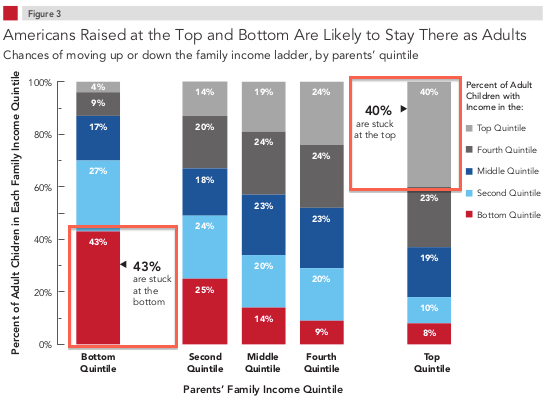
Now, what is the evidence on social mobility in the U.S., notably in terms of how educational attainment influences the relationship between social class or race and that mobility?

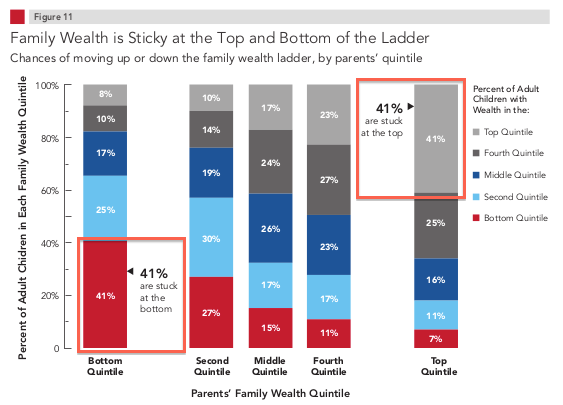
Social mobility appears fairly sticky in the bottom and top quintiles:

mobility
From Pew’s Economic Mobility Project data; analysis by Bruenig, 2013, June 13: “As far as income mobility goes, you are 10x more likely to wind up in the richest fifth as an adult if you were born there than if you were born in the poorest fifth.”
Fig 11
From Pew’s Economic Mobility Project data; analysis by Bruenig, 2013, June 13: “As far as wealth mobility goes, you are more than 5x more likely to wind up in the wealthiest fifth as an adult if you were born there than if you were born in the least wealthiest fifth.”

Next, Bruenig (2013, June 13) concludes:

One convenient way to describe what’s going on is that rich kids are more likely to get a better education, which translates into being richer and wealthier as adults. It is certainly the case that richer kids are more likely to get a college degree, and it is certainly the case that getting a college degree leaves you much better off on average than not getting one. But this does not explain the full picture of social immobility [emphasis added].

And thus, social mobility appears more strongly connected to the social class of a person’s family than to education (a function of combined school and teacher quality):

educationandmobility
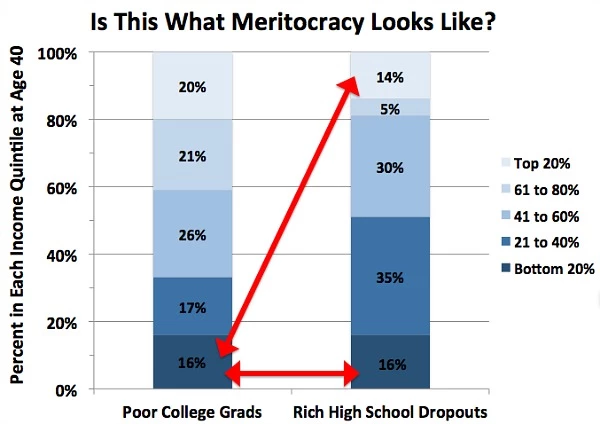
From Pew’s Economic Mobility Project data; analysis by Bruenig, 2013, June 13: “[Y]ou are 2.5x more likely to be a rich adult if you were born rich and never bothered to go to college than if you were born poor and, against all odds, went to college and graduated.”
The consequences of the dynamic between social class and education are, as Matt O’Brien explains, as follows:

meritocracy
Data from Richard Reeves and Isabel Sawhill. O’Brien concludes: “Even poor kids who do everything right don’t do much better than rich kids who do everything wrong.”

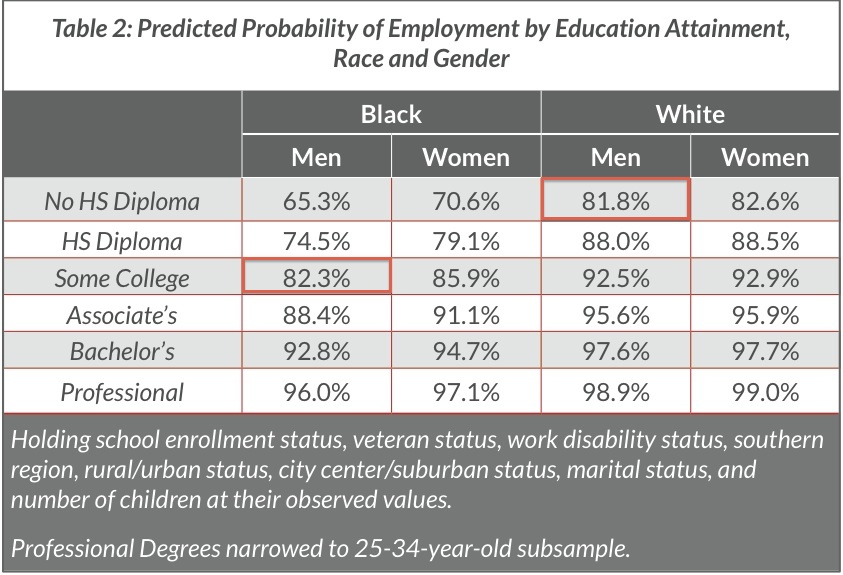
Now, consider the relationship between educational attainment and race. First, in Closing the Race Gap, O’Sullivan, Mugglestone, and Allison (2014) detail that blacks with some college earn about the same as whites with no high school diploma:

Table 2 copy
O’Sullivan, Mugglestone, and Allison (2014)

From this report as well, Susan Adams explains: “African-American college students are about as likely to get hired as whites who have dropped out of high school.”

Significant income disparities exist along racial lines despite educational attainment, as Bruenig (2014, October 24) shows:

fig_2
Bruenig (2014, October 24): “First, understand that blacks and Hispanics have lower incomes than whites up and down the educational spectrum. On average, black families at a given level of educational attainment receive incomes that are just 66% of what white families at the same level of educational attainment receive. For Hispanic families, that figure is 79%. Naturally, when education-controlled income disparities like this exist, education-controlled wealth disparities will exist.”

The impact of education (school and teacher quality), then, when placed in the context of both social class and race refutes the opening claims: (i) education is the single most important lever for lifting anyone above the circumstances of her/his birth, and (ii) teacher quality is the single greatest factor in whether that educational experience accomplishes the first belief.

When I offer these measurable facts to either the public or my students, often I hear: “So you are saying that education and teachers do not matter?”

Here is the hard part.

First, making claims that measurable education and teacher impact exists is problematic. Thus, I absolutely support that both education and teachers matter, but I also caution that this impact is not singular, direct, or easily quantified.

Part of that problem is that the impact of any person’s education or the influence of any teacher or teachers tends to occur over long periods of time, and we are hard pressed to tease out and measure specific teachers or practices since that impact is cumulative, interrelated, and multi-faceted (consider that a student can learn a valuable lesson from a flawed lesson or a weak teacher).

Our first conclusion, then, is that making claims about education being the single or sole factor in success or that the teacher is the single most important factor in achievement is misleading, overly simplistic.

But, there are fair and accurate claims we can make about the importance of education, leading to our second conclusion.

Our second conclusion is that within social class and race, educational attainment has significant influence, but that education alone appears less effective in overcoming large social inequities such as classism and racism.

From this, I think we have several important lessons:

  • Media, public, and political hyperbole about education and teacher impact does a disservice to public education, teachers, students, and the public. Overstating the impact of education and teachers assures that we will continue to fail our students and the promise of universal public education.
  • In our endless quest for education reform, we would be better served if we moved away from mostly measurable data points for making claims about and policies in education. Education is messy and complicated; quantified data are in fact simplistic and misleading.
  • Until we confront the corrosive influence of class and race in the U.S. and until we admit that education alone is not enough to overcome classism and racism, we are perpetuating social inequity.

Let’s be clear: Education and teachers matter. But, regretfully, they simply do not matter in the ways most people claim or believe, and certainly not in ways that are easy to identify.

The good news, however, is that there is much we can do to change this, if we have the resolve to confront the evidence, accept the ugly truths, and then to do something different.

See Related: If social mobility is the problem, grammar schools are not the solution, Gaby Hinsliff


[1] This post is in debt to my current, fall 2014 EDU 111 course at Furman University, a group of students fully committed to engaging with the topics, challenging claims, and seeking to understand the complexity of education. They are proof that teaching is an act of learning, if the teacher is there to listen as well as talk.