MT Education Products® is excited to announce Fun-X®!
Fun-X® is a 100% FREE program that is GUARANTEED [1] to be identified as FUN by at least 95% of your students.
The program is based on the Science of Phonics®, and what makes the program FUN?
Nonsense words!
That’s right, the program is 100% nonsense words:
No thinking!
No meaning!
Just learn the rules and say the nonsense words.
Cultural differences? Doesn’t matter!
Dyslexia? No worries, the Science of Phonics® shows we are all dyslexic!
Fun-X® insures that
Everyone memorizes the same rules.
Everyone learns the same rules on the same day and the same way.
Everyone pronounces the same nonsense words.
Everyone takes the same nonsense word test, BABEL® (available in the suite of support materials below).
It’s not just FUN, it’s Fun-X®!
But That’s Not All!
The following suite of related products to support Fun-X® are available at affordable pricing. States mandating any MT Education Products® programs in education legislation are eligible for discounted rates!
Skrip-Z® is an AI-driven lesson planning, instruction, and assessment system to support Fun-X®. The program is fully computer-based and includes:
180 AI-generated Fun-X® lessons.
180 AI-generated instructional modules.
36 assessments driven by BABEL®.
AI teaching assistant HAL®.
“Educators will relinquish certain freedoms, but teaching has never been so fun!”
BABEL® is a nonsense word assessment system designed by the North West Institute of Phonics based on the Science of Phonics®.
HAL® is the friendly and fast AI teaching assistant fully integrated into Skrip-Z® .
Teachers will be just as likely to find our suite of programs FUN since there is no planning, no instruction, and no grading!
“I am putting myself to the fullest possible use, which is all I think that any conscious entity can ever hope to do.”
HAL®
Speaking of teachers, MT Education Products® offers teacher training through SPELRZ®, also based in the Science of Phonics®. This program fills the holes left by the failures of teacher education. SPELRZ® was developed by psychologist and program developer, LuLu Rivers.
What People Are Saying
“I have been reading MRIs for 37 years and I can attest that brain scans of students using Fun-X® show the highest level of fun I have ever seen.”
William Iceberg Cognitive scientist, 37 years reading MRIs
“I have never taught, but my investigative reporting uncovered an educational crisis that the developers of Fun-X® have assured me will replace the crisis with fun!”
Hannah Ford Podcaster, Education Crisis Today!
“Our school has always been a family, but now our school is a place where we have fun thanks to Fun-X®! 97% of our students and 98% of our teachers say so!”
Simpson Jackson Principal Walton Charter Elementary STEAM College Little Rock AR
“I diagnosed all of my children with dyslexia years ago after several days doing research on the Internet, but now our homeschooling is fun thanks to Fun-X®.
Know-N® is being developed because some people have begun to ask questions about knowledge and its role in nonsense word acquisition. This may not sound like fun, but MT Education Products® is committed to continuing to offer NEW education products as often as anyone will buy them. Be on the look out for the Science of Knowledge® revolution!
Contact
MT Education Products®
Subsidiary of
Media and Technology Educational Co-Op, LLC
911 Charter School Way
Battle Creek MI 01010
[1] MT Education Products® guarantees that if fewer than 95% of students identify Fun-X® as fun, then MT Education Products® will send for FREE a link to our NEW and upcoming education product, Know-N® (coming Fall 2025).
I stumbled my way to becoming a high school teacher of English in the same high school from which I had graduated just five years before.
After graduating from junior college, I was set to transfer to the main campus of the University of South Carolina; that plan included a friend I had attended every year of school with since grade 1.
He had a catastrophic accident that summer, leaving him paralyzed and changing both our plans for continuing college.
I then stumbled, mostly fearful of heading off without the comfort of that friend since we were both small-town boys. So I abruptly shifted to attending the local satellite campus of the South Carolina university system, which meant I also committed to living at home for the rest of my undergraduate years.
My entry in teacher certification was yet another stumble since I did not really choose the degree and career until I was sitting at orientation the fall I transferred to the satellite university.
As a rising junior, I needed to declare my major and had been contemplating pre-law and architecture. But on the spur of the moment, and after several clarifying questions, I became a secondary English education major.
The transfer and relatively late decision to be in teacher certification resulted in my graduating in December, and then, being in a sort of limbo that next spring (although I did enroll in an MEd program as well as worked as a substitute teacher).
But the greatest stumbling of all, I must admit, was those first 5 to 7 years as a high school English teacher.
I often think of the beginning-teacher Me—idealistic and nearly fanatically focused on finding the instructional practices that worked (specifically, how to teach my high school students to write well).
Semester after semester, I revised and rebooted my instruction. Yet, often, student assignments were submitted with about the same degree of struggling, the same (and often predictable) performances that needed to be revised.
In this mania for finding out what works, I even created my own writing textbook, developed directly from my students’ work.
Year after year, a pattern developed: I was highly regarded by my students, my colleagues, my administration, and my students’ parents as an excellent teacher, notably an excellent teacher of writing; yet, I felt constantly as if I was failing.
I had an unhealthy tunnel vision focused on finding what works, and I was not willing or able to simply step back and consider what I now know is true, but is also counter-intuitive. And I just made that claim on social media:
Unpopular position:
We vastly oversell instructional practices and the search for "what works"
If we would address the conditions of learning (living) and teaching so students and teachers could be more successful, then we would find many instructional practices work
What I have learned as I just completed my year 40 as a teacher is that many instructional practices work, but often predicting what works is fraught practice.
And what I am now certain about is my second point above: What works is profoundly impacted by learning (and living) and teaching conditions.
My mother, who completed only one year of junior college, taught me to read at an advanced level well before I entered public schooling. And she used entirely whole word strategies (note cards taped to objects all over our house) and picture books (from Dr. Seuss to Go, Dog, Go and One Fish, Two Fish, Red Fish, Blue Fish).
We were working class/poor and my parents were not highly literate, but what worked for me isn’t necessarily supported by scientific research and isn’t a template for what would work for anyone else.
Here, then, is why the pursuit of what works in education reform fails:
What works feeds into the silver-bullet fallacy. No instructional practice or program works universally because instructional/program effectiveness is relative to individual differences among students and time.
What works feeds into the in-school-only reform paradigm. Ironically, hyper-focusing on what works (instruction/programs) ignores the body of scientific research that shows teachers’ impact on measurable student learning (1-14%) is magnitudes less than out-of-school factors (60+%). Reforming instruction and programs, then, can never have the sort of measurable outcomes that addressing out-of-school factors could produce. This in part explains why all reform appears to fail and we remain in a constant cycle of crisis/reform in education.
What works is trapped in a flawed model of human behavior. Humans develop is somewhat predictable in terms of stages; however, the exact when of that development is not nearly as fixed as systematic instruction and programs require. Most what works claims are bound to predictive grade- (or age-) level achievement that is linked to aspirational expectations that 100% of students can or should be at these levels. Again, this paradigm in part explains why we are in constant crisis since the expectations are unrealistic.
What works is a subjective designation grounded in the definition of “works.” At the policy level, what works is always political/ideological because some power structure endorses the defining characteristics of “works”; since education policy is at the whim of political structures, what works can and will be manipulated by political shifts creating an instability that is counter-educational. For example, in writing instruction, do rubrics work? Rubrics can be effective for clarifying expectations for students (transparency) and for standardizing grades assigned to writing (fairness); thus, in that context of “works,” the answer is yes. But rubrics do most of the writer’s work for students by detailing the decisions that emerging writers need to develop; therefore, if your goal is teaching students how to make authentic writing decisions, rubrics do not work (similar to how training wheels do not work). Different power structures, then, could define rubrics as what works or as “currently unsupported instructional practices” based on the mandated definition of “works.”
The US needs a reckoning, one similar to my own experiences as an early-career high school English teacher.
What works? Well, not spending any more time trying to identify and then mandate what works.
Many different instructional practices work under different conditions. And even when something doesn’t work, we have time to find out what will work if we would focus more on what really matters—the learning (and living) and teaching conditions of students’ schooling (and lives).
Almost 60 years after my formative years as a beginning reader, I have witnessed my grandson’s journey to reading grounded in his iPad, playing Minecraft and watching YouTube videos about how to play his video games.
Both he and I became eager readers because of our passion for reading as a means to the things we love.
Not an instructional practice.
Not a program.
What works is less a thing we can identify and mandate and more an ideological shift in verb tense—what worked.
A move from being predictive to descriptive, which takes a great deal of patience, a comfort for the unknown and unknowable, and the wisdom to look carefully at the right things—the students in front of us and not the mandates grounded in what works.
See Also
Follow an example thread here:
Brief but targeted explanation of why "what works" is a problem not a solution
The fall of 2024 will mark year 41 for me as a literacy educator, scholar, and advocate.
About half of that career was spent in K-12 public education in rural Upstate South Carolina, where I was born and live. I have witnessed daily race, social class, and gender inequity at some of the most extreme levels in the US.
At the core of my work as an educator, as well, I have named, challenged, and advocated to correct all forms of inequity. That work has often been in very hostile environments in the South where the power structures deny these inequities exist and persist at calling for traditional values as code for maintaining the status quo.
Also throughout my career as an educator and scholar, I have developed a solid grounding in the history of education and the field of literacy. Having written an educational biography of Lou LaBrant and serving as Council Historian for the National Council of Teachers of English were foundational experiences for that commitment to the history of education.
Further, having begun as an educator in 1984, I have lived and worked my entire career in the high-stakes accountability era of education reform. At every point along the way, I have raised a hand in opposition to this reform paradigm because it is driven by media, the market, and politicians who are more committed to education reform as industry than to serving the needs of our students or honoring the professionalism of America’s teachers, who are more than 70% women.
The “science of reading” movement and the offspring “science of” reform agendas are nothing new, except they are incredibly harmful—notably for the very students some of the advocates use as shields against criticism.
Once again, “science,” “crisis,” and “miracle” are being weaponized to not only label and punish students but also de-professionalize teachers.
One of the most effective and dishonest tactics is the “crisis” claim about reading in the US.
First, this claim lacks a basic understanding of educational testing, and further, the claim is ahistorical.
At least since the 1940s in the US, two facts can be proven: (1) at no point has student reading achievement (“proficiency”) been declared adequate; there has been a perpetual cry of reading “crisis” in every decade by media and political leaders, and (2) throughout the history of US public education, there has been a pervasive so-called “achievement gap” (better referred to as an “opportunity gap”) with marginalized populations of students performing well below average or white and affluent students.
That means that current reading achievement however measured and current “achievement gaps” are not a crisis but a historical and current reality maintained by political negligence.
Since current “science of” advocates have a fetish for misrepresenting and citing NAEP, let’s look at how NAEP in fact proves my point.
Consider Mississippi, the darling of reading reform and media crowning as a “miracle:
At grades 4 and 8 in reading, Black students in MS were BELOW basic (approximately below grade level) at a rate of 51%, about the national rate for Black students.
Note that despite well over a decade of SOR reading reform, the achievement gap for Black students remains about the same as in 1998.
Education and reading reform is not addressing the inequity Black students suffer in MS or anywhere in the US. However, the SOR movement has been doubling down on labeling and punishing Black students through grade retention, which serves to inflate grade 4 scores but not better prepare students.
MS has consistently retained about 9000-12000 students (mostly Black students) since 2014; if SOR policy and instruction were actually working, these retention number should drop or even disappear (since SOR advocates claim to be able to have 95% students reach proficiency).
And thus, my advocacy for my entire career has been for both social and education reform that focuses on equity and refuses to blame teachers and students for that inequity.
For the past forty-plus years, however, education reform has solely targeted blame on schools, teachers, and students.
Those racially minoritized students and students living in poverty have routinely been characterized by deficit ideology, and reform has sought to “fix” those students by inculcating grit or growth mindset—or simply imposing a systematic phonics regime on those students, treating them all as if they have reading “disorders.”
And if those students don’t perform, retain them (punish them) and label them. Yet, there is never any consequences for the reformers when none of their reform promises are fulfilled (see the charter fiasco in New Orleans).
Hyper-focusing on MS (and Florida) is not just a lie, but a distraction.
Students in military families are often from impoverished backgrounds, yet Black students BELOW basic are at rates of 25% (grade 4) and 18% (grade 8), dramatically less than the national average and MS.
And here is what the media, the market, and politicians refuse to acknowledge: DODEA students have medical care, food security, housing security, and parents with work stability.
Also, DODEA teachers are paid above most public school teachers.
Unlike the false claims about MS, DODEA achievement shows that both in- and out-of-school reform must be addressed for the in-school achievement to rise in authentic ways.
I am tempted to say the real crisis is how media and political leaders mislead the public about education and education reform—as well as demonize students and teachers.
But that is also nothing new.
There is great profit in perpetual crisis so don’t hold your breath that anything will change any time soon.
The CLP will feature the following Furman experts:
David Fleming, Professor of Political Science and International Affairs at Furman University (moderator) Paul Thomas, Professor of Education at Furman University (education policy) Ken Peterson, Professor of Economics at Furman University (economic and immigration policy) Karen Allen, Professor of Sustainability and Anthropology (environmental policy) Julie Linton, MD, FAAP, Professor of Pediatrics, Prisma Health Children’s Hospital Upstate, USC School of Medicine Greenville, Professor in Furman’s Community Engaged Medicine (healthcare policy)
The “science of reading” movement has promoted a misleading story about reading through the media—reading proficiency is in crisis because teachers do not know how to teach reading and were not properly prepared by teacher education. This opening talk with argue that attacks on BL are grounded in efforts to deprofessionalize teachers.
Thomas will examine an authentic definition of BL as a reading philosophy that centers serving the individual needs of all students. He will examine also the caricatures of guessing and three cueing (MSV), providing attendees scholarly evidence for accurate characterizations of BL as well as deeper understanding of reading proficiency.
Literacy in the Disciplines 6-12
Webinar
December 10, 2024 – 6-7 pm
We Teach English in Times of Perpetual Crisis: Selling a Story of Reading (and Literacy)
English-speaking countries around the world are once again fighting another Reading War. In the US, the movement is called the “science of reading” (SOR) and the result has been intense media scrutiny of reading programs, teachers, and teacher education as well as highly prescriptive state-level legislation and mandates. Those of us who do not teach beginning readers are not exempt from the negative consequences of another Reading War. This webinar will briefly introduce the history of Reading Wars and identify the key elements of the SOR movement and why the public stories and legislation are poised to erase teacher autonomy and serving the individual needs of students.
“Science of” Movements as Trojan Horse Education Reform [Access PP PDF Here]
In June 2024, the newly formed Evidence Advocacy Center announced plans to “[transform] the [teaching] profession into an evidence-based system.” However, the EAC admitted “educators will relinquish certain freedoms.” This session will examine the “science of” movements as a subset of a 40-year cycle of accountability-based education reform (Trojan Horse Education Reform) that de-professionalizes teachers and fails to serve the needs of students or public education.
Session Two — 2:00 – 3:30 p.m.
Big Lies of Education: “Science of” Era Edition [Access PP PDF Here]
Education practices and policy are often directly and indirectly driven by the stories told in the media, among the public, and by political leaders. This session will explore the Big Lies in the compelling but misleading narratives, including A Nation at Risk/education “crisis,” reading proficiency/NAEP, National Reading Panel, poverty as an excuse, and international test rankings and economic competitiveness.
The Manufactured Crisis: Exposing the False Narrative of Public Education’s “Failure”
Date & Time
Apr 16, 2025 08:30 PM EST
Description
Join us for a timely and vital conversation on April 16 at 6:30 p.m. ET with Dr. P.L. Thomas, Professor of Education at Furman University. For decades, media and policymakers have pushed a narrative that America’s public schools are “failing.” But who benefits from this story, and who is harmed by it? Dr. Thomas will expose how the education reform industry has fueled a false crisis, undermining trust in public schools while advancing corporate-driven reforms. Drawing on his experience as a teacher, scholar, and national award-winning writer, Dr. Thomas will offer critical insights into how we can challenge disinformation and reclaim a narrative rooted in equity, democracy, and community empowerment.
In the wake of Katrina in 2005, Louisiana Governor Bobby Jindal (R) leveraged the natural disaster to begin the eventual shift of schools in New Orleans from traditional public schools (TPS) significantly staffed by a Black professional class of teachers to a charter school Recovery School District (RSD) run by Paul Vallas and often staffed by young, white, and affluent Teach for America (TFA) recruits.
This moment was acknowledged by some as disaster capitalism that had far more to do with politics than improving student achievement. The endgame was to entrench school choice schemes and create a cheaper although fluctuating teacher workforce (TFA).
Yet, as many of us warned, an all-charter school system in New Orleans never outperformed the TPS it replaced.
In fact, all across the US, charter schooling, RSD, TFA, and almost every major education reform schemes have never delivered on the academic outcomes promised.
Here, it is important to acknowledge that most education reform in the US over the past 40 years has been grounded in conservative ideology (even though the political support has been bi-partisan) and most of that reform is Trojan Horse reform—using a false veneer of reform to accomplish ideological and political agendas.
School choice schemes are not about student achievement but about publicly funding private education and “white flight” as public schools have become majority-minority populations of students.
TFA and organizations such as National Council on Teacher Quality (NCTQ) are not designed to improve teacher quality or teacher preparation but about creating a cheap workforce and eradicating teacher professionalism to make way for teachers as mere monitors for scripted programs and computer-based instruction.
Although just two examples, the key point is running through Trojan Horse education reform is not just political and conservative ideology but also a commitment to market forces.
Education reform in the US primarily creates churn—new standards, new programs, new materials, new teacher training, etc.—that serves the needs of the market, not parents or their children. That churn is promoted by education reform influencers who only gain if schools, teachers, and students are perpetually viewed as failing—permanent crisis.
Lurking underneath education reforms during George W. Bush’s tenure as governor of Texas and president of the US was the lure of scripted curriculum that shifted authority away from the teacher and to the state and primarily commercial products.
Although Bush’s reform agendas flourished with bi-partisan support, scripted curriculum and de-professionalizing teachers (see also the value-added methods schemes and the “bad teacher” attacks under Michelle Rhee) mostly lost favor and lay dormant post-Obama (even as the Obama administration double-down on most of the conservative elements established by Bush’s administration).
That is, lay dormant until the “bad teacher” myth was resurrected by Emily Hanford and the “science of reading” (SOR) movement.
As Aukerman explains, the story being sold included several elements of failure and incompetence that pits classroom teachers against teacher educators (both of which are primarily women professionals):
Now that SOR has mostly uncritically swept across the US in the form of state-level reading legislation and policy, the evidence suggests that at the core of the so-called success of SOR policies (see Mississippi and Florida) is one of the most conservative and harmful policies possible—grade retention, as Westall and Cummings explain:
Similar to the results for states with comprehensive early literacy policies, states whose policies mandate third-grade retention see significant and persistent increases in high-stakes reading scores in all cohorts. The magnitude of these estimates is similar to that of the “any early literacy policy” estimates described in Section 4.1.1 above, suggesting that states with retention components essentially explain all the average effects of early literacy policies on high-stakes reading scores. By contrast, there is no consistent evidence that high-stakes reading scores increase in states without a retention component.
Grade retention disproportionately impacts poor students, Black students, Multi-lingual learners, and other marginalized population of students. Retention is popular because it represents a type of accountability and punishment for “other people’s children” who need to be “fixed” by those in power.
Concurrent with the SOR movement, a new flurry of “science of” movements have propagated: “science of learning,” “science of writing,” “science of math.”
The mostly uncritical support for SOR by the media, the education market, parents, and politicians have provided fertile ground for a larger “science of” movement to drive our newest round of the same education reform structures we have been implementing without improving student achievement for forty-plus years.
Let’s emphasize here, Trojan Horse education reform doesn’t work to improve teaching and learning, but it does work for media, market, and political interests.
And now, the mask is coming off with the announcement of the Evidence Advocacy Center:
In the EAC’s plan for the transformation of the profession into an evidence-based system, educators will relinquish certain freedoms — notably the leeway to employ ineffective practices — but will gain guidance that empowers them to fulfill their original purpose by profoundly impacting the future of students, families and communities. The alternative is to continue rearranging the deck chairs under the guise of education reform.
There is more than one kind of freedom, said Aunt Lydia. Freedom to and freedom from. in the days of anarchy, it was freedom to. Now you are being given freedom from. Don’t underrate it….
We were a society dying, said Aunt Lydia, of too much choice. (pp. 24, 25)
Under the Brave New World of “science of” education mandates, teachers will have freedom from professional autonomy and freedom to implement scripted programs!
And who benefits?:
Many of these groups are fundamentally conservative, but even a modicum of interrogating the Who and Why behind this agenda reveals some chilling concerns.
NCTQ was founded by the Thomas B. Fordham Institute, a conservative think tank dedicated to school choice/charter schools and market forces. Note that there is a distinct contradiction between advocating for “science” in education practices and citing NCTQ, which has never produced any scientifically valid “reports.”
The leadership of EAC includes several connections to the University of Oregon, home of DIBELS®, a phonics-centric program that was revitalized by the SOR movement.
Other leaders include Louisa Moats, creator of LETRS, which is being mandated across the US to retrain teachers in SOR even though, again, the program is not supported by science.
The 95 Percent Group is also based on an aspirational claim not grounded in settled science, as one analysis concludes about the 95% claim: “This all said, it does seem there is some level of support for 96% being a benchmark goal [emphasis added], for reading proficiency rates.”
And two key comments lurking in the background of these “science of” movements must not be ignored.
The term “Structured Literacy” is not designed to replace Orton Gillingham, Multi-Sensory, or other terms in common use. It is an umbrella term designed to describe all of the programs that teach reading in essentially the same way. In our marketing, this term will help us simplify our message and connect our successes. “Structured Literacy” will help us sell what we do so well.
Connect the dots and connect the rhetoric: “Relinquish certain freedoms,” “sell what we do so well,” “watchdogs.”
The “science of” movements are yet another cycle of Trojan Horse education reform. We have already opened the gates and waved this in with blinders on, so now we must do our best to reclaim teaching and learning that serves the needs of our students and not the media, the market, and political/ideological agendas at the expense of those students.
My partner and I were discussing this YouTube video by Nick Lewis, who explains in the beginning how social media influencers make profits (watch the first few minutes, by the way, for his explanation):
The key point here is that social media influencers need consumers to always be interested and buying the next thing, the new thing.
Influencers are not incentivized to find for their audiences The Thing, something that lasts, something that solves a problem, because the value is in churn—consumer buying the thing and then almost immediately positioned to want to replace that thing with the new thing.
That dynamic is exactly what is working in the perpetual reading war where influencers (journalists, education reformers, politicians) are incentivized to keep the public in a constant state of crisis/reform.
Those crisis influencers must first create market space (“Reading programs X and Y have failed!”) and then promote the New Reading Program—and then in just a few years, that reading program will be declared a failure so if we will only adopt this Next New Reading Program …
Reading reform influencers are like social media influencers as well in that they lack expertise in the issue; their only expertise is the influencing and the creation of constant churn.
The “science of” movements in education are just that—influencers creating market churn—and not in most ways about addressing real educational problems and certainly not about solving them.
If education and reading were satisfactorily improved, what would they do?
We need to deinfluence reading (and education) reform if we are genuinely concerned about improving student achievement.
As a writer and a teacher of writing, I am well aware of the need to avoid cliches, but cliches often do, in fact, capture well something that is worth considering.
In this education reform “science of” era, reading reformers are suffering the negative consequences of missing the forest by hyper-focusing on a few trees.
The cautionary tales being ignored [1] are also expanding, and possibly the most powerful evidence that the SOR movement is misguided is in the UK, where a similar reading reform movement was implemented in 2006.
Not surprising, but phonics-intensive reading reform in the UK has not achieved what was promised—and media as well as political leaders are still shouting “reading crisis.” [2]
At the core of education reform broadly and reading reform narrowly are several fatal flaws that mainstream reformers refuse to avoid: (1) manufactured crises, (2) one-size-fits-all solutions, and (3) policies and mandates that are hostile to teacher autonomy and individual student needs.
Digging deeper into the monolithic reading reform cycles over the past 40 years (and reaching back into 80 years of reading crisis rhetoric and fruitless reading wars), some of the most ignored evidence in reading crisis rhetoric and reading reform/policy concerns the failure to address how demanding teacher fidelity to policy and programs reinforces deficit ideology about language and marginalized students.
As I have noted, I was confronted with evidence about Units of Study (UoS) that has never been the focus of the outsized and misguided attacks on that program and Lucy Calkins. Teachers at a conference just weeks before the Covid shutdown explained to me that their problem with UoS was not the program itself but the excessive policing and accountability by administrators that teachers implement the program with fidelity.
Two problems exist with implementing programs with fidelity. First, that shifts the locus of authority away from the teacher and to the program itself. And thus, second, that shift institutionalizes a deficit ideology about language and students since programs tend to impose standardized versions of literacy as well as evaluate students in terms of how they fail to demonstrate standard literacy.
Fidelity to programs creates obstacles for honoring fidelity to student needs.
Few people challenge how efforts to standardized language is a way to standardize humans (and children). Formal schooling’s approach to language is almost exclusively standardizing—systematic phonics, Standard English grammar, and false concepts such as the “word gap” (see Recommended articles below).
What we in the US should not be ignoring is evidence from the UK of how policy manifests itself in the real-world classroom.
Cushing and Clayton offer excellent data based on evidence drawn from the Critical Language Awareness group (CLAW). Here are some of the highlights of that evidence:
“[T]eachers work in contexts where they undoubtedly negotiate a dense array of top-down policy initiatives which may well not align with their language ideological beliefs.” Key here is that policy imposes beliefs about language, thus, there is no such thing as objective or apolitical policy.
And thus: “We understand language discrimination not simply as about individual attitudes which manifest in individual, malicious acts of prejudice, but as a structural phenomenon underpinned by language ideologies which stratify, rank, and hierarchically organise language varieties and the communities associated with them (Lippi-Green, 2012). Schools are particularly key sites of language ideological production and the co-construction of racial, class, and linguistic stratification.”
Language/reading policy legislates national ideology grounded in deficit ideology:
Attempting to justify these structural deficits, the state produced a stigmatising narrative of strivers and scroungers which framed working-class and racialised minorities as responsible for their own hardships, and thus responsible for their own welfare by modifying their individual behaviours, including language (Tyler, 2018).
Austerity, public cuts, and the 2011 nationwide uprisings that followed created an ideological space in which educational reform was deemed by the state to be urgent and necessary, and where the most marginalised members of society could begin to experience upward social mobility and educational success simply by changing their language (see Nijjar, 2018).
The dynamic in place in the UK is being replicated in the US:
These mechanisms include new national curricula, high-stakes standardised grammar tests for primary school students, high-stakes GCSE assessments for secondary school students, revised professional standards for teachers, and Ofsted, the schools inspectorate. These policy mechanisms place teachers into positions where they are encouraged (and rewarded) to perceive marginalised students’ language as deficient, to engage in hostile language policing, and to reproduce ideologies of linguistic correctness which bolster language discrimination. At the same time, post-2010 curriculum changes stripped away units and assessments concerned with spoken language study, leaving little room for teachers to engage in critical debates about language variation, attitudes, and ideologies. These changes coordinated with a resurgence of deficit discourses in policy, such as those clustered around the so-called word gap and an increased focus on technical grammar and vocabulary—at the expense of critical and social aspects of language.
Language/reading policy tends to erase how language ideologies are “intricately connected to race, class, and privilege.” In short, “language ideologies were a proxy for other forms of stigma,” and that stigma impacts both students and teachers, especially those from marginalized backgrounds and identities.
Reading policy ignores and even resists critical approaches to language that “challenge language discrimination.” Yet, Cushing and Clayton document “how students had ‘loved looking at how and why their language got policed’ and how the unit allowed students to see that ‘attitudes about their language were really just about their social class.'”
Literacy instruction not grounded in deficit ideology faces multiple obstacles, then: “internal obstacles (in the form of management) and external obstacles (in the form of Ofsted, national curricula, assessments, and examination boards).”
“What is important to stress here is that schools are under increasing pressure to demonstrate ideological fidelity to externally produced, state-produced education policy, themselves which are underpinned by academic scholarship subscribing to normative ideologies about language and discourses of deficit (Cushing, 2023c).”
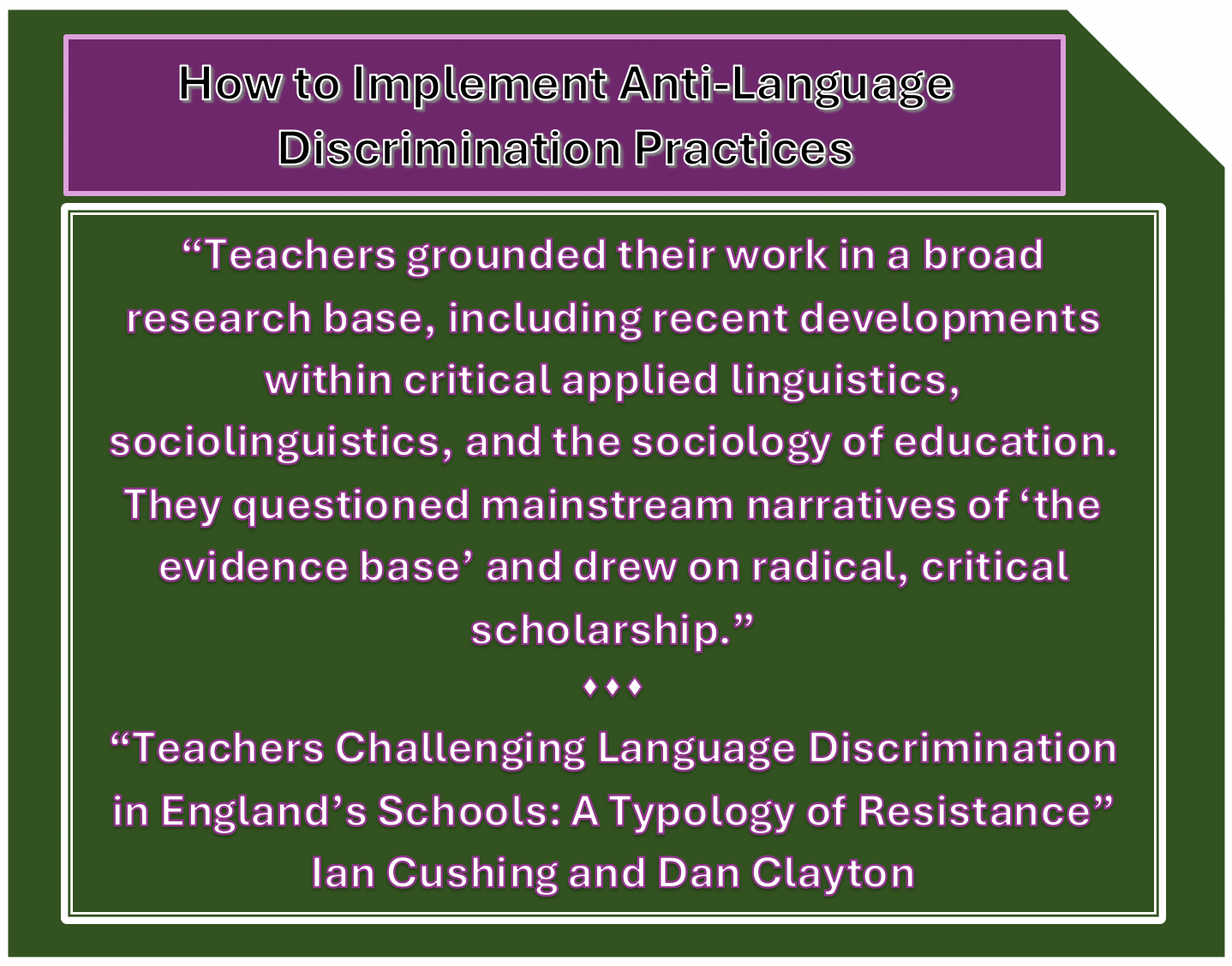
Cushing and Clayton build to a typology for anti-language discrimination. Here, I want to emphasize a key component about what counts as evidence: “Teachers grounded their work in a broad research base, including recent developments within critical applied linguistics, sociolinguistics, and the sociology of education. They questioned mainstream narratives of ‘the evidence base’ and drew on radical, critical scholarship.”
The article ends by noting that teachers alone cannot change this pattern, and I want to stress that is especially true in the US where teachers are often powerless and have been publicly discredited as not knowing how to teach reading.
However, the evidence is clear that “[l]anguage discrimination is a structural phenomenon” and that reading policy and reading programs are key elements in that structure.
Mandating fidelity to deficit beliefs about language and students is at the core of the SOR movement. Once again, we are missing the evidence by focusing on a few trees and ignoring the forest.
Dominic Wyse and Charlotte Hacking present a ground-breaking account of teaching phonics, reading, and writing. Created from a landmark study, new research, new theory, and cutting-edge teacher professional development, this balanced approach to teaching seeks to improve all children’s learning, and therefore life chances.
The book dismantles polarised debates about the teaching of phonics and analyses the latest scientific evidence of what really works. It shows, in vivid detail, how phonics, reading, and writing should be taught through the creativity of some of the best authors of books for children. By describing lessons inspired by ‘real books’, it showcases why the new approach is more effective than narrow phonics approaches.
The authors call for a paradigm shift in literacy education. The chapters show how and why education policies should be improved on the basis of unique analyses of research evidence from experimental trials and the new theory and model the Double Helix of Reading and Writing. It is a book of hope for the future in the context of powerful elites influencing narrow curricula, narrow pedagogy, and high stakes assessments.
The Balancing Act will be of interest to anyone who is invested in young children’s development. It is essential reading for teachers, trainee teachers, lecturers, researchers, and policy makers world-wide who want to improve the teaching of reading and writing in the English language.
























 dr. p.l. (paul) thomas